


Related Posts




Podcasts




You’ve hit your lead targets. Your campaigns are live. Your MQLs are rolling in. But then sales turns around and says, “These leads are cold. They’re not ready.” Frustrating, right?
Most marketers have been here, where it feels like you’re throwing leads into a black hole and hoping sales will eventually say, “thanks.” Instead, they say, “Who are these people?”
It’s like setting up a speed date and your date doesn’t even know your name.
Here’s the thing: they’re not just being difficult. Sales has a point… and so do you.
We’ve worked with enough marketing and sales teams to know this truth: when sales says “these leads suck,” what they’re really saying is “these leads don’t match the moment we’re in.”
That’s a strategy issue, not a personality conflict.
In this article, you’ll learn exactly why sales might be rejecting your leads, and more importantly, what you can do about it. You’ll walk away with practical strategies to improve lead quality, create real alignment with sales, and stop the cycle of blame once and for all.
The Root of the Friction
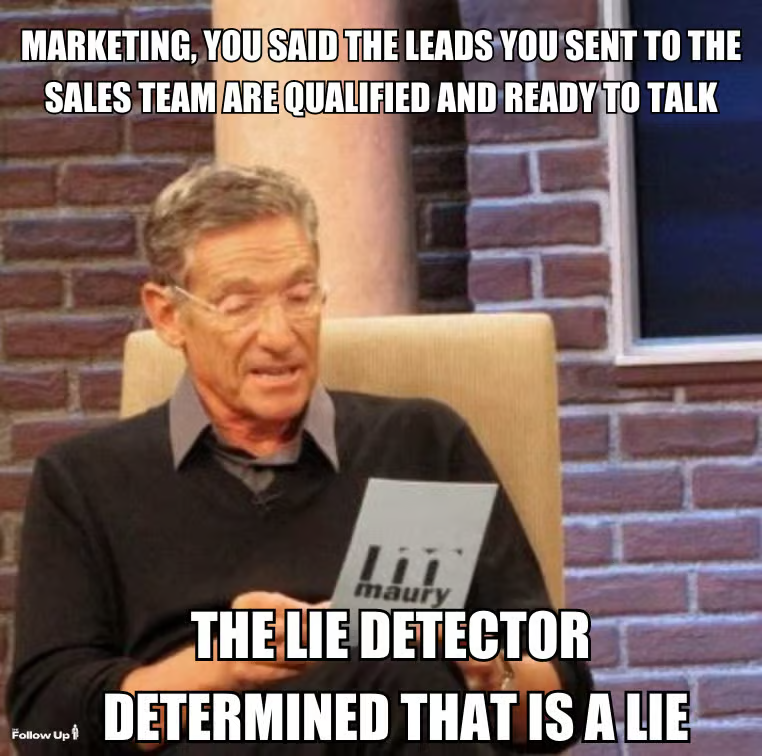
Sales and marketing are supposed to be on the same team, but often, they act like rival departments. And at the centre of that tension? Leads.
Marketing wants to generate demand. Sales wants to close deals. But if the definition of a “qualified lead” isn’t shared, you’re playing two different games with the same ball. That’s where the friction starts.
Here’s what’s really going on under the surface:
- Marketing is optimising for engagement. You’re looking at clicks, downloads, webinar sign-ups, all useful signals. But they don’t always mean buying intent.
- Sales is optimising for readiness. They want to talk to someone who has a problem, a budget, and urgency. They don’t care if someone read a blog post six months ago.
If your leads are based on content engagement alone, you’re likely sending people who are aware, but not active. Sales sees that as wasted time.
This misalignment leads to finger-pointing, dropped leads, and frustration on both sides. But it’s not that anyone’s doing their job wrong. It’s that you’re not calibrated on the same criteria.
Before you can fix lead quality, you have to fix the definition of quality.
Signs Sales Thinks Your Leads Suck

Sales rarely comes out and says, “Hey, your leads suck.” Instead, they drop hints, some subtle, some not. If you’re hearing any of these, it’s a clear sign there’s a disconnect:
1. “These leads are cold.”
Translation: They’re not showing buying intent. They may have interacted with your brand, but not in a way that signals readiness to buy.
2. “They didn’t even know who we were.”
Translation: Your leads aren’t being nurtured properly. They might have come through a top-of-funnel blog post or ad, but never received the right follow-up to move them down the funnel.
3. “I called them and they had no idea why.”
Translation: There’s no context. Sales was sent a name and number, but no information on what content they engaged with, what problem they might have, or why they were flagged as a lead.
4. “We’re wasting time chasing the wrong people.”
Translation: The leads don’t match our ideal customer profile. Wrong industry, wrong role, wrong stage of business, and it all adds up to wasted effort.
When you hear any of this, it’s not an attack. It’s a signal. These complaints are your clue that it’s time to dig into the how and why of your lead qualification process.
The Strategic Gaps Behind the Complaints
When sales pushes back on your leads, it’s tempting to get defensive. But most of the time, it’s not that your campaigns are broken, it’s that there are strategic gaps in the handoff between marketing and sales.
Let’s break down where things typically go wrong:
1. Your Targeting Is Too Broad
If your ads and content are pulling in anyone who fits a surface-level demographic—say, “marketing manager” or “SaaS company”—you’re going to get a mixed bag. Not all leads are created equal, and not all are ready.
Fix it: Tighten your ICP. Focus your targeting on intent-based signals and narrow your audience based on firmographics, behaviour, and pain points. One great way to to do this is by focusing on nailing your offer, creative and copy so that the right people respond.


Download Your Free 5 Point Ad Audit eBook Guide for Facebook & Instagram Ads
2. You’re Mistaking Interest for Intent
Someone reading a blog post isn’t the same as someone requesting a demo. But if both get passed to sales with the same label (MQL), you’re setting sales up for disappointment.
Fix it: Separate leads by funnel stage. Build in behavioural scoring so you’re only escalating contacts when they’ve shown buying signals, like pricing page visits or product-related downloads.
To give context, MQLs in our system are defined as users coming from marketing sources (like ads, SEO, social media, etc) that have reached out and enquired, and SQLS are also defined as enquiries but those generated from sales sources (like sales prospecting, networking events, etc).
This means that our sales team only talks to leads that have directly enquired, which means the role of marketing is to generate direct enquiries. Users might download lead magnets, read blog articles and this all might be positive signals for marketing, but the main goal remains generating real enquiries.
This system enables us to ensure that sales is only spending time on real leads that are interested and potentially ready to buy, and it helps marketing get focused on how we can get more of those leads.
We’re not saying you should do this, because every company is different, but the only reason we were able to understand this is because our marketing and sales department talk to each other. That communication is key to nailing the marketing to sales handoff process. Which brings us to our next point…
3. Your Lead Handoff Is Fuzzy
Even if your leads are good, the way they’re handed off might not be. If sales doesn’t know why someone was marked as a lead, or what to say when they call, they’ll lose trust in the process.
Fix it: Set up a meeting with sales and get clear on both the current marketing and sales process. Understand how sales conversations are usually handled and what steps are involved to get from discovery to the close. Once you understand that, sketch out the stages and assign responsibility. From there, you can develop materials for each stage.
For example, you might have the following stages:
| Stage | What Happens | Who Owns It | What’s Needed |
| 1. Awareness | User finds us via ad, SEO, or social | Marketing | Blog posts, landing pages, search ads |
| 2. Engagement | User consumes content or signs up for newsletter | Marketing | Lead magnets, email nurture series, segmentation setup |
| 3. Lead Capture | User fills out a form (guide download, webinar, etc.) | Marketing | Forms, CTAs, automation workflows |
| 4. Lead Qualification | Lead is scored and evaluated for fit and intent | Marketing (with Sales input) | Lead scoring model, MQL criteria, behaviour triggers |
| 5. Lead Handoff | Qualified lead sent to sales with context | Shared | Lead summary, last touchpoint data, recommended next step |
| 6. Discovery Call | Sales connects with lead and confirms needs | Sales | Call scripts, case studies, battle cards |
| 7. Solution Presentation | Sales presents tailored solution | Sales | Decks, proposals, product sheets |
| 8. Nurture or Follow-up | Lead not ready → goes back into nurture sequence | Shared | Nurture emails, retargeting ads, personalised content |
| 9. Closed-Won | Deal closes and becomes a customer | Sales | Handoff to onboarding/customer success |
This is just an example of what it could look like. The key is to start that communication process with your sales team.
4. There’s No Feedback Loop
If you’re not hearing back from sales about what worked and what didn’t, you’re flying blind. And worse, sales might just start ignoring your leads altogether.

Fix it: Set up regular syncs with sales. Track lead outcomes. Use a shared scorecard to review pipeline quality, conversion rates, and close rates.
The problem isn’t always volume. It’s often that the strategy isn’t matching sales reality. But these gaps aren’t hard to close, once you know where to look.
Strategies to Improve Lead Quality Without Starting From Scratch
You don’t need to burn your entire lead gen strategy to the ground. Often, small, smart adjustments can transform how sales perceives your leads and how well those leads convert.
Here’s how to make that shift without starting over:
1. Layer in Behaviour-Based Lead Scoring
If your MQLs are still defined by a job title and a single download, that’s a problem. Add behavioural signals like:
- Number of website visits
- Visits to pricing or product pages
- Email engagement (opens + clicks)
- Webinar attendance or repeat form submissions
Tip: Use scoring to prioritise, not just qualify. It helps sales know who to call first.
2. Use Intent Signals and Segmentation Together
A blog click from six months ago isn’t useful. But if someone reads three product-focused articles in a week? That’s different.
Segment leads based on recent behaviour and create tailored journeys that keep them moving forward or flag them for sales when they’re hot.
3. Tighten the Feedback Loop
Set up a recurring 15-minute check-in with a sales rep. Ask:
- Which leads worked?
- Which didn’t?
- What trends are they noticing?
Even a small feedback loop can reveal patterns automation won’t catch.
4. Build Lightweight Sales Enablement
If your sales team has no idea what the lead downloaded or why they were qualified, help them out:
- Create short lead handoff notes (auto-generated if possible)
- Add last content engagement to the CRM record
- Include “next best action” suggestions (e.g. ask about X guide they downloaded)
Make it easy for sales to pick up the conversation with context.
5. Don’t Wait for Perfect Data
Start with what you have. Improve as you go. You’ll never have every touchpoint perfectly tracked, but you can start building a smarter funnel by taking what is working and refining from there.
The One Conversation You Need to Have With Sales This Week
If you’re tired of hearing that your leads are rubbish, the fix starts with one conversation, not another campaign, tool, or form.
Here’s how to have that conversation in a way that builds trust and gets results:
1. Lead With Curiosity, Not Defence
Start by saying:
“I want to understand how the leads we’re sending are landing on your side. What’s working, what’s not?”
This isn’t about defending your efforts. It’s about opening the door to collaboration.
2. Bring Data, Not Just Gut Feel
Show recent conversion rates. Bring examples of leads that converted and leads that didn’t. You could say something like:
“Here are three leads we sent last month. One closed, two didn’t. Can we walk through what separated them?”
This moves the discussion from vague complaints to actionable insights.
3. Ask What Makes a Lead Worth Their Time
Let them define their version of a “hot lead.” Ask:
- What signals are you looking for?
- What’s an instant disqualifier?
- What’s missing in the leads you’re getting?
Then write it down. This becomes your new working brief.
4. Propose One Small Change
Whether it’s a new lead scoring rule, a better handoff process, or a weekly sync, suggest a small tweak, and agree to test it together.
You don’t need to fix everything overnight. But if you show that you’re listening and taking action, you’ll start to rebuild credibility.
Sales doesn’t hate your leads. They just want leads they can win with.
And the truth is, so do you.
By stepping into their shoes, tightening your process, and opening up honest feedback loops, you can stop throwing leads into a black hole and start building a pipeline that actually converts.
Next, learn how you can avoid generating low quality leads from paid advertising.