
Related Posts



Podcasts




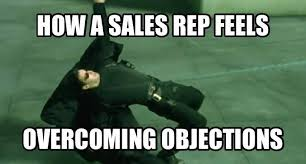
If you’re in sales, you already know: objections aren’t roadblocks, they’re signposts. They point directly to what your prospect is thinking, fearing, or misunderstanding.
2025 isn’t the same as 2015. Buyers are smarter, tech is faster, and decision-making cycles look completely different. The old “feel-felt-found” trick isn’t cutting it anymore.
To win in 2025, you need to anticipate the objections before they come up, and respond with confidence, clarity, and proof.
Here are the five biggest objections you’ll hear this year and how to crush them.
1. “AI can already do that for me.”
Artificial intelligence is everywhere. Prospects are being pitched daily by tools that promise to replace people.
The knee-jerk reaction is: “Why pay you when I can plug in ChatGPT or another AI app?”
Don’t fight the AI wave, ride it.
Position your offer as the human edge on top of AI efficiency.
Show how AI gives speed, but without strategy, it produces garbage. Then back it with examples of how you combine tools plus human insight to deliver results AI alone can’t.
For example, you might say something like, “AI is like giving every business a Ferrari. But without a professional driver, you can’t take full advantage of the Ferrari.”


How to Use AI to Close More Sales Deals
2. “Budgets are frozen”

This one is timeless, but in 2025 it’s louder than ever. With economic uncertainty, boards cracking down on expenses, and CFOs scrutinizing every line item, “we don’t have a budget” is the default stall tactic.
But here’s the truth: “no budget” rarely means no money exists. What it really means is: “I don’t see the value yet.” Your job is to flip that perspective. Don’t push harder on price, push deeper into ROI.
Reframe the conversation around the cost of inaction.
- What happens if they stay exactly where they are?
- What’s the financial hit of continuing with inefficiencies, missed opportunities, or wasted ad spend?
The easiest way to overcome this objection is to put numbers in front of them.
Quantify the loss of not solving the problem. If your service helps generate revenue, position it as the thing that unlocks budget. If it helps cut costs, show how it pays for itself.
For example, you might say: “I get it, budgets are tight everywhere. If nothing changes in the next six months, how much will that cost you in lost revenue or wasted resources?”
Now the budget objection isn’t about money, it’s about priorities.
3. “We already have a tool/team for that.”
In 2025, almost every company has some system or team in place. Whether it’s a marketing stack, a CRM, or an in-house hire, the instinctive response is: “We’ve already got something for this.”
Most reps panic here and go into defense mode. Don’t.
Instead, agree and position yourself as a force multiplier. They don’t need another “tool”, they need results.
Show how what they already have isn’t being maximised, and explain how you integrate with, enhance, or unlock what they’re already using.
The message is simple: you’re not adding complexity, you’re making their current investment actually work.
One way you might handle this is: “That’s perfect, it means you’ve already laid the groundwork. What we do is take what you’ve built and amplify it so it delivers at 5x the level. Think of us as the accelerator for what you already have.”
This shifts you from being seen as “extra” to being essential.

Why Trust is The Ultimate Ingredient for Sales
4. “We need to get the team’s approval first.”
Decision making in 2025 is more collaborative than ever. Nobody wants to be the one who bets wrong, so hiding behind “the team” is a way to slow things down.
Don’t roll your eyes… embrace it. If someone’s taking your proposal back to their team, that means they’re your internal champion. The key is to arm them with ammunition.
Instead of leaving it up to them to “explain it,” give them a clear, compelling package they can share: one-pagers, case studies, ROI breakdowns.
Make it easy for them to look like the smartest person in the room.
Also, don’t be afraid to ask: “Who else needs to be in the conversation?” That way you can move from waiting to participating in the decision-making.
5. “We’re not ready yet.”
This is the polite stall. It really means: “I’m not confident enough to move forward.” The fear could be timing, bandwidth, or risk of failure, but underneath, it’s hesitation.
Your job is to lower the perceived risk and make the first step feel easy. Show them how waiting doesn’t create safety, it creates loss. Then highlight how your process, onboarding, or guarantees make starting now feel simple and safe.
The way to win here is with risk-reversal and speed-to-results. Prove that getting started today is low-risk and high-upside.

How Can I Make My Sales Process More Profitable With Buyer Decision Points?
So, What’s Next?

Objections aren’t deal-killers. They’re simply windows into the buyer’s thought process.
When you know the 2025 landscape, you can anticipate these five objections before they come up, and turn them from roadblocks into stepping stones.
The salespeople and entrepreneurs who win this year won’t bulldoze objections, they’ll disarm them, reframe them, and use them as leverage to close more deals. Next, discover the one question every sales person should ask to close more deals.