
Related Posts




Podcasts




Let me guess—you’re burning cash on Meta ads that should be working, but they’re just… not.
You’ve tested different headlines, swapped out visuals, even tweaked your targeting. Nothing sticks. Performance dips, and you’re left staring at your dashboard, wondering what changed.
Here’s the truth: it’s not your offer. It’s not your copywriter. It’s not even Meta’s algorithm.
It’s your angle.
Your ad angle is the spine of your creative. It decides what your ad says, shows, and who it speaks to.
Without a strong angle, your creative is just noise.
But with the right angle? You multiply performance without spending a penny more.
We’ve been in your shoes—launching new ads, watching them tank, thinking “Maybe I just need a better hook.” But better hooks don’t work when the angle’s wrong.
That’s why we built this 7-step system: a repeatable process that shows you exactly how to build high-performing Meta creatives from the ground up, starting with a clear, compelling angle.
In this article, you’ll learn what makes Meta ads actually perform, why angles matter more than you think, and how to build scroll-stopping creatives with a proven step-by-step strategy.
Why Creative Is the Battlefield
Meta’s algorithm has changed in 2025, and the focus is now on creative. Targeting is broad. Attribution is fuzzy. But one thing hasn’t changed and that’s the importance of creative.
If your ads aren’t converting, it’s almost always a creative problem. And not just what you’re showing… but how you’re showing it.
Creative does the heavy lifting.
Most people treat creative as decoration. They’ll plug a decent offer into a Canva template, add a headline, and hope for the best. But Meta doesn’t work that way anymore. Your creative is your targeting, your copy, and your landing page—compressed into 3 seconds or less.
But what powers creative? Your angle.
The ad angle is the difference between someone scrolling past or stopping dead in their tracks. It decides:
- Who the ad speaks to
- What pain or outcome it focuses on
- How the mechanism is framed
- Why they should care right now
You don’t need more ads, you need better angles.
Think of your angle as the blueprint. It’s what your hook, copy, visuals, and CTA are all built from. Without it, you’re just guessing. But with it? You can create dozens of high-performing variations without changing your offer.
That’s how you scale without reinventing the wheel every time.

Why Your Remarketing Ads Are Failing & The Simple Fixes That Drive Conversions
What Makes an Ad Angle High-Performing?
High-performing ads don’t start with a cool idea—they start with a sharp angle.
If your ad creative is the house, the angle is the blueprint. You can’t build anything solid without it. So what separates a throwaway idea from a high-performing angle?
Here’s what a strong angle actually does:
1. It multiplies creative yield. One great angle gives you dozens of hooks, visuals, and variations, without changing your offer. You get more mileage, more testable assets, and more chances to win.
2. It pre-qualifies the right audience. A clear angle attracts the exact people your offer is built for, even with broad targeting. You don’t need hyper-segmentation when your message makes the right people stop scrolling.
3. It explains the mechanism in plain English. People don’t click unless they understand how it works for them. A good angle makes that crystal clear in seconds.
If you’re guessing your angles, you’re gambling.
This is the silent killer of performance. You don’t need more creative variations, you need smarter ones, rooted in the right angle from the start.
So now that you know why angles matter, let’s walk through exactly how to build them from scratch.
The 7-Step Angle System (Step-by-Step Guide)
Forget “creative inspiration.” This is a system. A repeatable, practical framework you can use to create Meta ads that actually perform.
Step 1: Build Your Motivator Table
Start by mapping your audience and what truly drives them.
You’re not writing for everyone, you’re writing for one person, in one moment, with one pain.
Fill out this table:
| Segment | Core Pain | Desired Outcome | Objection / False Belief | New Mechanism | Proof | Visual Idea | CTA |
| Who are they? | What hurts? | What do they want? | Why don’t they believe you? | What makes your product work? | Case studies, demos etc. | Demo, pattern break, before/after | 1 clear action |
Do this for 3–5 distinct customer segments or use cases. Don’t move on until each row feels sharp.
Step 2: Choose an Angle Archetype
Each motivator row can snap to a proven narrative pattern. Start with one per row, then test more later.
- Problem → Solution: Pain-first story
- New Mechanism: “Why this works now”
- Objection-Smash: Handle their #1 “yeah but…”
- Proof-Led: Let evidence carry the message
- Risk Reversal: “Try it without the risk”
- Enemy/Status: “Outsmart the old way”
- Value Stack: “Look how much you get”
Step 3: Write the Angle Statement
One powerful sentence that becomes your North Star for the entire creative. Use this formula:
If you’re [Segment] who [Pain], here’s how to [Outcome] without [Objection]—thanks to [New Mechanism] (backed by [Proof]).
If that sentence isn’t clear, your angle isn’t ready.
Step 4: Create Hooks & Visuals
This is where your angle turns into actual creative, the words and visuals people see in their feed. If your first 3 seconds don’t grab them, it’s over.
Here’s how to make sure it does:
Write 3–5 Hook Lines
These are short, punchy lines that show up first in your ad—the bolded line of text above the image or video, or the opening line of your primary text. Good hooks:
- Call out the audience or pain directly
- Tease a transformation or result
- Create curiosity or urgency
Use these templates to start:
- “Stop doing [old way]—do this instead.”
- “How [audience] gets [result] without [objection].”
- “I tried [new mechanism] for 7 days—here’s what happened.”
- “If you’re a [segment], this fixes [pain] fast.”
- “What no one tells [audience] about [problem].”
Example: “10,000+ Aussies switched to water flossing and here’s why.”
Create 1–2 Visual Starters
These are your first-frame visual ideas. You can use video or image, but either way, the goal is to stop the scroll. Your visual should either show the pain, the transformation, or the mechanism that makes it work.
Proven visual formats:
- Pattern break: Side-by-side, timer overlay, big red “X”
- Instant demo: Show the product doing its job in the first 3 seconds
- Checklist overlays: Put text like “Bleeding gums? ✅ Sensitive teeth? ✅”
- Review screenshot: Use a UGC-style reel of happy customer comments
- Text-only visual: Bold claim with contrast colours
Pro tip: Whatever the hook says, the visual should show. Don’t repeat the same thing in both.
Here’s an example of a creative we recently used:

Step 5: Write the Copy
Your long-form ad text should do 6 things in this order:
- Call out the reader: “If you’re a [segment] tired of [pain]…”
- Promise a result: “Get [outcome] in [timeframe] without [objection].”
- Explain the mechanism: “It works because [mechanism] does [cause/effect].”
- Drop proof: bullets with reviews, results, numbers.
- Stack value: bonuses, speed, urgency.
- Reverse risk: “Try it free / 30-day guarantee.”
- CTA: “Tap Learn More to [action].”
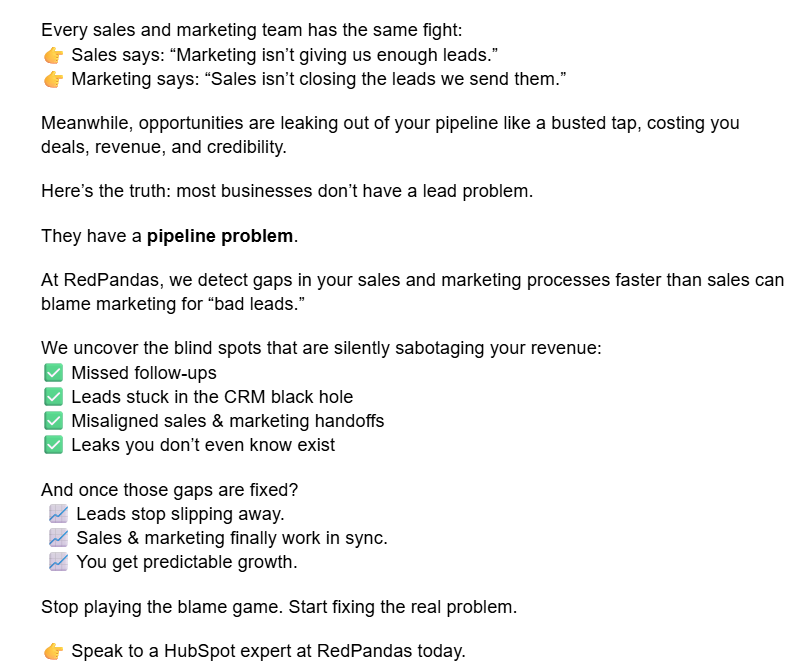
Here’s an example we’ve used with our ad campaigns, following the exact formula above:
Step 6: Package & Launch Your Angle Variations (Without Getting Lost)
Once you’ve built a few angles, it’s time to actually run the ads. This step is where most people overcomplicate things.
Here’s how to keep it simple and efficient:
Build your test batch like this:
- Choose 3–5 angles: The ones that best match your different audience segments or use cases.
- For each angle, create:
- 2 hook lines
- 2 visual variations
- That gives you 4 ad variations per angle
→ (2 hooks × 2 visuals = 4 combinations)
So with 3 angles, you’ve got 12 ads. With 5, you’ve got 20. That’s plenty to start testing without overwhelming your account.
How to set up the campaign:
- One campaign
- One ad set using broad targeting (Meta will figure out who to show it to)
- All your ads go into this one ad set. This way, they all compete under the same conditions, and you can easily compare performance.
Not sure how to set up campaigns and ad sets? Use Meta’s default: Advantage+ placements, broad targeting, and let the algorithm do its thing. The magic is in your creative.
CTA: How to Combine Search, Display, and YouTube Ads for a Full-Funnel Campaign

How to Combine Search, Display, and YouTube Ads for a Full-Funnel Campaign
What to look for in the first few days:
You don’t need weeks to know what’s working. After your ads get about 1,000–2,000 impressions each, look at:
- 3-second video views / thumb-stop rate
→ Are people stopping to watch or scroll past instantly? - Outbound click-through rate (CTR)
→ Are people curious enough to click? - Cost per add to cart / lead / view content
→ Are they taking meaningful actions?
If an ad gets views and clicks but no conversions, the angle is probably okay, but your landing page or offer might need work. If people don’t even stop or click, the angle is wrong.
Start by killing the worst performers. Double down on the ones with strong early signals (views, clicks, low CPC). Then iterate using new hooks or visuals on the winning angles.
Step 7. Iterate with “Angle Surgery” (Scale What’s Already Working)
Once you find a winning angle, don’t leave it alone.
Most people treat a winning ad like a fluke and move on to the next idea. Don’t do that. Instead, dissect what’s working, and build more ads off that same foundation.
Here’s how to stretch a single angle into 10+ winning variations:
1. Change the audience or context
If an angle works for one segment, test it against others.
Example: Angle: “Sensitive gums? Stop bleeding when you floss, do this instead.”
→ Test new segments:
- Teens with braces
- Older adults with dental implants
- Parents helping kids brush
The product hasn’t changed, just the context.
2. Flip the tension (pain vs. gain)
Use the same message, but reframe it as avoiding loss.
Original (gain-focused): “Cleaner teeth in 7 days, no painful flossing.”
Flipped (loss-aversion): “Still bleeding every time you floss? You’re doing it wrong.”
Pain often drives stronger reactions than pleasure.
3. Give your mechanism a name
A named method sounds proprietary and trustworthy. It also gives you a repeatable hook.
Example: Instead of: “Uses a soft-gum jet.” Say: “PulseClean™ soft-gum technology”
Now you can build angles around:
- “Why PulseClean™ works for sensitive teeth”
- “PulseClean™ vs. string floss: Which wins?”
4. Escalate the proof
Take the same angle and support it with stronger evidence.
- UGC → Influencer → Expert testimonial → Clinical study
- One review → Compilation → Case study → Data-backed results
Example: You might start with: “2,100+ 5★ reviews.” Upgrade to: “Dentists tested PulseClean™, here’s what they found”
Your Angle Is the Ad
Your angle does the heavy lifting. It gives you the structure to write scroll-stopping copy, design visuals that show the benefit, and call out the exact person who needs what you’re selling.
Now you’ve got a repeatable 7-step system to do just that. Use it every time you launch a new campaign, test a new audience, or reposition your offer. Your creative process will be faster, your results more predictable, and your ad spend more profitable.
Start with the angle. Then build the rest. That’s how you win.
Want to test your creatives against our benchmarks? Check out our free paid ad audit guide below.
Download Your Free 5 Point Ad Audit eBook Guide for Facebook & Instagram Ads