Related Posts



Podcasts




You’ve got traffic. People are landing on your website. But the leads? They’re just not coming in like they should. You’ve tweaked your ads, posted on social media, maybe even redone your homepage last year. Still, nothing’s really changed. Deep down, you know your website could be the problem—but you’re not sure where to start, and the idea of a full rebuild is already giving you a headache.
Most of the time, you don’t need to burn everything down and start from scratch. You just need to fix a few key mistakes—the kind that quietly kills conversions without you even realising it.
In this article, you’ll learn the five most common website mistakes we see (all the time), why they matter, and how to fix them quickly without a huge budget or complex tech.
These are real-world issues with real-world solutions and fixing them can make a bigger difference than you think.
Mistake #1: Confusing Messaging
Most websites lose people in the first few seconds. Not because they’re ugly or slow, but because the messaging isn’t clear.
Too often, websites launch straight into buzzwords, industry jargon, or clever taglines that don’t actually tell visitors what the business does or how it helps them.
And if your visitors have to work to figure it out? They won’t. They’ll just leave.
Here’s an example of ambiguous fluff with a weak offer:

Here’s an example of a business in the same industry but with a STRONG offer:

What to look for:
- Does your homepage clearly explain what you do, who it’s for, and why it matters, within the first second?
- Is your headline focused on your customer’s problem or goal, rather than just your company name or features?
- Can a complete stranger understand the value of your offer without scrolling?
How to fix it:
Use the StoryBrand framework to simplify and clarify your message. This approach flips the focus from your business to your customer—and positions them as the hero of the story.

Mistake #2: Weak or Hidden Calls to Action

You’ve probably seen it before—a beautiful website, sleek design, solid copy… but you’re left wondering, “What am I supposed to do next?”
This is where many websites fall flat. They either bury their calls to action (CTAs) or make them too vague, like “Learn More,” “Discover Our Services,” or the classic “Contact Us.”
These don’t inspire action, and they definitely don’t convert well.
What to look for:
- Are your CTAs clear, visible, and consistent across your site?
- Do you tell your visitor exactly what to do and what they’ll get?
- Is your primary CTA repeated multiple times (especially on key pages)?
How to fix it:
Make your CTAs bold, direct, and benefit-driven. Instead of saying “Submit” or “Learn More,” try something like:
- “Book a Free Strategy Call”
- “Get My Quote”
- “See How It Works”
And don’t just use your CTA once—repeat it at logical points throughout the page, especially after explaining a benefit or solving a pain point.
If you’re using StoryBrand principles, your CTA is the clear next step in your customer’s journey. Make it obvious, easy, and focused on what they’ll gain.
Mistake #3: No Clear User Journey

Think about your website from a visitor’s perspective: they land on your homepage… now what?
If there’s no clear path to follow, no logical flow from problem to solution, people get lost. And when they’re lost, they leave. Fast.
Many websites are built around what the business wants to say, not what the visitor needs to hear or in the order they need to hear it.
What to look for:
- Does each page guide the visitor toward a specific next step?
- Are your service pages easy to find and understand?
- Can users tell where to go depending on who they are or what they need?
How to fix it:
Plan your site around your user’s journey, not just your internal structure. Ask yourself:
- What are they looking for when they arrive?
- What questions do they have?
- What do they need to believe before they’ll take action?
Then, structure your content to answer those questions in the right order.
Using the StoryBrand approach, this means introducing the problem first, positioning your brand as the guide, offering a clear plan, and showing them what success looks like. Every page should have a beginning, middle, and end—with a CTA at the end of each one.
Think of your site like a story your customer is walking through. Each click should bring them closer to a decision.
Mistake #4: Poor Mobile Experience

Over half of all website traffic now comes from mobile devices. Yet, many websites still feel clunky or broken on smaller screens. Buttons are too small, text overlaps, and navigation becomes a guessing game. If your mobile experience is frustrating, people won’t stick around.
What to look for:
- Does your site load quickly and look clean on mobile?
- Are buttons, menus, and forms easy to tap and use?
- Is important content visible without endless scrolling?
How to fix it:
- Design with mobile in mind from the start.
- Use a responsive theme that adapts seamlessly to different screen sizes.
- Keep layouts clean, text legible, and actions easy to take.
- Don’t just check your site on desktop, test it on multiple devices and screen sizes.
- And if you’re using StoryBrand, make sure your core message and CTA still appear above the fold, even on the smallest screens.
Mistake #5: Slow Load Times or Clunky Tech
Speed matters—a lot. If your site takes more than a few seconds to load, people bounce.
And it’s not just users who hate slow websites, Google does too. Load times, outdated plug-ins, bloated themes, and poor hosting can all drag your performance down and damage your rankings.
What to look for:
- Does your site take more than 3 seconds to load?
- Are there any broken scripts, pop-ups, or outdated plug-ins?
- Are you using cheap or overloaded hosting?
How to fix it:
- Compress your images, remove unnecessary plug-ins, and keep your site as lightweight as possible.
- Use tools like Google PageSpeed Insights or GTmetrix to identify what’s slowing you down.
A faster site isn’t just nicer to use, it converts better too.
Quick Fixes and Action Steps
You don’t need to overhaul your entire website to start seeing better results. Small changes, done right, can make a big difference.
Here’s how to get started:
- Review your homepage messaging. Does it clearly explain what you do, who it’s for, and why it matters within the first few seconds?
- Add or improve your CTAs. Make them clear, benefit-driven, and repeat them throughout key pages.
- Map your user journey. Make sure each page has a logical flow and leads to a specific next step.
- Test your site on mobile. Fix any layout issues, check button functionality, and ensure your main CTA appears quickly.
- Run a speed test. Use a tool like GTmetrix or Google PageSpeed Insights, then fix anything that’s slowing your site down.
Start with one or two of these. You don’t need to do everything at once. But the sooner you address the gaps, the sooner your site starts doing what it’s meant to do: convert traffic into leads.
So, What’s Next?
Your website doesn’t need to be perfect. But it does need to be clear, fast, and easy to use if you want it to convert visitors into leads.
The good news? You don’t need a full redesign to get there. Most of the time, a few small changes—tweaking your messaging, improving your CTAs, tightening the structure—can unlock way better results without blowing up your budget or timeline.
These five mistakes are incredibly common, but they’re also totally fixable.
Because the truth is, your website isn’t just a brochure. It’s your hardest-working sales rep. And when you get it right, it works 24/7 to bring in the right kind of leads.
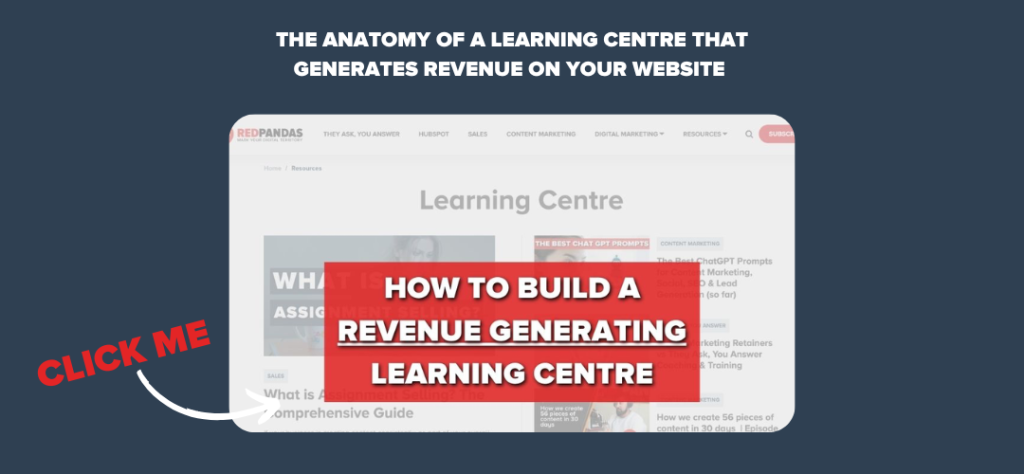
Next, learn how to build a high converting Learning Centre to generate traffic, leads and sales.