









Meta Ads’ Andromeda Update: What Does It Mean for Your Paid Media Campaigns in 2026?

What if the real reason your Meta campaigns slowed down this year has nothing to do with your budget, your agency, or your audience targeting?
Instead, what if it has everything to do with the signals you’re feeding Meta Ads?
And, here’s the most important question: what if Andromeda didn’t “break” your account… but simply exposed weaknesses that were already there?
If you’re responsible for revenue, whether you lead marketing, sales, or the entire business, that thought probably hits a bit too close.
After all, you might already be dealing with rising costs, inconsistent lead quality, and pressure from every direction to “fix it”.
But, despite what many marketers believe, the Andromeda update doesn’t exactly make things harder.
Instead, it’s giving you an opportunity to sharpen your Meta Ads strategy and get ahead of the competition in 2026 with lower spend and higher returns.
The Andromeda update forces the platform to prioritise signal quality and creative clarity above everything else. This means that your old structures, stacked audiences, and recycled ad angles probably don’t stand a chance anymore.
And this is exactly where we specialise.
We’ve helped repair and set up dozens of accounts following the Andromeda update to see the same pattern over and over: teams don’t fail because the algorithm changed… they fail because their setup didn’t.
By the end of this article, you’ll know precisely what Andromeda changed, what you should stop doing immediately, and how to rebuild your Meta Ads campaigns so they scale properly in 2026.
What is Meta Ads’ Andromeda Update?
Simply put, the Andromeda update is Meta’s way of saying: “Stop trying to outsmart the system. Give us cleaner signals, better creative, and simpler structures, and we’ll find your buyers for you.”
That’s it.
It’s not sexy. It’s not mystical. But, it’s very different from how most Meta Ads accounts still operate.
Before Andromeda, you could get away with messy targeting, stacked interests, dozens of ad sets, and throwing creative variants at the wall until something stuck. The auction was more forgiving and relied heavily on your manual inputs.
With the update in play, however, the auction behaves more like a prediction engine.
Meta cares far less about who you think your audience is and far more about the signals your account sends: creative behaviour, data reliability, conversion quality, and how clean your structure is.
Here’s the simplest way to understand it:
- Your campaign structure = the map.
- Your creative = the signal.
- Your tracking = the truth.
- And, Meta’s algorithm with the Andromeda update = the hunter
Andromeda made the hunter smarter. But it can only perform if the map is simple, the signal is strong, and the truth is accurate.
If your campaigns are cluttered, your creative angles are weak, or your tracking is held together with duct tape, Andromeda won’t “figure it out”.
Instead, it can hamper scale, inflate costs, and send your performance sideways.
But if you adjust how you structure campaigns and how you feed Meta signals, Andromeda can actually make your lead gen more efficient than it’s been in years.


Can Facebook Ads Target Specific Users?
Why Meta Ads Rebuilt the Game, and What That Means for You

Despite what most marketers think, Meta didn’t wake up one morning and decide to make advertisers miserable. Andromeda is a response to three problems that have been building for years:
Here’s some reasons why Meta introduced Andromeda:
Problem #1: Targeting Was Getting Too Noisy
Every business, at one point, was stacking audiences, layering interests, excluding random behaviours, and creating 15 versions of the same ad set.
From Meta Ads’ point of view, that noise made it harder to find the right buyers.
But, Andromeda cleans the slate.
Fewer ad sets. Broader audiences. Simpler structures.
This change didn’t come as a way to hop on the “simple is trendy” mindset, but because Meta’s prediction engine performs best when it isn’t fighting your manual controls.
Problem #2: Manual Targeting Wasn’t Enough to Fine-Tune Ad Performance
Meta has mountains of behaviour data… which way more than you could ever target manually.
But, what it can’t do is fix weak creative.
So Andromeda shifts more weight onto the creative itself, strategising based on different parts like:
- The angle.
- The hook.
- The format.
- And, how people respond to it.
If your creative doesn’t generate strong early signals, the system doesn’t have enough confidence to push your ads deeper into the auction.
That’s why recycled templates and generic messaging are tanking faster than ever before.

How to Create High-Performing Meta Ad Creatives
Problem #3: The Algorithm Needed Cleaner Conversion Data
Third-party cookies are fading. Privacy rules are tightening. And Meta Ads’ access to user-level tracking is shrinking fast.
So, the platform doubled down on what it can rely on and easily access, like:
- Server-side tracking.
- CRM-delivered conversion signals.
- Event matching accuracy.
- And, high-quality lead data
If your tracking setup is outdated, inconsistent, or missing key events, Andromeda will treat your conversions as low trust… and low trust equals low distribution.
What this means for you in 2026
Andromeda isn’t asking you to spend more; it’s asking you to spend smarter by giving the system exactly what it needs:
- Simpler structures: so Meta can hunt properly.
- Better creative signals: so the algorithm knows who to go after.
- And, cleaner tracking: so it can learn fast and optimise with confidence.
If your campaigns feel like you’re pushing a boulder uphill, it’s usually because one of these three pillars could be weak, not because Meta is “getting worse” or your audience is “tapped out”.

Everything You Need to Know About Meta’s Ad Algorithm Changes
The 5 Big Changes From Meta Ads’ Andromeda Update That Could Matter in 2026
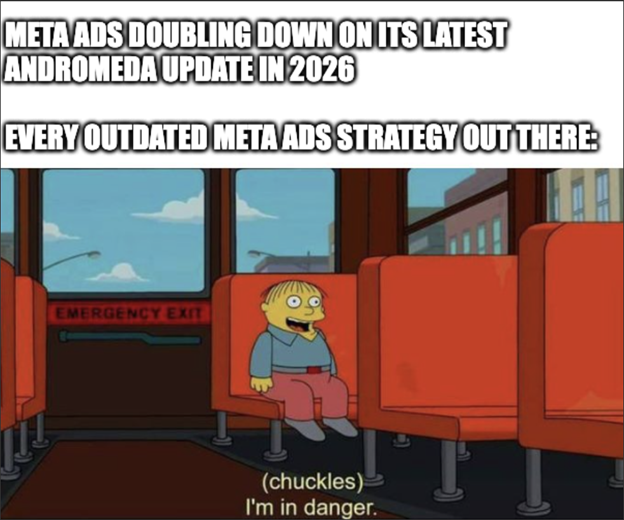
Andromeda made a lot of noise in 2025, but most of it might not matter at this moment unless you specialise in setting up Meta Ads.
But, these five shifts do; and when you understand why they matter, the entire update suddenly clicks into place:
Change #1: Simpler Structures Outperform Complex Ones
Before Andromeda, you could run:
- Multiple campaigns targeting different interests.
- Variations of lookalikes.
- Small-budget ad sets.
- And, duplicated campaigns with slightly different angles.
And up until 2025, the system still managed to make sense of it.
Post-Andromeda, every one of those decisions becomes a signal… and every conflicting signal weakens your optimisation.
Here’s what’s happening inside the system when you set up a Meta Ads campaign now:
A. Each Ad Set Tells Meta “This Is Who I’m Trying To Reach.”
If you have five ad sets targeting similar audiences, Meta Ads now sees five competing signals about who your “ideal” buyer is.
This forces the system to spread data thin, slowing down the learning phase in every single ad set.
B. When Budgets Are Split, Meta Can’t Gather Enough Data On Any Campaign Fast Enough.
If you were to only spend AU$20/day on an ad set right now, Meta Ads probably won’t get enough conversion data to build a strong predictive model. And this can result in:
- Slower learning
- Higher costs.
- And, less stable performance.
C. Broad Targeting Works Because The Algorithm Is Smarter Than Your Old Interests.
With the Andromeda update, interests are now outdated, inconsistent, and often inaccurate.
Meta Ads’ latest system uses behaviour signals, creative interactions, and conversion history to predict who is actually likely to convert.
By going broad, you’re letting Meta use the real data you’re already generating.
So yes: fewer campaigns equals stronger signals, which equals faster optimisation, which equals lower costs, which equals better leads.

3 Quick Tips to Improve Your Meta Ads ROI Without Increasing Your Budget
Change #2: Your Content Now Needs a “Promotion Path” With the Graduation System
Think of your ads as employees in an average workplace:
- Some are great.
- Some are mediocre.
- And, some clearly aren’t working.
But, if you force them all to work in the same room, chaos breaks out and nobody performs at their best. The same example applies to Meta Ads nowadays.
Andromeda relies on a confidence scoring system that weighs:
- Early engagement.
- Click behaviour.
- Conversion quality.
- Post-click actions.
- And, creative stability.
Because of this, good ads are constantly “re-judged” against weak ads,. And here’s what usually could happen because of this:
- A strong ad gets early traction.
- Two weaker variants in the same ad set drag down the overall signal.
- And, Meta Ads reduces distribution because it doesn’t have enough consistent data to trust the winner.
This could happen not because your ad failed, but because its environment may end up corrupting its signal. But, the Graduation System fixes this with these four key steps:
- Run your tests in a controlled environment: limited variables, clear test groups, simple hypotheses.
- Identify winners based on real signals, not vanity metrics (early CTR is not a winner indicator anymore).
- Move the winners into a dedicated scaling campaign where they’re not competing with weaker ads.
- And, retire any losing ads quickly so they don’t poison the signal pool.
The Graduation System keeps your signal clean, your optimisation stable, and your spend focused where it actually works.
Change #3: Random Creative No Longer Works, So You Need Creative Pods
Most teams create ads like this: “let’s make 5 versions of our hero ad… change the colour… swap the hook… maybe add emojis?”
Unfortunately, this ends up working more as a decoration workshop instead of a proper paid media strategy.
And because of this, pods solve a problem that Andromeda made painfully obvious: Meta Ads now reads creative as the strongest signal in your entire account.
If all your ads communicate the same message, Meta has no way to learn who each message resonates with.
For example, let’s say you’re selling a B2B SaaS product and all your ads say the following:
- “Save time”.
- “Save more time”.
- “Save time today”.
While these might seem like smart headline variations, there’s a chance you won’t get the best results because having such a degree of similarity means that Meta Ads can’t figure out:
- Who cares about cost savings.
- Who cares about workflow.
- Who cares about compliance.
- Who cares about integrations.
You’ve given the machine one message, so it sends it to one type of person… and you miss everyone else.
Creative Pods fix this by grouping creative by intent through four main classifications:
- Trust Pods: testimonials, founder-led messaging, case studies.
- Awareness Pods: pattern interrupts, high-motion hooks.
- Value Pods: product breakdowns, demos, feature angles.
- Problem Pods: agitative “here’s what’s broken in your workflow” angles.
Each pod teaches Meta a different audience behaviour, and that’s what lets the algorithm build a full behavioural profile. And because of this, pods can dramatically improve delivery and lower CPAs under Andromeda.
Change #4: Andromeda Punishes Bad Tracking and Poor Signal Hygiene
You can have amazing creative and clean structure; but if your data quality is weak, Andromeda will cut your growth.
This is because the update relies more heavily on conversion trust. This means that you not only need to ask a standard question of “did a conversion happen,” but also provide clean data to answer questions like:
- “Was the event authentic?”
- “Was it matched correctly to a user profile?”
- “Did it happen in a clean funnel?”
- “Did the CRM confirm it?”
- “Does this lead behave like other leads who eventually closed?”
Here’s what could hurt your signal under the Meta Ads Andromeda update in 2026:
- Low event match rates.
- Duplicated pixel events.
- Browser events firing before server events.
- Missing values or parameters.
- HubSpot fields not syncing properly.
- Forms with incomplete or nonsensical data.
- Delayed CRM updates.
- Low-quality leads that don’t convert down-funnel
Meta now builds a “reliability score” based on all of this. And a low score can result in:
- Reduced distribution.
- Slower learning.
- Unpredictable scaling.
- Worse lead quality.
- Higher costs.
Strong data and cleaner signal hygiene can create stronger predictions, which could result in better auction placement. This is why lead gen accounts either soared or tanked after Andromeda: it made their data hygiene visible.
Stay on Top of Andromeda and Sharpen Your Meta Ads in 2026
Andromeda isn’t a future problem: it’s already shaping the campaigns that win and the ones that quietly bleed money.
If your structure, creative, and signals aren’t aligned with how the system now thinks, you’re not just “leaving performance on the table”… you’re training the algorithm to work against you.
So, why keep pushing budget into a setup you already know Andromeda might punish more and more over the next six to 12 months?
Every week you hold off, the system keeps learning from your old signals, and unlearning that later is always slower, harder, and more expensive.
Fortunately, you don’t need to rebuild your entire paid media machine overnight.
You just need to start with one decisive step: tighten your signals, simplify your structure, refresh your creative, and give the algorithm clean data it can actually use.
Once those pieces fall into place, everything else becomes easier with cheaper leads, clearer attribution, happier sales teams, and fewer firefights when reporting rolls around.

Why Do My Meta Ads Paid Media Campaigns Get Disapproved?
About the Author





Get the best content marketing insights right in your inbox!
Subscribe to our Newsletter and get marketing insights delivered to your inbox every week.