









Do We Get Penalised for Writing Articles with AI?

You’ve finally cracked it… a way to scale your content without burning out your team or budget. AI is helping you write faster, publish more, and keep up with the pace. But then the doubt creeps in.
“Is Google going to penalise me for this?”
You’ve heard people say AI content is bad for SEO.
Others swear by it.
You’re not trying to cheat the system, you just want to use smart tools without sabotaging your site’s visibility. And right now, it feels like there’s no straight answer.
Here’s the truth: Google doesn’t care how your content is made. It cares what it’s like. And that subtle difference is everything.
In this article, you’ll get clear, grounded answers about whether AI-written content puts your site at risk, and more importantly, how to use AI responsibly without tanking your rankings.
You will hear what Google actually says, when AI content can become a problem, and how to stay safely on the right side of search.
What Does the Data Say About AI Written Articles Ranking On Google?
SEMRush ran their own tests and came up with the following data after analysing over 20,000 articles:
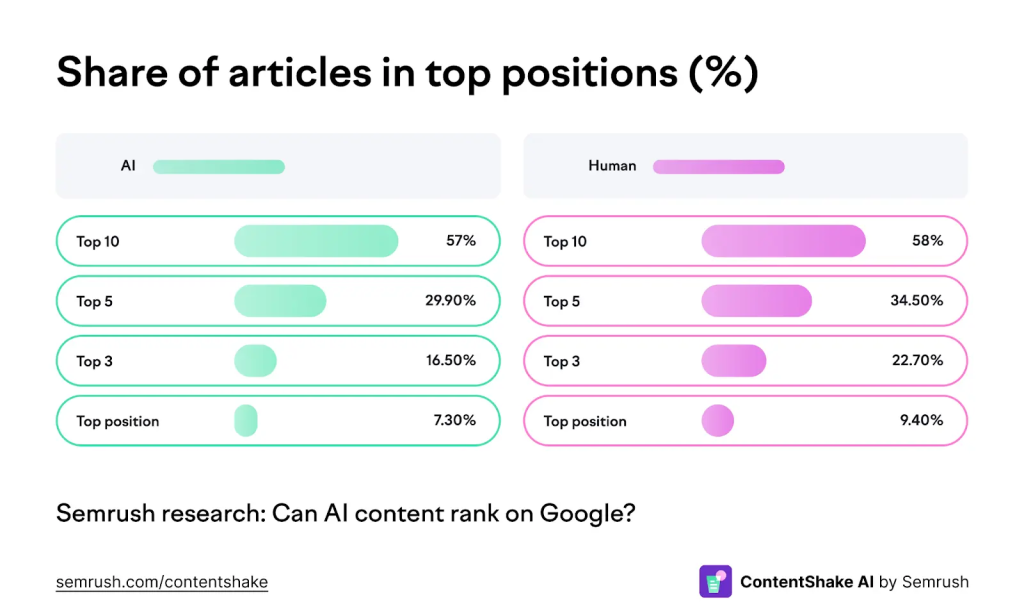
As shown in the above results, 57% of articles in the top 10 positions are written by AI and 58% of articles in the top 10 positions are written by humans.
This demonstrates that whether your article is written by AI or human, it’s still possible to rank in the top positions (at least for now).
What Google Officially Says About AI‑Written Content
“Using automation, including AI, to generate content with the primary purpose of manipulating ranking in search results violates our spam policies. Not all use of automation, including AI generation, is spam.”
Google, 2025
This distinction is crucial: AI is okay if it serves users meaningfully, but misused AI is against policy.
Google has clarified its stance on AI‑generated content in several public guidance documents. The short version: using AI to write content isn’t automatically forbidden or penalised.
What matters is how it’s used and what quality it delivers.

Here are the key takeaways from Google.
Key Guidance & Policies
Google’s Guidance on Generative AI Content
Google says that generative AI tools can be useful (for research, structure, idea generation, etc.), but using them to generate many pages without adding value may run afoul of their spam policies.
They emphasise that major issues arise when content has “little to no originality, effort, or added value.”
“Creating Helpful, Reliable, People‑First Content”
Google’s “helpful content” guidance (Search Central) insists that content should primarily benefit humans, not be produced just to satisfy search engine algorithms.


How Google’s New ‘Helpful Content’ Algorithm Update Changes the Way We Write Content
Some of what they look for:
- Does the content provide original information, reporting, research, or analysis?
- Does the content provide a substantial, complete, or comprehensive description of the topic?
- Does the content provide insightful analysis or interesting information that is beyond the obvious?
- If the content draws on other sources, does it avoid simply copying or rewriting those sources, and instead provide substantial additional value and originality?
- Does the main heading or page title provide a descriptive, helpful summary of the content?
- Does the main heading or page title avoid exaggerating or being shocking in nature?
- Is this the sort of page you’d want to bookmark, share with a friend, or recommend?
- Would you expect to see this content in or referenced by a printed magazine, encyclopedia, or book?
- Does the content provide substantial value when compared to other pages in search results?
- Does the content have any spelling or stylistic issues?
- Is the content produced well, or does it appear sloppy or hastily produced?
- Is the content mass-produced by or outsourced to a large number of creators, or spread across a large network of sites, so that individual pages or sites don’t get as much attention or care?
- Does the content present information in a way that makes you want to trust it, such as clear sourcing, evidence of the expertise involved, background about the author or the site that publishes it, such as through links to an author page or a site’s About page?
- If someone researched the site producing the content, would they come away with an impression that it is well-trusted or widely-recognized as an authority on its topic?
- Is this content written or reviewed by an expert or enthusiast who demonstrably knows the topic well?
- Does the content have any easily-verified factual errors?
“Helpful Content System” & Updates
Google’s Helpful Content System (launched 2022, updated periodically) aims to reward content that is genuinely useful and people‑first, and to demote content that is shallow, mass‑produced, or made primarily for search engine visibility rather than for users.
One important update was in September 2023, when Google changed guidance to remove wording like “written by people” and instead emphasise “content created for people.”
That’s often interpreted as a shift giving more acceptance to AI as long as content meets quality criteria.
Search Quality Rater Guidelines
These are the manuals used by human raters who assess content to help improve Google’s algorithms (though rater ratings don’t directly map 1:1 to rankings).
The Rater Guidelines include sections on “scaled content abuse” and on main content with “little to no effort, originality or added value.” AI‑generated content that is mass‑produced and not carefully edited or enriched risks triggering those negative signals.

The Best ChatGPT Prompts for Content Marketing, Social, SEO & Lead Generation (so far)
What Google Doesn’t Say
- Google has not said that all AI‑written content will be penalised. There is no blanket ban. The risk is tied to content quality, value, user experience.
- They haven’t defined “AI content” in a way that is automatically disallowed; rather, they define problematic content more by behaviours (spam, low effort, misleading, etc.) than by the tool used.
Putting these together, the official position suggests:
- You can use AI to help write content, but you must ensure that content is useful, accurate, and adds value.
- If content is just rehashed, generic or only created to “fill up the site” or target keywords, that’s when risk arises.
- Human oversight / editing is helpful (if not essential) for ensuring compliance with Google’s guidelines.
- The intent, structure, user value, and credibility of content are more important than the mere fact that AI was involved.
When AI Can Lead to Penalties
Here are concrete scenarios when AI can lead to penalties:
| Situation | Why It’s Problematic | Potential Effect |
| Mass‑produced or auto‑generated content with minimal review or human editing | These tend to be shallow, generic, contain mistakes, duplication, or filler material — content quality suffers. | Algorithmic de‑ranking, possibly manual actions under “spammy” auto content rules. |
| Duplicate / very similar content across pages or sites | AI tends to repeat common information. If many pages cover the same ground, Google can view them as redundant. | Lower visibility; only the best‑version pages rank. |
| Misleading or factually incorrect content | AI may hallucinate or produce outdated/incorrect info. If users are misled, trust drops. Google’s E‑E‑A‑T (Experience, Expertise, Authoritativeness, Trustworthiness) signals are damaged. | Ranking drop; reduced trust and engagement. |
| Content created solely for SEO / keywords without caring about usefulness or user experience | If the purpose seems to be “just rank” rather than help, that violates people‑first guidance. | Demotion via helpful content signals; lower user engagement, possibly manual penalty if spam policies are triggered. |
| Pages where the main content is purely machine‑generated without human oversight / originality | Google’s quality raters are now instructed to flag such pages as “lowest quality” when little value has been added. (PPC Land) | Likely poor performance in search; risk of removal or deindexing if manual spam actions apply. |
Best Practices for Using AI Content Safely
At this point, it’s clear: AI content can rank, but only when it meets Google’s quality standards.
The safest way to use AI isn’t to let it write your articles end-to-end, it’s to treat it as a tool in your process, not a replacement for it.
Here’s some guidelines you can follow to make sure your AI content ranks.
1. Always Edit, Enrich, and Add Human Value
AI can draft, outline, or suggest, but you need to add expertise, nuance, and originality.
- Add personal experience, examples, or commentary that AI can’t invent.
- Update with the latest data, stats, or industry trends (AI models may be outdated).
- Ensure your unique voice and tone are consistent.
Think of AI as scaffolding… the house still needs to be built by you.
2. Follow E-E-A-T Principles (Experience, Expertise, Authoritativeness, Trustworthiness)
Google looks for signals that prove content is reliable. You can boost trust by:
- Including author bios that highlight credentials.
- Linking to credible sources.
- Adding case studies, testimonials, or real-world results.
- Demonstrating lived experience (e.g., “I tested this method for 3 months and here’s what happened”).
3. Fact-Check Everything
AI can “hallucinate”, making up sources, dates, or even entire facts.
- Cross-check every claim against a trusted source.
- Verify quotes, statistics, and figures.
- Use plagiarism checkers to avoid unintentional duplication.
4. Avoid Mass Production for the Sake of It
Publishing hundreds of thin, templated AI posts just to target keywords is one of the fastest ways to get flagged as low-quality.
- Prioritise depth over volume. A smaller library of genuinely helpful articles will always outperform a flood of shallow ones.
- Focus on topics you can add authority to, rather than trying to cover every keyword.
5. Write for People, Not for Google
AI tends to produce “search-enginey” text: overly formal, keyword-stuffed, or bland. That’s exactly what Google’s Helpful Content updates aim to devalue.
Ask yourself:
- Would a human find this genuinely useful?
- Does it answer the actual question the searcher has?
- Would I share this with a colleague or friend?
If the answer is no, don’t publish it.
6. Keep a Strong Editorial Process
Treat AI content like an intern’s draft: promising, but not publish-ready.
- Have human editors review for clarity, flow, and originality.
- Run text through style/grammar tools.
- Check how it aligns with your brand voice.
- Test readability: is it engaging, not just correct?
7. Monitor Performance Closely
Google’s systems are always evolving, so don’t “set and forget.”
- Track your rankings and impressions in Search Console.
- Watch bounce rates and engagement. If people leave fast, it signals low value.
- Audit your content regularly to make sure it stays relevant, accurate, and high quality.
8. Use AI Where It Shines
AI is great for:
- Generating ideas, outlines, FAQs, or content briefs.
- Speeding up research by summarising long documents.
- Drafting first versions of content you’ll later improve.
- Producing supporting assets like meta descriptions or alt text.
It’s not great for:
- Final drafts published with no human touch.
- Content requiring nuanced expertise or sensitive topics (medical, financial, legal).
Bottom line: Google won’t penalise you for using AI. But it will penalise you if your content is low-effort, inaccurate, or clearly written for search engines instead of humans.
Use AI as a helper, and keep the final word human.
So, What’s Next?
So, do you get penalised for writing articles with AI?
Not automatically. Google has been clear: it doesn’t care how content is made… it cares what it’s like.
If your articles are shallow, inaccurate, or produced just to game rankings, they’ll underperform whether they’re written by AI or by people.
But if they’re helpful, original, and built with the reader in mind, Google is fine with AI as part of the process.
The real danger isn’t the tool, it’s the temptation to churn out content without adding real value. That’s when rankings fall, traffic drops, and penalties become a risk.
If you want to use AI safely:
- Treat it as a writing assistant, not a replacement.
- Add human editing, fact-checking, and expertise.
- Focus on E-E-A-T: Experience, Expertise, Authoritativeness, and Trustworthiness.
- Publish fewer, higher-quality pieces instead of mass-produced filler.
Bottom line: AI can help you scale content, but it can’t replace your judgement, expertise, or authenticity. If you keep people (not search engines) at the heart of your content, you’ll stay on the right side of Google and keep building long-term visibility.
Next, learn about how to improve your SEO even if nothing else is working.
About the Author





Get the best content marketing insights right in your inbox!
Subscribe to our Newsletter and get marketing insights delivered to your inbox every week.