









3 Ways to Improve Your Google Ads

You’re running Google Ads. You’ve picked your keywords, written the copy, maybe even set up a few landing pages. But the results? Meh. You’re getting clicks—but not the right ones. Leads are either unqualified, uninterested, or just not showing up at all. And worst of all, your budget’s disappearing faster than your patience.
You’re not alone. Most people running Google Ads—especially without agency support—hit this wall. The good news? You don’t need to blow everything up to see better results. You just need to make smarter adjustments.
I’ve worked with dozens of accounts that looked like yours. Often, it’s not about spending more or getting fancier. It’s about tightening what you’ve already got. In this article, you’ll learn three practical tweaks that can seriously improve your Google Ads performance—starting with your targeting, then your message, and finally your landing page offer.
Tip #1: Use Search Term Insights + Negative Keywords
One of the fastest ways to improve your Google Ads performance is by cleaning up your traffic. And that starts with diving into your Search Terms Report.
If you haven’t looked at this yet, here’s what you’re missing: the exact words people typed into Google before clicking your ad. And spoiler—those words often aren’t what you thought they’d be.
For example, if you’re bidding on “business coaching”, your ad could be showing up for searches like “free business coaching” or “how to become a business coach”. These people aren’t buyers. They’re browsers, job seekers, or just curious. And you’re paying for every one of those clicks.
That’s where negative keywords come in. They let you block out terms that waste your budget. In the example above, you’d want to add “free” and “how to become” as negative keywords.
Here’s how to do it:
- Go into your Google Ads account and navigate to your campaign and then Campaigns > Search terms.
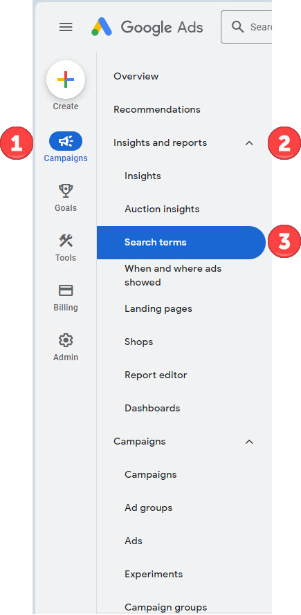
- Look for terms that don’t align with what you’re offering and check the box next to those keywords. Then, click the ‘add as negative keyword’ text.
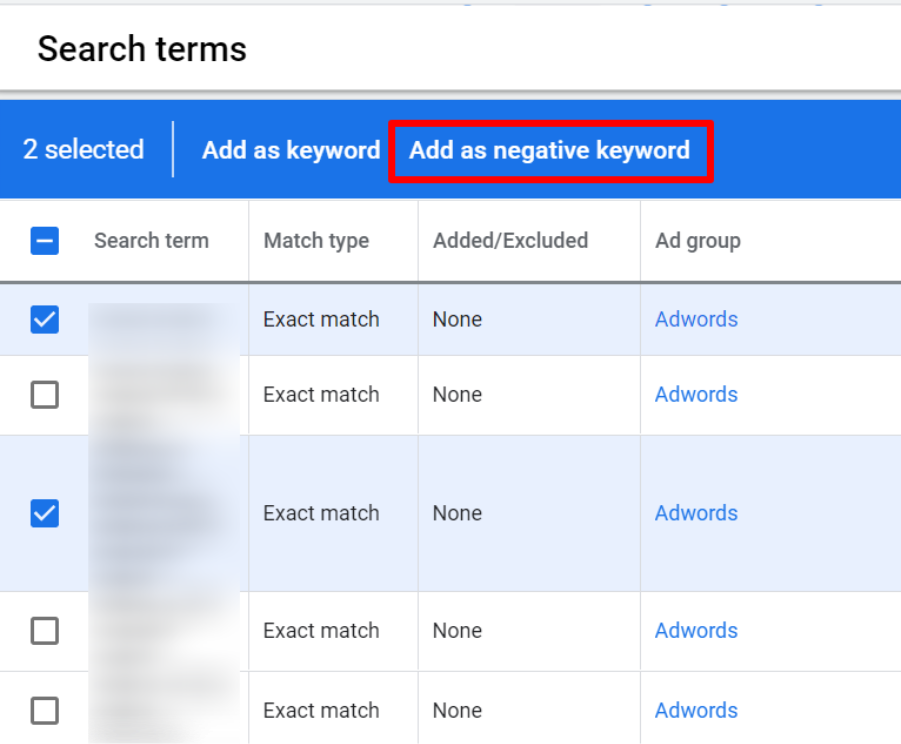
This alone can stop wasted spend in its tracks and help your budget go further.
Here’s an example of keywords that wouldn’t be relevant for a shoe brand but that this brand was spending budget to show up for:
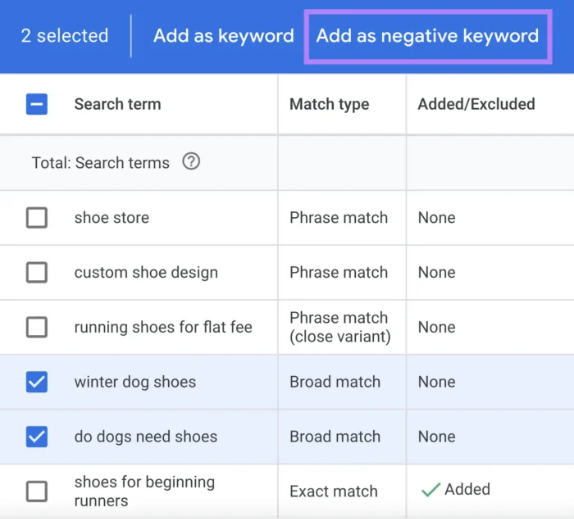
This helps you achieve three things:
- Stops irrelevant, low‑intent clicks from draining your budget.
- Helps improve your Quality Score, meaning better ad placement at lower cost-over-time.
- Gives you control over misaligned traffic you otherwise wouldn’t know about.
When adding negatives, you must select the right match type (broad, phrase, or exact) to control how strict the exclusion is.
For example:
- Broad: excludes any query containing the term(s), regardless of order.
- Phrase: excludes searches containing that exact phrase in that order.
- Exact: excludes only the exact match search.
Tip #2. Match Your Headline to Your Landing Page
You’ve crafted a decent ad. The headline speaks to what your ideal customer is looking for. They click through, and then hit a landing page that feels… off.
Maybe the headline is vague, maybe it’s different from the ad, or maybe it just doesn’t echo what they expected.
That disconnect kills conversions.
This is what marketers call message match, and it’s one of the most overlooked (but powerful) ways to boost your Google Ads results.
Here’s why it matters:
- Google rewards relevance. If your ad and landing page align, you get a better Quality Score, which can reduce your cost per click.
- People don’t want surprises. When someone sees the same language on your landing page as they did in the ad, it builds trust. It reassures them they’re in the right place.
What to do:
- Take your ad headline and make sure the core message shows up as the first thing on your landing page.
- Use the same or very similar phrasing. For example, if your ad says “Get Expert Business Coaching”, your landing page should say “Expert Business Coaching That Helps You Grow Fast”.
- Avoid generic headlines like “Welcome” or “Our Services”—they add nothing and disconnect the journey.
This one fix can improve both click-through and conversion rates because it shortens the gap between ad interest and action.
How to Implement Message Match in Your Ads
Here’s a quick guide on how you can improve your quality score via this method:
| Step | Action |
| 1. Extract your ad headline | Copy the exact wording from your Google Ads headline. |
| 2. Mirror it on the landing page | Use the same or near-identical phrasing as your H1. Include it inside the first visible section—above the fold. |
| 3. Include it in subheadline (H2) | Reinforce the promise by echoing key words—ideally matching major points in your ad. |
| 4. Align visuals and CTA | Same or similar imagery, button text, and value proposition should echo the ad. Keep colours, tone and offer consistent. |
| 5. Test and iterate | A/B test variations to see which message match boosts conversions best. Use dynamic text replacement tools if you have multiple variants |
Tip #3. Fix Your Offer on the Landing Page
Let’s say your ad is solid. Your targeting is dialled in. And your landing page matches the message perfectly. But conversions are still low.
Here’s a hard truth: it might not be your ad or your page, it might be your offer.
Your offer is the thing you’re actually putting in front of people: a free consultation, a downloadable guide, a discount, a demo. It needs to feel valuable, clear, and low-risk.
If someone clicks your ad and lands on a page offering something vague like “Learn more” or “Contact us”, that’s not an offer, it’s a shrug.
And it’s probably why they’re bouncing.
So, what does a strong offer look like?

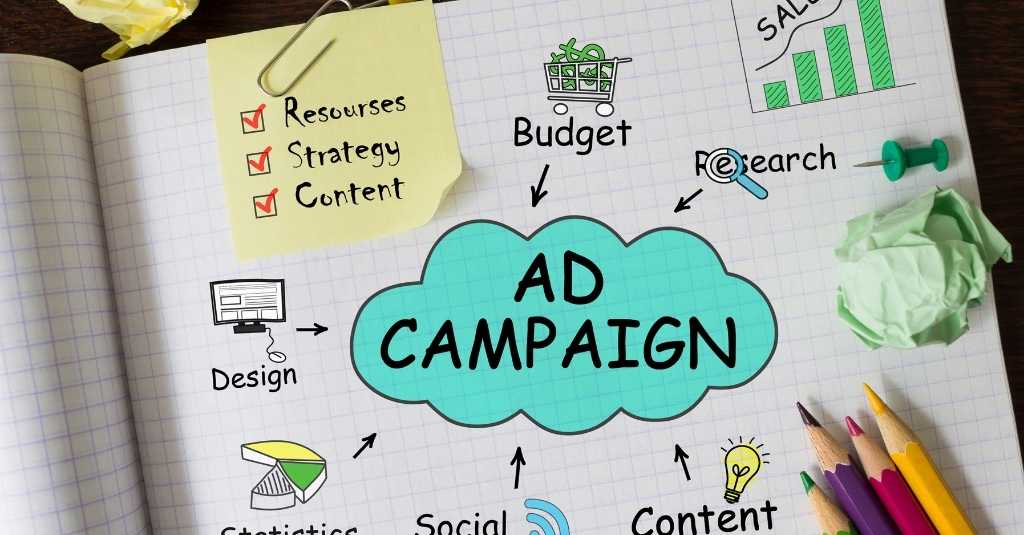
Use the 5-Point Ad Framework to Drastically Increase Leads From Your Paid Ads
What a strong offer looks like:
- It must matter to your audience: Tap into what they really want or fear, such as their hopes, pain points, barriers, or uncertainties
- It must be clear and benefit‑driven: Your offer shouldn’t be vague; it has to promise a specific outcome. If they don’t immediately see what they get and why it matters, they won’t convert
Examples of Weak vs Strong Offers
| Weak Offer Example | Why it underperforms |
| “Contact us” | Generic. Leaves visitor guessing |
| “Get a free quote” | No clear outcome, no urgency |
| Strong Offer Example | Why it works |
| “Book a 15‑minute ad audit & find out why your Google Ads aren’t converting” | Specific, low effort, diagnostic value |
| “Download our 7 highest-performing ad headlines… steal them for your next campaign” | Tangible resource with immediate benefit |
| “Free strategy call this week only,see what better ad copy could do for your leads” | Time‑sensitive, high clarity, tied to a real outcome |
How to Fix Your Offer Fast
- Rewrite your offer using customer language: Start by writing the problem in your customer’s own words (e.g. “I don’t understand why my ads aren’t getting leads”) and then frame the solution as a “how to” statement (“How to get your ads converting again”).
- Connect the offer to a desired outcome: Show what they’ll gain: clarity, leads, quick wins. Don’t just describe your service, instead, lead with what they walk away with.
- Make it low-friction and specific: Free downloads, short audits, or time-limited calls are more inviting than long forms or confusing language.
- Add urgency or exclusivity (if possible): A phrase like “this week only” or “limited spots” nudges faster decisions.
Your ad is just an invitation. Your offer is the reason to say yes.
FAQ: Quick Answers to Common Questions
Q. What if I don’t have time to check search terms every day?
A. You don’t have to. Even reviewing them once a week and updating your negative keywords can drastically reduce wasted spend.
Q. How do I know if my landing page headline matches well enough?
A. Ask yourself this: if someone read only the ad and then the headline on your page, would they feel like they’re still on the same topic? If not, it’s time to rewrite.
Q. My offer is already free, why isn’t it converting?
A. Free doesn’t mean valuable. Make sure the offer speaks to a specific problem and outcome. “Free ad audit” is vague. “15-min audit to fix what’s wrong with your Google Ads” is compelling.
Q. Should I be testing all three areas at once?
A. Not necessarily. Start with the one you think is most broken, then test others one at a time. That way, you’ll know what’s actually moving the needle.
Wrap-Up: Small Tweaks, Big Gains
Improving your Google Ads doesn’t always mean starting from scratch or hiring an agency. Sometimes, it’s about fixing what’s already there, cleaning up your targeting, tightening your message, and sharpening your offer.
Let’s recap:
- Use search term insights and negative keywords to stop paying for junk traffic.
- Match your ad headline with your landing page to boost relevance and trust.
- Upgrade your offer so it’s clear, specific, and tied to something your audience actually wants.
If you focus on these three things, you’ll start seeing better leads, better clicks, and better return, without needing to blow up your campaigns.
Next, learn about the top reasons your Google Ads might not be converting the way you want it to.
About the Author





Get the best content marketing insights right in your inbox!
Subscribe to our Newsletter and get marketing insights delivered to your inbox every week.