









What the First 15 Minutes After a Home Builder Enquiry Should Look Like

Picture this: a prospective client just spent 20 minutes on your website.
They’ve looked at your display homes, read through your inclusions, and maybe even checked out a few of your completed builds. They’re genuinely interested, so they fill out your enquiry form and hit submit.
Within four minutes, they get a text message.
But it’s not from you… It’s from another builder that your lead sent an enquiry to right after they looked at your website.
It says: “Hi, thanks for reaching out. One of our consultants will call you within the hour to chat through your build. In the meantime, here’s a quick overview of how we work.”
Simple. Warm. Fast.
By the time your team notices the lead sitting in the inbox about two hours after it comes in, that prospect’s already had a conversation with your competitor. And research consistently backs up what that scenario implies: 78 per cent of customers buy from the business that responds first.
Not the best builder. Not the cheapest. The first.
For residential builders investing in lead generation through channels like Google Ads, Meta campaigns, display, and SEO, this is where the money quietly disappears.
Not at the top of the funnel.
But right at the bottom of it, in the gap between enquiry received and first human contact.
At RedPandas, we work with residential building businesses across Australia and New Zealand and see a pattern constantly.
The marketing is working. The leads are landing. But without a defined first-response process, those leads cool off fast.
And the builder is left wondering why their cost-per-acquisition keeps climbing.
In this article, you’ll learn what the first 15 minutes after an enquiry should look like, as well as the three steps that separate builders who convert enquiries into consultations from those who keep losing jobs.
Why the First 15 Minutes Are Make-or-Break

Every time a prospective client submits an enquiry, whether it’s through your website, a landing page, or a Facebook lead form, their intent to buy is at its absolute peak:
- They’ve done the research.
- They’ve narrowed down their options.
- They’ve made a decision to raise their hand.
That is, arguably, the single hottest moment in the entire sales cycle. But it lasts for a very short window.
The MIT Lead Response Management Study shows numbers to demonstrate exactly how short that window is.
Based on research, the odds of contacting a lead drop by 10 times in the first hour alone. And the odds of qualifying that same lead drop 21X when you compare responding in five minutes versus waiting for 30.
Let that sink in for a moment: 21X. And it gets steeper from there.
The chance of qualifying a lead drops by 80 per cent after the first five minutes. Move from 5 minutes to 10, and the odds of qualifying drop by a staggering four times lower.
And that drop-off is sharp, fast, and unforgiving.
Now, apply this to a residential building context.
A prospective client looking to build a new home in ANZ isn’t usually making an impulsive decision. This makes more sense when you consider that the average new home build in Australia costs hundreds of thousands of dollars.
But the decision about who to talk to first is made in minutes, which means that a typical prospect is almost certainly filling out enquiry forms with more than one builder.
High-urgency industries like real estate and home services see the steepest conversion drop-offs with delayed response: when someone submits a request, they’re contacting multiple companies simultaneously.
The first responder wins.
So, while the purchase decision itself takes weeks or months, the window to become the builder they’re talking to and, eventually, picking is brutally short.
There’s also a compounding cost here that most builders don’t think about: every lead that goes cold isn’t just a missed conversation. It’s a missed job worth $400,000, $600,000, or more.
Over 30 per cent of inbound leads are never contacted at all. And in B2B alone, an estimated $2.7 billion of advertising spend is wasted each year due to slow or nonexistent follow-up.
But the good news here is that most of your competitors are making the same mistake, which means that your company still has the room to capitalise.
For context, 63 per cent of companies still didn’t respond to an inbound enquiry at all. And the bar to stand out isn’t high: it’s just about being consistent, in the first place.
And consistency starts with having a defined process for the first 15 minutes.
That process has three parts:
- An automated acknowledgement.
- A lead routing rule.
- A callback window.
With these three parts, it becomes easier to avoid being part of the unaware majority of residential builders who are losing leads in a timeframe that only lasts a few minutes.


Why Your Sales Reps Aren’t Hitting Their Targets & How to Fix It
Step 1: The Automated Acknowledgement
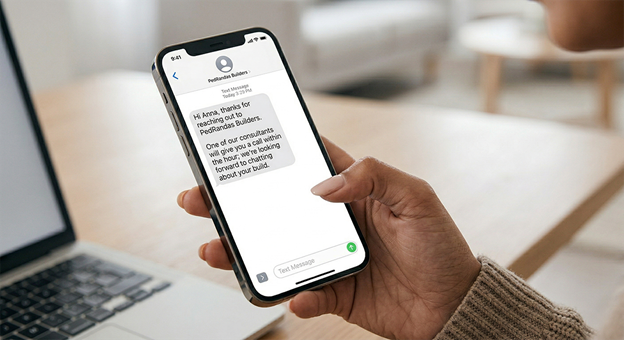
The moment an enquiry lands, something needs to happen immediately.
Not when your sales consultant gets back from a site visit.
Not when admin checks the inbox at 9 am.
But the moment the form is submitted, a response needs to automatically go out.
This is where the automated acknowledgement helps, and it serves one specific purpose: to let the prospect know their enquiry has been received and that a real person will be in contact soon.
It buys your team the time they need to prepare a quality human response, without leaving the lead sitting in silence.
Why Silence in the First Few Minutes Costs You the Job
If nothing comes back in the first few minutes after a prospect messages you, a few things can start to happen in their mind:
- First, they question whether their message was received at all, which creates doubt.
- Second, they move on: checking another tab, looking at another builder’s site, or simply getting pulled back into their day.
- Third, their initial energy is completely dissipated by the time your team calls two hours later.
Sure, the prospect might still take the call after these three things, but the emotional momentum is likely going to be long gone, which means that the conversation starts from a much colder place.
An automated acknowledgement can solve this because it confirms receipt immediately, keeps the lead’s attention on your business, and signals a level of professionalism and responsiveness that most builders aren’t delivering.
Why SMS Outperforms Email for the First Touch
Most builders default to an email auto-reply, largely because it’s the easiest option to configure.
But email is generally a crowded, low-attention channel, particularly in the first few minutes after a prospect has submitted a form and is still actively browsing on their phone.
SMS marketing, on the other hand, delivers an average open rate of around 98 per cent, vastly outperforming email’s typical 20 per cent open rate. The same study also shows that 90 per cent of SMS messages are read within three minutes of delivery.
An email auto-reply sent to someone sitting on their phone mid-research session will, in most cases, go unseen for hours. But an SMS lands on their screen within seconds and displays a banner that they’ll almost always see instantly.
The channel preference data backs this up, too.
Research by GSMA found that 67 per cent of people prefer SMS or instant messaging over email or phone calls when communicating with a business about appointments and scheduling.
For a prospect who’s just submitted an enquiry and is waiting to hear back, a well-timed SMS can feel responsive and personal. An email, by comparison, feels like a system-generated formality.
The table below illustrates why SMS is the stronger first-touch channel for the acknowledgement stage specifically:
| SMS | ||
| Open rate | ~98 per cent | ~20 per cent |
| Read within 3 minutes | 90 per cent of messages | Rare |
| Response rate | ~45 per cent | ~6 per cent |
| Best for | Immediate acknowledgement | Longer-form follow-up content |
Taking all of this into consideration, you can use SMS to acknowledge, and use email as a supporting channel for follow-up content, such as:
- A brochure.
- A link to your display homes.
- A project portfolio.
Each channel does a different job in the sequence.
What the Message Should Say
The automated SMS acknowledgement has one job: to reassure the prospect that they’ve been heard and set a clear expectation for what happens next.
Keep it short, keep it warm, and make it specific.
A well-constructed acknowledgement covers three things:
- Confirmation that the enquiry’s been received.
- A branded sender so the prospect immediately knows who’s reaching out.
- A clear, concrete timeframe for when they’ll hear from a real person.
Something like: “Hi [First Name], thanks for reaching out to [Your Company Name]. One of our consultants will give you a call within 24 hours; we’re looking forward to chatting about your build.”
That’s fewer than thirty words, and it does everything it needs to do. The prospect now has confirmation, context, and a timeframe. There’s no ambiguity, and no reason to go looking elsewhere.
If your SMS says “a specialist will call within 15 minutes,” the phone call should reference the SMS to create a coherent narrative across the interaction.
The automated message and the human follow-up aren’t two separate touchpoints; they’re the opening moves of the same sequence.
When they’re aligned, the prospect experiences a seamless, professional interaction. But when they’re disconnected, such as when the SMS mentions one thing and the call doesn’t refer to it, trust can erode before the conversation’s even started.
How to Set It Up: Actionable Steps
Implementing automated SMS acknowledgement usually doesn’t require a sophisticated tech stack.
Most modern CRMs and enquiry platforms support this out of the box or through a straightforward integration. Here’s how to approach it:
- Audit your current enquiry forms: Identify every channel through which leads come in, such as your website contact form, Facebook or Google lead forms, and landing pages. Each one should trigger the same automated response.
- Add an SMS consent checkbox to your forms: Under Australia’s Spam Act 2003, businesses must obtain consent before sending direct marketing communications via SMS. The ACMA recommends express consent as a clear tick-box at the point of enquiry for this part instead of relying on inferred consent.
- From December 2025, alphanumeric sender IDs, particularly your brand name in the “from” field, must also be registered with the ACMA’s SMS Sender ID Register, or else your messages risk being flagged and blocked.
- Connect your forms to a CRM or SMS platform: Tools like HubSpot and construction-specific CRMs all support trigger-based SMS automation. When a form is submitted, the automation fires instantly: no manual action required from your team.
- Write your acknowledgement message: Draft one version for business hours and one for after-hours enquiries. The after-hours version should acknowledge the time and set an expectation for the following business day.
- Test the full sequence end-to-end: Submit a test enquiry through each of your lead channels and confirm that the SMS fires immediately, the message reads correctly, and the opt-out mechanism works as required.
- Review and refine quarterly: Check delivery rates, opt-out rates, and whether prospects are responding to the message. If more than a small percentage are opting out, the message wording or timing may need adjustment.

How to Grow a Home Building Company | Episode 142
Getting the automated acknowledgement right takes an afternoon to set up and protects every lead that comes in from that point forward.
The prospect hears from you before they hear from your competitor, and that’s where the advantage begins.
Step 2: Lead Routing
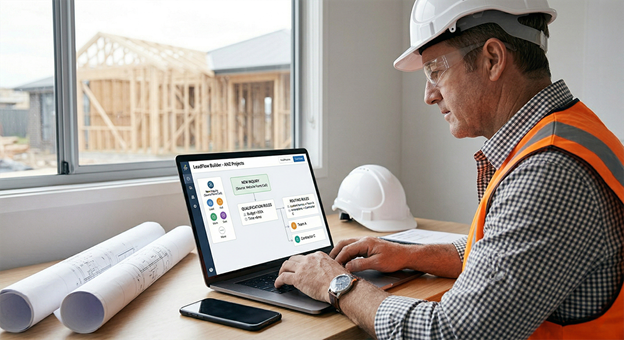
So, the automated acknowledgement’s gone out, and the prospect knows someone is coming.
Now, here’s the question your system needs to answer instantly: who’s going to reach out?
Lead routing is the process of assigning an incoming enquiry to the right consultant the moment it lands, without anyone having manually triaged it.
In a residential building business, this is typically the step where most enquiries quietly go cold because ownership is unclear.
Why Shared Inboxes and Manual Triage Kill Response Speed
A lead sitting in a shared inbox, waiting for someone to “grab it,” is a lead at risk.
When there’s no predefined rule about who owns an inbound enquiry, the natural response is to assume that someone else will handle it. And as every minute that assumption goes unchallenged passes, the lead cools.
When there’s no defined system, even good builders can lose winnable work because the process behind the handoff isn’t built to handle the volume or the pace that inbound enquiries demand.
Manual triage also compounds this problem.
In many residential building businesses, the process looks like this:
- An enquiry arrives.
- A manager or admin reviews it.
- The same manager or admin decides who should handle and forward it.
Each step adds time that forces the lead to cool, which can lower the chances of your team closing them.
Automation, in this case, can reduce the manual workload and speed up lead assignment. Instead of having a manager spend time assigning leads, the system can do it in seconds based on pre-defined rules.
For builders investing in paid lead generation, that manual lag is where marketing spend starts haemorrhaging quietly.
The Two Routing Models That Work for Residential Builders
There’s no single routing approach that suits every building business, but three models tend to work well in the residential construction context:
- Geography-based routing assigns leads based on where the prospect is located or which display home or campaign they enquired through.
This usually results in a system that carries out tasks like assigning a lead from a northern suburbs display to a consultant covering that region, or a lead from a coastal display going to another.
Assigning leads by location is one of the most popular routing methods because sales reps can leverage their local knowledge.
For builders operating across multiple display villages or regions, this model creates clean ownership without any ambiguity. - Availability-based routing works well for smaller teams where territory distinctions aren’t relevant.
One consultant is designated on call for a given time window and owns all inbound enquiries during that period. If they don’t act on the lead within a defined timeframe, such as ten minutes, it escalates automatically to the next person on the list. - Round-robin routing works best for teams where consultants are equally senior, cover the same territory, and share the same lead types.
Leads are distributed sequentially: the first enquiry goes to Consultant A, the second to Consultant B, the third to Consultant C, and then the cycle repeats. This model keeps workload balanced across the team and removes any subjectivity from lead assignment. No single consultant gets preferential leads, and no one gets left out.
The key risk to manage is that round-robin doesn’t account for availability. If Consultant A is on a site visit when their turn comes up, the lead sits until they’re reachable. Pair this model with an escalation rule: if a lead hasn’t been actioned within your defined window, it automatically reassigns to the next consultant in the rotation.
Both models share the same underlying principle: one name, one owner, one point of accountability per lead.
Here’s a quick comparison to help you decide which fits your business:
| Routing Model | Best For | How It Works | Key Risk to Manage |
| Geography-based | Multi-region or multi-display businesses | Leads auto-assign based on location or lead source | Gaps in coverage when a region is short-staffed |
| Availability-based | Small teams or single-location builders | One on-call consultant owns all inbound leads per shift | Consultant unavailability with no escalation path |
| Round-robin | Teams of equal seniority with no territory structure | Leads rotate sequentially through all consultants | Doesn’t account for lead quality or consultant availability |

How to Market Your Home Builder Company During Seasonal Downturns
How to Set Up Lead Routing That Actually Works
A routing model is only as good as its implementation. Here are the steps to get it right from the start:
- Define your routing criteria first: Decide whether you’re routing by geography, lead source, consultant availability, or a combination. Document this in plain language before touching your CRM.
- Build the rule into your CRM as an automated workflow: When an enquiry is submitted via your website form, Facebook lead ad, or landing page, it should trigger an automatic assignment to the relevant consultant without any human triage required. Most CRMs used in the residential building space support this natively.
- Set the notification to go to the consultant’s phone, not just their CRM queue: A lead assigned to someone’s desktop dashboard does nothing if they’re on a site visit. The assigned rep should receive an instant notification via the CRM, email, or mobile app, ensuring they have instant visibility and can reach out while the lead is still warm. For residential builders, an SMS notification to the consultant’s mobile is the most reliable method.
- Build in an escalation rule: If the assigned consultant hasn’t actioned the lead within your defined window, the system should automatically re-assign or flag it for a manager. High-performing teams often set SLAs for how quickly reps should act after assignment. A 15-minute SLA for high-intent inbound leads is a common benchmark, with automated escalation if a rep hasn’t engaged within that window.
- Review your routing performance monthly: Track which leads were actioned within your SLA window and which weren’t. If the same consultant is consistently missing the window, that’s a coaching conversation. But if the same lead source is consistently getting missed, that’s a system fix.
Consistent routing improves response speed and creates the visibility that sales leaders and business owners need to see where their pipeline is healthy and where it isn’t.
A well-structured CRM, on the other hand, creates accountability: everyone knows who owns which step and where the lead currently stands.
That kind of clarity pays dividends well beyond the first 15 minutes.
75.6 per cent of residential builders in Australia already report using a CRM system, which means the infrastructure for automated routing is likely already in place for most businesses.
But the gap, more often than not, is that the routing logic simply hasn’t been built out.
Step 3: The Callback Window
Step 3: The Callback Window

The automated SMS and routing notification both exist to make one thing possible: a real person picking up the phone and calling the prospect back within the window you’ve promised.
That call is the moment the process either converts goodwill into a conversation or lets it evaporate.
Understanding why this window matters so much, what a realistic standard looks like for a residential building business, and how to handle the enquiries that fall outside business hours are the three things most builders get wrong here.
Why the Callback Window is so Consequential
The data on the callback window speaks volumes about a key detail of customer service that residential builders can’t ignore.
Businesses that respond within an hour are almost seven times more likely to have meaningful conversations with decision-makers.
There’s also the competitive dimension to factor in.
In a study by RevenueHero covering over 1,000 companies, more than 63 per cent of businesses didn’t respond to an inbound enquiry at all, and the average response time was over 29 hours.
For residential builders in ANZ, this means the bar to stand out on speed is genuinely low, and the reward for clearing it is significant.
What a Realistic and Competitive Callback Target Looks Like
The five-minute benchmark is the research gold standard.
If your team setup and lead volume allow for it, it’s worth pursuing.
Especially for high-intent enquiries coming through paid campaigns, where the prospect has typically just filled out a form and is still sitting at their device.
For most residential building businesses operating with a lean sales team, a more achievable and still highly competitive target is a call-back within 60 minutes during business hours.
Getting that call made within the hour puts you in a category that most of your competitors have no systems to replicate.
Here’s a table that maps response windows to their impact on lead qualification, so you can see where your current standard sits and what you’re gaining or losing at each interval:
| Response Window | Impact on Lead Qualification |
| Under 5 minutes | Maximum conversion potential: leads are still engaged and actively comparing. |
| 5–30 minutes | Qualification likelihood drops 21x compared to a sub-5-minute response. |
| 30–60 minutes | Still competitive; 7x more likely to qualify than waiting beyond an hour. |
| 1–24 hours | Odds of meaningful contact drop sharply: most competitors have already called. |
| 24+ hours | Lead has almost certainly moved on or been won by a faster builder. |

Here’s How Marketing for Construction Companies Is Different From Other Industries
Regardless of the window you state in your automated SMS acknowledgement, such as “within the hour” or “within the day”, your routing and notification system needs to be built to hit that window consistently, not occasionally.
How to Handle After-Hours Enquiries
One of the most common barriers to a fast call-back standard is after-hours leads: the enquiries that come in on a Tuesday evening or a Sunday afternoon when your consultants aren’t at their desks.
This is a real operational challenge, but it’s also one of the biggest untapped opportunities in residential building sales.
In the home services industry, 41 per cent of weekend calls go unanswered.
The same study found that weekend leads represent 18 per cent of weekly enquiry volume, yet they receive 60 per cent slower response times than weekday leads.
That combination of high volume and slower response means a disproportionate number of quality leads are sitting uncontacted across the industry every weekend.
The fix has two parts, and neither requires round-the-clock staffing:
- Part one is handled by your automated SMS acknowledgement, which goes out immediately regardless of when the enquiry arrives.
The message simply adjusts to set an honest expectation based on the time of day. An evening or weekend enquiry gets a message along the lines of: “Hi [First Name], thanks for reaching out to [Your Builder Company]. We’ve received your enquiry, and one of our consultants will give you a call first thing tomorrow morning.”
A simple after-hours message like this provides an immediate touchpoint and can dramatically improve the odds the lead will answer when you call the next day because they’re expecting it.
- Part two is a clearly defined next-morning priority.
After-hours leads from the previous evening or weekend need to be the first calls of the following business day, not an afterthought after the inbox is cleared.
The way to ensure this happens consistently is to build it into your CRM as an automatic task: any lead received outside business hours generates a high-priority call-back task due within the first 30 minutes of the next business day, assigned to a named consultant.
Following this two-part solution can help you ensure that you get to close more leads that come in after office hours. The approach can help keep them on the hook until the moment your sales reps can respond to them.
Frequently Asked Questions: Home Builder Enquiries
What is lead generation for home builders?
Lead generation for home builders refers to the marketing activities that attract prospective clients and prompt them to submit an enquiry through Google Ads, Meta campaigns, SEO, display advertising, or referrals.
The goal is to move someone from passive interest to active contact with your business.
How does response time affect lead generation for home builders?
Response time determines how much of your lead generation investment actually converts into consultations.
Slow follow-up means enquiries go cold before a real conversation happens, increasing cost per acquisition and reducing return on marketing spend.
Research consistently shows that leads contacted within five minutes are 21 times more likely to convert than those contacted after 30 minutes.
What should happen in the first 15 minutes after a residential building enquiry?
The first 15 minutes should include these three steps in sequence:
- An automated SMS acknowledgement is sent immediately when the enquiry is received.
- A lead routing action that assigns the enquiry to a named consultant.
- A phone call is made within the hour.
This sequence ensures the prospect is acknowledged instantly and contacted by a real person while their interest is at its highest.
How fast should a home builder respond to a new lead?”
For residential builders, a realistic and highly competitive target is a call-back within one hour of receiving the enquiry, putting you well ahead of the industry average response time of 29 to 47 hours.
Why is SMS better than email for the initial lead acknowledgement?
SMS has an open rate of around 98 per cent, compared to email’s average of approximately 20 per cent, and 90 per cent of text messages are read within three minutes of delivery.
For a prospect who’s just submitted a building enquiry and is likely on their phone, an SMS lands immediately and confirms their enquiry was received, keeping them engaged while your team prepares to call.
What is lead routing, and why does it matter for home builders?
Lead routing is the process of automatically assigning an inbound enquiry to the right sales consultant based on pre-set rules, such as geography or availability.
For residential builders, it matters because an unassigned lead has no clear owner.
And without a named person responsible for the call-back, enquiries sit in shared inboxes until it is too late to reach the prospect competitively.
How should a residential builder handle enquiries that come in after hours?
After-hours enquiries should receive an immediate automated SMS acknowledgement that sets an honest expectation, like a confirmation that a consultant will call the following morning.
These leads should then be flagged as a priority for the next business day.
Weekend and evening leads represent a significant share of weekly enquiry volume and receive slower responses on average, making them a direct competitive opportunity for builders who have a defined process in place.
The Competitive Reality of Home Builder Lead Generation
Here’s the thing about the three steps in this article: none of them require a large team, a big budget, or a months-long technology rollout.
An SMS trigger, a routing rule, and a callback standard are more than capable of working together as the architecture of a high-converting home builder enquiry system.
The builders who have this in place aren’t doing anything extreme; instead, they’re simply doing the basics faster and more consistently than everyone else.
And right now, in the ANZ residential market, that bar is genuinely low to clear.
If you build even a modest first-response process and stick to it, you’re probably going to be ahead of most of the market, particularly the builders competing for the same prospects that you’re trying to close.
Now, if you want to understand how a first-response process fits into a broader lead generation and conversion strategy for your building business, get in touch with one of our growth specialists for a free consultation.
You’ll walk away with valuable insights on how to keep prospects engaged across the longer sales cycle that custom and residential builds require, regardless of whether you work with us or not.


Get in Touch With a Growth Specialist
About the Author




Get the best content marketing insights right in your inbox!
Subscribe to our Newsletter and get marketing insights delivered to your inbox every week.