









Am I Optimising for the Wrong Paid Media KPIs in 2026?

So, your paid media dashboard looks healthy.
Cost per lead is down. Click-through rates are strong. Conversions are flowing in.
But why does your revenue still feel unpredictable?
Well, here’s the thing: you can optimise your paid media campaigns perfectly… and still optimise for the wrong thing.
The problem of optimising for the wrong paid media KPIs happens more often today than most teams expect.
Attribution is messier than it used to be. Tracking isn’t as clean. Platforms are better at showing you what’s measurable, in the form of clicks, impressions, and leads… But not always what’s meaningful.
And when budgets are tight, optimising for what’s “easy” to report can quietly replace optimising for what actually grows the business.
So, if you’ve ever looked at a report and thought, “These numbers look good… but something feels off”, then this article is for you.
The real issue, at this point, isn’t whether your campaigns are working.
It’s whether your strategy is built around the right paid media KPIs in the first place.
After working with teams who generated thousands of leads but struggled to prove pipeline impact, one pattern shows up again and again: diagnostic metrics are being treated as decision metrics.
And this results in signals being mistaken for outcomes.
In this article, you’ll get clarity on the difference between platform KPIs and business KPIs, why optimising for cheaper leads can quietly damage growth, and what you should be measuring instead if revenue is the real goal.
By the end, you’ll know whether you’re optimising for the wrong paid media KPIs, and exactly what to change if you are.
Understanding the “KPI Trap” and (How It Hurts Your Paid Media Strategy)
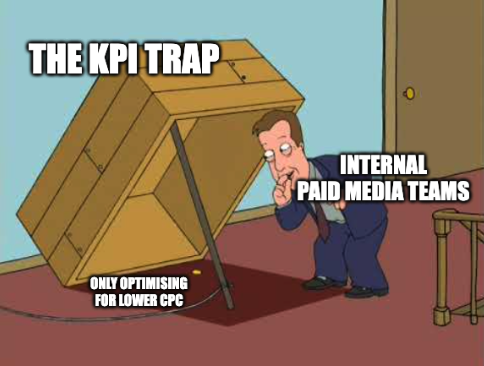
On the surface, your dashboard may look efficient. But platform-level efficiency doesn’t automatically translate into business-level effectiveness.
Let’s unpack how the KPI trap can affect your paid media strategy and why it happens in the first place.
See, the truth is that lower CPC and higher CTR do NOT automatically mean better outcomes.
It’s easy to assume that if you’re paying less per click and more people are clicking, your campaigns are improving.
In reality, those metrics only tell you how compelling your ad is, not how commercially valuable the traffic is.
Here’s what these metrics measure:
- Click-Through Rate, or CTR, measures how many people clicked compared to how many saw the ad. It indicates relevance and creative resonance
- Cost Per Click, or CPC, reflects how competitive and efficient your traffic acquisition is
But, it’s important to note that neither metric tells you if a website visitor was either:
- Qualified
- Ready to buy
- Aligned with your ICP
Generally, platforms optimise towards the goal you set.
If that goal is a top-of-funnel action, like a basic form submission, the algorithm will find more people likely to complete it… Even if those people rarely convert further down the funnel.
Google Ads’ Smart Bidding, for example, uses historical conversion data to predict the likelihood of a user converting and adjusts bids accordingly. So, if your conversion event is low-intent, that’s what it learns to pursue.
The logic is simple: if you reward the system for cheap leads, it will deliver cheap leads.
But that doesn’t mean those leads are commercially viable.
Not seeing above usually means that you’ll end up seeing “improvements” in cost metrics while your downstream revenue stagnates.
Looking for more insights to optimise your paid media strategy? Here’s an in-depth guide on the benchmarks you need to keep in mind as you go.


Meta Ads’ Andromeda Update: What Does It Mean for Your Paid Media Campaigns in 2026?
The Hierarchy for Better Strategy Optimisation and Paid Media KPIs
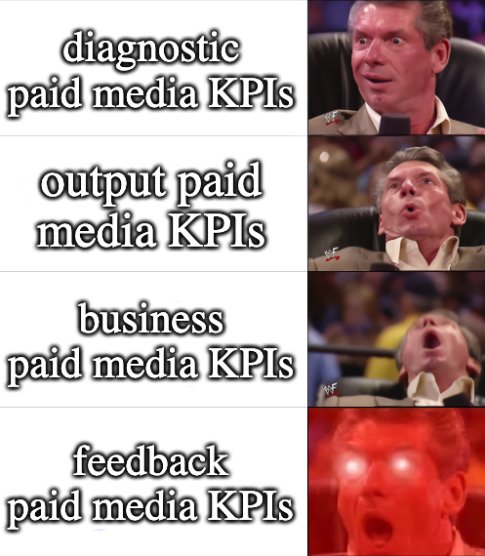
The reason conversations around paid media KPIs become messy is simple: not all metrics are designed to do the same job. When you treat every number as equally important, you end up making strategic decisions based on operational signals.
To help you better understand where the KPIs in your dashboards should stand in the totem pole, here’s a quick breakdown of every metric you might use and where it falls in the order of relevance:
Level 1: Diagnostic Paid Media KPIs
Diagnostic paid media KPIs are metrics that are your signals of mechanical health: these tell you whether your campaigns are functioning properly. They are early indicators of friction, but they aren’t proof of business value.
To understand their role, think of them as symptoms, not outcomes.
Here are the main diagnostic paid media KPIs you’re probably going to deal with day-to-day when managing your paid media strategy:
| Diagnostic Paid Media KPIs | Description |
| CTR (Click-through rate) | The percentage of people who click after seeing your ad. |
| CPC (Cost per click) | How much you’re paying for traffic. If CPC spikes, you may have increased competition, weaker quality signals, or inefficient targeting. |
| Conversion rate (CVR) | The percentage of visitors who complete your defined action. This helps you diagnose landing page clarity, offer strength, and friction in the form |
| Frequency or Impression Share | These indicate whether you’re over-exposing audiences or failing to show up consistently enough. |

Why Businesses Struggle With Social Media Ad ROI
These are performance health metrics. If CTR collapses, something is wrong. If CVR halves, investigate.
But it’s crucial to note that none of these metrics confirms that you’re attracting buyers. They only confirm that you’re attracting responders.
Level 2: Output Paid Media KPIs
Once campaigns are mechanically healthy, the next layer is output.
Output paid media KPIs are generally used to give a clearer picture of what you produced, but not what you earned. These are the numbers most dashboards are built around.
Here’s a quick overview of the three main output paid media KPIs you’ll need to account for with your paid media optimisation efforts:
| Output Paid Media KPIs | Description |
| Leads or Form Fills | These measure completed actions, not commercial intent. |
| CPL (Cost Per Lead) | How much you paid to generate those actions. |
| CPA (Cost Per Acquisition/Action) | Depending on how “acquisition” is defined, this may still represent an early-funnel event. |

How a Poor Landing Page Affects Your Paid Media Performance
Advertising platforms optimise towards the event you define.
If you tell Google Ads that a lead form submission equals success, its bidding algorithms, particularly when using Smart Bidding, will aim to maximise the likelihood of that event. This falls in line with the fact that Google explicitly states that automated bidding strategies use conversion data to optimise bids in real time.
So, if your conversion is shallow, optimisation will be shallow.
Now, whenever CPL drops, here are the most common culprits:
- Targeting widened
- The offer became softer
- The form asked for less commitment
- The audience became less commercially intent-driven
At the end of the day, CPL falls because the algorithm did exactly what it was asked to do.
This is why lead volume can rise while pipeline quality declines, since you’re measuring productivity instead of profitability.
Level 3: Business Paid Media KPIs
This is where your paid media strategy either matures… Or stays stuck.
Business paid media KPIs are often where strategy decisions belong because they answer a harder question: Would you willingly buy these results again?
And to make that assessment properly, you need to move beyond front-end metrics and look at revenue mechanics through these indicators:
| Business Paid Media KPIs | Description/Question it Answers |
| Qualified Lead Rate | What percentage of leads meet the agreed sales criteria? |
| Lead-to-opportunity Rate | How often do leads turn into pipeline? |
| Cost Per Qualified Lead (CPQL) | Depending on how “acquisition” is defined, this may still represent an early-funnel event. |
| Pipeline Generated | How much commercial opportunity is being created? |
| Customer Acquisition Cost (CAC) | Total cost to acquire a paying customer. |
| Payback Period | How long it takes to recover acquisition cost. |
| Pipeline Velocity | How quickly opportunities move through the funnel. |

Can You Scale Paid Media With a Limited Budget?
Instead of chasing a single “perfect” attribution number, the smarter move is to ask: Are we creating a profitable pipeline at an acceptable cost and speed?
If the answer is no, then lower CPL probably won’t save you.
And if you need help figuring out the next steps after reading this guide, here’s everything you need to know about improving lead quality from your paid media efforts.
Frequently Asked Questions: Paid Media KPIs & Strategy
What are the most important KPIs in a paid media strategy?
The most important KPIs in a paid media strategy are those that strongly predict revenue, not just traffic or leads.
For most B2B or high-consideration businesses, that includes:
• Cost per qualified lead (CPQL)
• Cost per opportunity (CPO)
• Pipeline generated from paid media
• Customer acquisition cost (CAC)
• CAC payback period
CTR, CPC, and CPL are useful diagnostic metrics. But they should not be your primary success measure.
Is cost per lead (CPL) a bad KPI in paid media?
CPL is not a bad KPI… But it’s an incomplete one.
CPL only tells you how much you paid for a form submission. It does not tell you:
• Whether the lead was qualified
• Whether it became an opportunity
• Whether it generated revenue
In a strong paid media strategy, CPL should be paired with a quality metric like qualified rate or opportunity rate. Otherwise, you risk optimising for volume instead of value.
What paid media KPIs should I optimise for in a paid strategy?
In most B2B paid media strategies, the best optimisation KPI is the closest measurable metric to revenue, such as:
• Cost per qualified lead
• Cost per opportunity
• Revenue generated from a paid-sourced pipeline
If possible, feed qualified or opportunity-stage data back into your ad platforms so algorithms optimise towards outcomes that matter commercially.
How do I connect paid media to revenue?
To connect paid media strategy to revenue:
1. Define clear lifecycle stages: lead → qualified → opportunity → closed-won
2. Capture original source and campaign data in your CRM
3. Import offline conversions, such as qualified leads or opportunities, back into platforms like Google Ads or Meta.
4. Report on pipeline and revenue alongside spend, not just lead metrics
You don’t need perfect attribution. You need consistent definitions and closed-loop feedback.
Why do my paid media KPIs look good, but revenue isn’t growing?
This usually happens when your paid media strategy is optimising for surface-level metrics such as:
• CTR
• CPC
• Raw lead volume
• Platform-reported ROAS
These metrics can improve even if lead quality drops or sales cycles slow down.
If revenue is flat, review:
• Lead-to-qualified rate
• Opportunity rate
• Cost per opportunity
• Pipeline velocity
If those aren’t improving, you may be optimising for the wrong KPI.
Should I trust GA4 or ad platform reporting more?
You should use each for different decisions.
• Use ad platform reporting for in-platform optimisation
• Use CRM and revenue data for commercial decision-making
• Use GA4 directionally to understand cross-channel patterns
Modern attribution models, like GA4’s data-driven model, use modelling and fractional credit.
They are helpful for insights, but they’re not perfect proof.
How often should I review paid media KPIs?
Review diagnostic KPIs like CTR, CPC, and conversion rate weekly for performance health.
Review business KPIs like qualified leads, opportunities, pipeline, and CAC monthly or quarterly to guide budget and strategy decisions.
A strong paid media strategy separates tactical monitoring from commercial steering.
Change Your Paid Media KPIs, Change the Outcome
You can keep optimising for cheaper leads.
You can keep celebrating lower CPL, higher CTR, and platform-reported ROAS.
And you can keep having the same uncomfortable conversation every quarter when revenue doesn’t match the story your dashboard told.
Or… You can change the finish line.
If your paid media strategy is built around the wrong KPI, you’re not just reporting the wrong numbers; you’re training your entire growth engine to chase the wrong outcomes.
Platforms optimise exactly what you tell them to. Teams prioritise exactly what you report on. Leaders fund exactly what they believe is working.
So if “lead submitted” is treated as success, that’s what you’ll get more of… Even if it quietly damages pipeline quality, slows sales cycles, or inflates CAC.
But if you want to go further and start optimising for KPIs that will significantly impact the level of growth and returns your paid media strategy delivers, you can start by:
- Choosing a KPI that strongly predicts revenue
- Adding guardrails that protect quality
- Closing the loop so platforms learn what “valuable” actually means in your business
From here, it’s crucial to move fast: every month you optimise towards the wrong KPI, the algorithm gets better at finding the wrong customers. The compounding effect works both ways: for you or against you.

What is a Paid Media Retainer & What Does It Include?
About the Author





Get the best content marketing insights right in your inbox!
Subscribe to our Newsletter and get marketing insights delivered to your inbox every week.