









Construction Ad Spend Not Converting? This Might Be Why

You might be shocked to hear that up to 78 per cent of buyers in the construction industry choose the first business that contacts them after filling out online forms.
Speed is one of the most decisive competitive levers available to any builder.
Every month, you’re spending money on Google and Meta, pouring construction ad spend into campaigns.
And the same question pops up consistently: “Why isn’t our pipeline growing the way it should?”
If you don’t know the answer off the top of your head, that’s part of the problem.
But you’re not the only construction company with this problem in ANZ.
Research shows that 51 per cent of leads are never contacted at all, and 48 per cent of salespeople never make a single follow-up call after initial contact.
Across industries, the average lead response time sits at over 42 hours.
And in residential construction, where you’re competing for the same homeowner who has just submitted the same enquiry to three other builders, 42 hours is a lifetime.
Additional research from Bokka shows that responding to a lead within five minutes can increase qualification rates by 21 times compared to waiting just 30 minutes.
The problem here is that a significant chunk of your construction ad spend probably isn’t being held back by bad targeting or weak creative.
It’s most likely being wasted after the enquiry arrives, in the gap between a lead coming in and someone actually picking up the phone.
At RedPandas, we’ve worked with builders running serious Google Ads and Meta budgets between $15,000 to $50,000 a month. When we audit their pipelines, the pattern is almost always the same:
- Enquiries sitting uncontacted.
- Leads gone cold.
- Jobs that should have been on the books, handed silently to a competitor who simply responded faster.
In this article, you’ll learn exactly how the math works against you when enquiries go unanswered, how to maximise your construction ad spend, and what a properly optimised follow-up system looks like in practice.
How Much Does a Lead Cost in the Construction Industry?

Before you can understand what missed enquiries are costing you, it helps to understand what you spent to generate them in the first place.
For residential builders, that number is higher than most people realise.
If you’re running Google Ads, you’re generally operating in one of the more expensive corners of the home services advertising market because of the average construction ad spend.
Construction and contractors recorded the highest cost per lead in home services on Google Ads in 2025, averaging $165.67 per enquiry.
And that’s the average, not the ceiling.
The reason it’s so expensive comes down to a simple supply-and-demand dynamic: more builders are bidding on the same keywords than ever before, which drives the auction price up with every passing year.
What makes this more challenging is that those clicks don’t convert into enquiries easily.
Construction and contractors in the aforementioned study also recorded the lowest ad-to-lead conversion rate across all home services categories in 2025, at just 2.61 per cent.
To put that in plain terms: for roughly every 38 people who click your Google Ad, only one of them fills in a form or picks up the phone. The other 37 leave without a trace… And you still pay for every single one of those clicks.
Meta campaigns, on the other hand, work differently.
Rather than targeting people who are actively searching for a builder right now, Facebook and Instagram put your ads in front of people who broadly fit the profile of a future client. The leads tend to come in cheaper because of this.
Construction leads on Meta platforms averaged around $41.26 per lead in 2025, with that figure projected to climb toward $45 heading into 2026.
The trade-off here is intent.
A Google enquiry, for one, typically comes from someone ready to act.
On the other hand, a Meta enquiry often comes from someone who is still in the research phase and needs more nurturing before they’re ready to commit (not always the case, but more often than not, this is how it works).
Most builders running both channels can end up with a blended cost per lead that sits somewhere between $40 and $165, depending on how their budget is split.
For the sake of a working example, let’s use $100 per lead: a reasonable mid-point that keeps the numbers clean without underselling the reality.
So, let’s say you’re shelling out $5,000 of construction ad spend a month across Google Ads and Meta.
At $100 per lead, that’s 50 enquiries landing in your pipeline every month.
These numbers will vary depending on your budget split, but a combined Google and Meta spend of $5,000 per month might look something like this:
| Ad Platform | Budget | No. of Enquiries | Cost per lead | Lead Behaviour |
| $3,000 | 18 | $165 | Higher intent, actively searching, and more ready to act. | |
| Meta | $2,000 | 32 | $62 | Lower intent on average, earlier in the decision-making process, and requires faster and more thorough follow-up to convert. |
The channel mix shapes how you should respond to each enquiry, but the underlying rule is the same for both: every single one of those 50 people represents a real human being who put their hand up.
The clock starts ticking the moment they send in an enquiry.

Are Paid Ads Worth It When Marketing for Construction Companies?
Why Your Pipeline Won’t Grow (Even if You’re Spending 1000s on Ads Every Month)
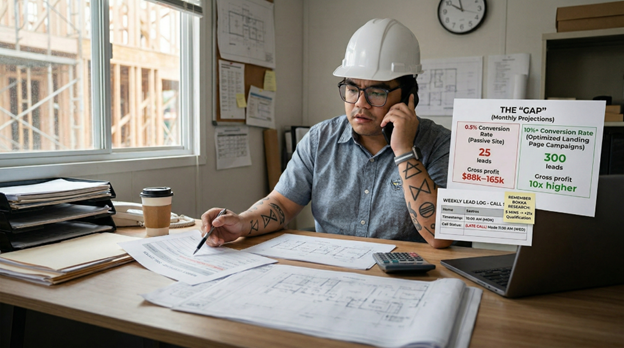
Research shows that more than 30 per cent of leads across industries are never contacted at all. And the construction industry, with its busy site schedules, stretched admin teams, and frequently informal follow-up processes, isn’t immune to this pattern.
If even 30 per cent of your 50 monthly enquiries go uncontacted, that’s 15 leads you paid between $100 and $165 each for, and then never spoke to. And at $100 per lead, that’s $1,500 of your construction ad spend evaporating every single month through silence after the enquiry arrived.
And given that up to 78 per cent of buyers choose the first business that responds, speed is one of the most decisive competitive levers available to any builder.
Yet most builders are operating nowhere near that standard. In fact, most builders take 24 to 48 hours to follow up. By that point, the prospect’s moved on, called your competitors, and lost their initial excitement altogether.
If you feel like you’re racking up too much construction ad spend every month and your pipeline isn’t growing, it’s most probably a response time gap.
You’ll spend years tweaking your ad creative, adjusting your targeting, and debating your landing page headline, and none of it will move the needle as much as simply calling your leads back the same hour they enquire.

How to Convert More Leads with a Buyer’s Guide
How to Grow Your Sales Pipeline in the Construction Industry

By now, the problem’s clear: your construction ad spend won’t deliver a strong ROI unless you have a well-established approach to following up with leads.
The question is what to do about it, and what “doing something about it” looks like in practice for a residential builder running paid advertising.
The answer isn’t complicated, but it does require acknowledging something most builders are reluctant to admit: the follow-up problem is a systems problem, not a capacity problem.
Generally, it stems from having no structured, repeatable process to ensure every enquiry is handled the same way every time.
Think of it like a production schedule.
When a builder has a documented process for site delivery for materials, trades, and inspections, projects can run on time.
And when there’s no process, things slip, things get forgotten, and money gets lost.
The sales pipeline works the same way: without a documented, repeatable follow-up system, leads can consistently fall through the cracks and waste construction ad spend.
According to a 2026 survey of 8,462 residential builders by the Association of Professional Builders, builders with a documented sales process reported gross markups of 26.5 per cent on new homes, compared to just 21 per cent for those without one.
That results in a gap of 5.5 percentage points on every single job.
On a $1,500,000 contract, the difference between a 21 per cent and a 26.5 per cent gross markup is roughly $82,500 in additional gross profit per job.
The same study found something even more compelling: builders with these five core sales systems documented reported a median gross markup of 32 per cent, compared to just 20 per cent with no documented sales systems at all:
- A sales process: A step-by-step guide that moves a prospect from first contact to signed contract, so nothing falls through the cracks
- Scripts: Prepared language for common conversations, like first calls or follow-ups
- Process for charging for quotes: A clear policy on when and how you charge for estimates
- Regular training: Scheduled sessions that keep your team sharp on product knowledge, sales skills, and handling tough conversations
- An objections manual: A documented set of responses to the most common pushbacks, like price or timeline concerns
On top of this, speed to first contact is the single highest-impact lever available to a builder running paid advertising, but it also happens to be one of the most consistently underestimated.
Leads contacted within five minutes are 21 times more likely to convert than those contacted after 30 minutes.
This shows a 21x difference driven entirely by when you call, not what you say. And that can completely transform the returns you get out of your construction ad spend.
“But I Don’t Want to Annoy My Potential Customer”
A homeowner enquiring about a new build or renovation is almost certainly submitting their details to more than one builder at the same time.
They’re doing their research, filling in two or three contact forms, and waiting to see who gets back to them first.
Whoever responds within minutes usually signals professionalism, organisation, and genuine interest. And in a high-consideration purchase like building a home, that first impression carries significant weight.
The builder who calls back two days later, on the other hand, isn’t just late; they’re already working against the mental picture the homeowner has formed of them based on their absence.
The goal of that first contact is to acknowledge the enquiry, show the homeowner their time is valued, and create a clear next step; whether that’s a discovery call, a site visit, or a meeting to go through their brief.
The customer wants to be contacted.
This can be partially automated: an instant SMS or email confirmation firing the moment a form is submitted, while a real-time notification alerts your sales coordinator to make a personal call within the hour.
Two steps, largely automated, that cover the first five minutes without requiring your team to sit watching a screen all day.
How a CRM Ensures That No Lead Gets Forgotten
A structured follow-up sequence only functions reliably if it is tracked.
And tracking it reliably requires a customer relationship management system, also known as a CRM, that every person in the business actually uses consistently.
Only 32 per cent of general contractors currently use a CRM for sales management or lead tracking, which means the majority of residential builders are still running their pipeline from a combination of:
- Email inboxes
- Spreadsheets
- Memory
In a sales cycle that can run twelve to eighteen months and require a dozen or more touchpoints per lead, that approach can filter out countless opportunities for profit and waste construction ad spend.
This is because leads that aren’t actively tracked do not stay warm:
- They go cold
- Get forgotten
- Eventually, enquire with someone else
The right CRM for a residential builder does not need to be complex. In fact, it generally needs to do four things well:
- Capture every enquiry automatically from every source, namely: your website, Google Ads, Meta, and phone
- Show every lead’s current status and the date of last contact at a glance
- Send automated reminders to the team when a follow-up action is overdue
- Provide a simple pipeline view that tells you how many leads are in the system at any moment, where they are, and what needs to happen next
A simple system that every team member uses daily is infinitely more valuable for maximising construction ad spend and converting leads than a complex system that everyone ignores.
Without the visibility a CRM provides, potential leads for your construction business can simply disappear.
And no amount of construction ad spend can fix a pipeline that leaks quietly in the background.
Read: 5 Benefits of Using HubSpot to Grow Your Business

5 Benefits of Using HubSpot to Grow Your Business
Frequently Asked Questions: Construction Ad Spend and Leads
Here are the most common questions builders ask about construction ad spend and lead conversion.
What is the most effective way to get residential construction leads for better return on construction ad spend?
The most effective way to get residential construction leads is to combine targeted Google Ads and Meta campaigns with a fast, structured follow-up system.
Generating enquiries is only half the equation.
Builders who respond to leads within five minutes are 21 times more likely to qualify them than those who wait 30 minutes.
A CRM, automated first-contact sequences, and consistent multi-touch follow-up are what separate builders who convert leads from those who simply collect them.
Why are my Google Ads not generating construction jobs?
Your Google Ads (or where your construction ad spend goes, in general) may be generating enquiries that your team isn’t contacting quickly enough.
The average home builder website converts visitors to leads at just 0.5 per cent, and even when leads do arrive, research shows 51 per cent of leads across industries are never contacted at all.
The problem is the pipeline process that receives the leads. Auditing your response time and follow-up rate will almost always reveal where jobs are being lost.
How many leads does it take to close a residential construction job?
This depends heavily on your lead source and follow-up system.
Builders receiving leads from paid advertising typically close at around 20 per cent, meaning roughly five qualified enquiries per signed contract.
Builders with optimised follow-up systems and dedicated sales processes can push that closer to one in three. Referral leads close at significantly higher rates, often above 50 per cent, because trust is already established before first contact.
What is a good conversion rate for residential construction leads and maximised construction ad spend?
For builders with a passive website and basic contact form, the average visitor-to-lead conversion rate is around 0.5 per cent.
Builders running optimised, targeted landing page campaigns regularly achieve ten to 15 per cent.
From lead to signed contract, a realistic close rate from paid advertising is 20 per cent, though this rises significantly with faster response times and structured follow-up sequences.
How quickly should a builder respond to a new enquiry to make the most out of their construction ad spend?
Builders should aim to make first contact within five minutes of receiving a new enquiry.
Research consistently shows that leads contacted within five minutes are 21 times more likely to convert than those contacted after 30 minutes.
A practical approach is to use automated SMS or email acknowledgements that fire instantly, while a team member follows up personally within the hour.
How much does a residential construction lead cost on Google Ads?
Based on 2025 benchmarks, the average cost per lead for construction and contractors on Google Ads is approximately $165.
Meta campaigns typically generate leads at a lower cost, around $41 to $45 per lead for construction, though intent tends to be lower than search.
A blended Google Ads and Meta strategy commonly produces leads in the $80 to $120 range, depending on targeting, market, and campaign optimisation.
What happens to residential construction leads that are never followed up on?
Unanswered construction leads do not wait… And this leads to wasted construction ad spend.
Research shows that 85 per cent of homeowners contact three or fewer contractors, and 60 per cent make a hiring decision within 72 hours.
When a lead goes unanswered, 80 per cent of callers who reach voicemail hang up without leaving a message and immediately contact a competitor.
Every uncontacted paid lead represents both wasted ad spend and a job handed directly to whoever responds first.
The Cost of Waiting Is Already Compounding and Draining Your Construction Ad Spend
Every month that passes without a structured follow-up process can be another month of compounding losses for your construction business.
The construction ad spend is rising.
Competition for the same homeowner’s attention is intensifying.
And the builders who already have a system in place are quietly scooping up the leads that fall through the cracks in yours.
The good news is that this is one of the most solvable problems in the business.
You don’t need a larger budget. You don’t need to rebuild your marketing from scratch, either.
You need:
- A CRM that your team actually uses.
- A response process that fires within five minutes of every enquiry.
- A follow-up sequence that stays alive long enough to actually convert.
If you’re not sure where your pipeline is leaking and wasting your construction ad spend right now, that’s the first question worth answering.
A simple audit of the last 30 days, namely how many enquiries came in, how many were contacted, how quickly, and how many times, will tell you everything you need to know.
If you’d like help running that audit, or you want to understand what an optimised follow-up system would look like specifically for your business, get in touch with us for a free consultation.
The builders we work with are often surprised by how much revenue is already sitting in their existing lead flow.
It just needs a system to capture it.

How to Market Your Home Builder Company During Seasonal Downturns
About the Author





Get the best content marketing insights right in your inbox!
Subscribe to our Newsletter and get marketing insights delivered to your inbox every week.