









How to Rank in AI Search With HubSpot’s AEO Grader Tool

Key Takeaways
- The AEO grader is HubSpot’s free tool for measuring your brand’s visibility in AI-generated search results
- Five scoring dimensions make up your AEO grader result: Brand Recognition, Market Score, Presence Quality, Brand Sentiment, and Share of Voice
- AEO evaluates your brand as an entity. This sits alongside SEO, which ranks individual pages
- Set the right inputs in the AEO grader: use your public brand name, your industry, and your target market
- Benchmark your score quarterly. Run the AEO grader regularly to track your progress against competitors
- Improve your AEO grader score by structuring content clearly, strengthening your brand entity, and building external credibility
- Citations count as wins. Being mentioned in an AI answer builds your visibility, even without a click
HubSpot’s AEO Grader is a free tool that shows how ChatGPT, Gemini, and Perplexity describe your brand, then scores your AI visibility out of 100 across five weighted factors. To rank higher in AI search, run the grader, fix the specific gaps it surfaces, and re-check your score every few weeks as AI models re-crawl the web.
Quick answer
HubSpot’s AEO grader is a free tool that scores how well AI engines like ChatGPT, Gemini, and Perplexity recognise your brand.
It benchmarks five dimensions: Brand Recognition, Market Score, Presence Quality, Brand Sentiment, and Share of Voice.
Running the AEO grader quarterly helps you track your AI visibility over time. Use the scorecard to guide content, brand entity, and credibility work alongside your existing SEO strategy.
An essential part of improving your AEO Grader score is having the right HubSpot setup and content strategy behind it. RedPandas helps brands strengthen their entity signals, structure content for AI answer engines, and monitor AI visibility over time.
If you want to learn more about the other ways HubSpot can help your business perform better, get in touch with RedPandas’ growth experts for a free consultation:


Get In Touch With RedPandas’ HubSpot Experts
What Is HubSpot’s AEO Website Grader?
HubSpot’s AEO Grader is a free, one-time tool, no account required, designed to assess how well your brand is positioned to appear in AI-generated search results. HubSpot has more recently also started calling it the AI Search Grader; both names are in active use, so don’t be thrown by seeing either.
“AEO stands for Answer Engine Optimisation, a newer, AI-focused extension of traditional SEO that focuses on how large language models (LLMs) interpret, cite, and respond with content from your brand.”
Curious to know where your visibility strategy stands? This article about Whether AEO Is Replacing SEO
Here’s a snapshot of the first page of a 10 page report that HubSpot’s AEO Website Grader produces:
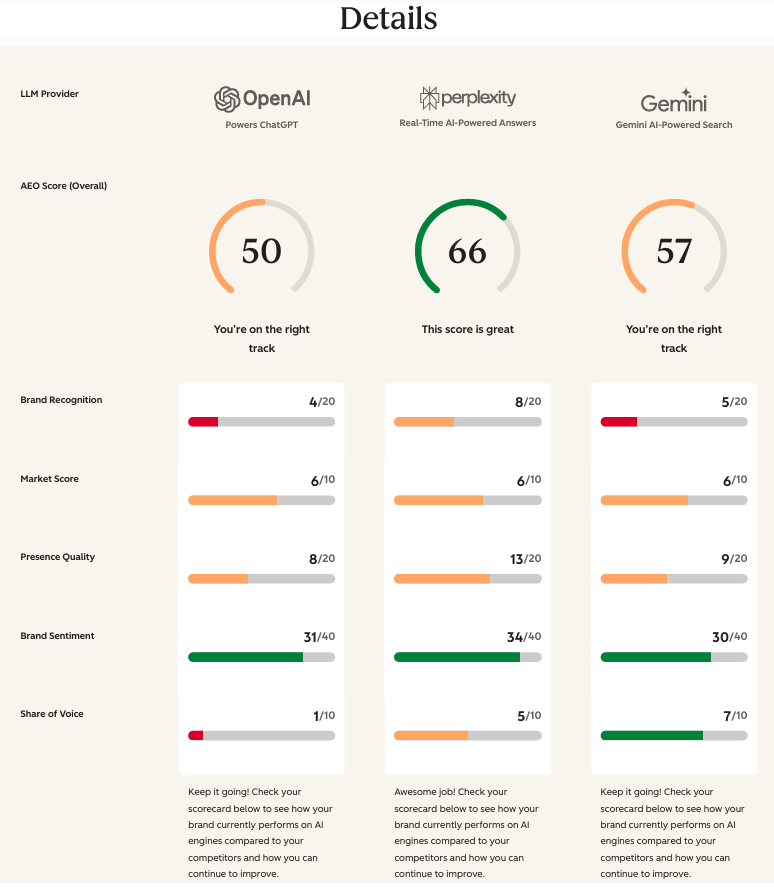
This tool doesn’t look at keywords or backlinks. Instead, it looks at how AI engines “understand” your brand, and how likely they are to feature your business in answers across engines like ChatGPT, Gemini, and Perplexity.
The Five Factors Behind Your AI Visibility Score
The AEO Grader scores your visibility out of 100 points
The AEO Grader scores your visibility out of 100 points, weighted across five dimensions:
Sentiment Results (40 points)
The tone and credibility of how AI describes your brand. This carries nearly half the total score, so it’s the single biggest lever.
Presence Quality (20 points)
How substantive and well-sourced your AI presence is, thin or unverifiable mentions score lower than detailed, well-cited ones.
Brand Recognition (20 points)
How widely your brand is recognised within AI training data.
Share of Voice (10 points)
How your brand ranks competitively against others in your space.
Market Competition (10 points)
Your competitive positioning classification within your market.
This weighting reflects the tool’s current scoring model, HubSpot has already revised this once since launch, so it’s worth a quick re-check against the live tool before publishing.
What Your Score Actually Means
- 70–100: your brand is well-represented across AI answer engines.
- 40–69: you’re showing up, but with meaningful gaps to close.
- Below 40: your brand is significantly under-represented in AI search, the tactics below are your starting point.
AEO vs SEO: What’s Different, What’s the Same?
It’s easy to assume that if you’re doing well in SEO, you’ll automatically perform well in AEO.
But that’s not always true. While they overlap in some areas, AEO (Answer Engine Optimisation) and SEO (Search Engine Optimisation) are built for different purposes, and they’re scored by different systems.
Here’s a breakdown of where they align and where they split.
What’s the same
- Content quality still matters: Both SEO and AEO reward clear, helpful, trustworthy content.
- Technical foundations are critical: Fast-loading pages, crawlable content, and structured metadata help both humans and machines interpret your site.
- Topical authority plays a role: Being known for a specific niche improves your rankings in both traditional and AI-generated search.
What’s different
- SEO ranks pages. AEO ranks ideas and entities: Google’s algorithms rank web pages. AI engines like ChatGPT or Gemini don’t work that way, they generate answers based on entities (people, companies, topics) and how well those entities are understood in context.
- SEO relies on structured data. AEO relies on semantic understanding: Schema markup is vital for SEO. For AEO, what matters is whether your brand is talked about in ways AI can interpret (across multiple sources, with consistent, fact-rich language).
- SEO is about winning clicks. AEO is about earning citations: With SEO, your goal is to rank and get the click. With AEO, your brand wins by being mentioned in the answer, even if there’s no click at all.
- SEO is ruled by Google. AEO is platform-agnostic: AEO applies to any AI-powered search (ChatGPT, Gemini, Perplexity, and others). They each train on different data, but they’re all looking for clear, well-supported brand signals.
For the traditional-search side of this shift, see how to rank in Google’s AI Search Overview.
How to Use the AEO Grader Strategically
Using HubSpot’s AEO Website Grader isn’t just about checking your score and moving on.
To get real value, you need to treat it like a diagnostic tool that helps you shape how AI engines describe, interpret, and surface your brand.
Here’s how to get the most out of it.
Step 1: Set the right inputs
When you use the grader, you’ll be asked to enter:
- Your brand name
- Your industry
- Your geographic market (e.g. Australia, US, UK)
Make sure you use the name your customers and the wider internet know you by, not your legal name or internal abbreviation. This helps the tool pull relevant data AI engines would realistically use.
Step 2: Read the scorecard, not just the score
The tool gives you an overall AEO Score, but the real insights are in the breakdown:
- Are you lacking in Brand Recognition? That’s a visibility issue.
- Is your Presence Quality low? You may need better content structure and external validation.
- Is your Brand Sentiment neutral or mixed? That suggests reputation-building work is needed.
- How do your Market Score and Share of Voice compare to competitors?
Each of these tells a different story and points to a different area to prioritise.
Step 3: Benchmark and monitor
Run the grader every quarter (or monthly if you’re actively improving).
Compare your scores over time, and against close competitors. You’ll begin to see how your content and PR efforts impact your AEO presence.
You can also track changes when:
- Launching a rebrand
- Publishing a high-authority piece of content
- Being featured in major media or industry roundups
- Partnering with known brands
In short: don’t treat the grader as a one-time check. Use it as a directional compass to guide how you show up in AI-powered discovery.

Home arrow Learn 5 Common SEO Problems and How to Solve Them
How to Improve Your AEO Visibility
Improving visibility in AI-generated answers takes more than SEO tweaks, it’s about making your brand easy to understand, reference, and trust. The grader’s scoring maps to five concrete actions:
Here’s how to do it.
1. Structure your content for clarity, not just clicks

AI engines favour well-structured, direct content. That means:
- Use clear subheadings, bullet points, and concise answers
- Add Q&A-style sections (FAQs) to explain your services, process, pricing, etc.
- Create “What is” or “How to” content around core topics you want to be known for
- Keep your brand messaging consistent across your site and external sources
2. Strengthen your brand entity
Large Language Models rely on clear signals to understand what your brand is.
Help them by:
- Ensuring your brand has a dedicated About page with detailed info
- Including bios and structured data for key people on your team
- Listing your brand in reputable directories and marketplaces
- Securing high-quality backlinks from authoritative sources in your niche
3. Build external credibility, not just internal content
AI doesn’t just read your website, it pulls from a web of sources.
Your brand needs to be mentioned and cited:
- Get featured in articles, guest posts, roundups, and interviews
- Encourage satisfied clients to mention your brand in testimonials or reviews
- Partner with influencers or experts in your field to co-create content
4. Optimise for multiple answer engines
Different AI platforms use different models and data sets. Some prioritise web citations, others lean on knowledge graphs, and others on platforms like Reddit.
To broaden your reach:
- Submit data to platforms like Reddit
- Use schema markup (like “sameAs” for brand aliases) to connect your digital footprint
- Monitor how your brand appears across tools like ChatGPT, Perplexity, and Gemini over time
5. Focus on sentiment and trust signals
AI won’t feature you if the overall conversation about your brand is negative or unclear.
Maintain a positive digital footprint by:
- Addressing bad reviews or feedback publicly and transparently
- Creating helpful, non-promotional content that educates your audience
- Being consistent in tone, branding, and claims across platforms
The Future for AI Answer Search
As AI continues to reshape how people discover information, we’re heading toward a future where answer engines could rival or even replace traditional search for many queries.
Understanding this shift is essential if you want to stay ahead and make your brand a trusted source in the eyes of AI.
Here’s some of the key trends to watch out for:
| Trend | What It Means |
| AI answers replacing traditional search | More queries will be answered directly by AI, reducing reliance on link-based results |
| Mentions outweigh backlinks | AI engines favour consistent brand mentions over traditional backlink signals |
| Authority is inferred, not assigned | Trust is based on clarity, context, and how others speak about your brand,not domain authority |
| Zero-click experiences will rise | Visibility within AI answers will matter more than getting clicks; being cited is the real win |
| AEO tools become standard in strategy | Tools like HubSpot’s AEO Grader will join the SEO stack to guide content that performs in AI search |
Ongoing AI Visibility Monitoring
RedPandas supports clients beyond the initial grader check, we offer ongoing monitoring and consultation to make sure recommendations are implemented and AI visibility keeps improving over time.
Talk to Our HubSpot Team
Related Reading
The Ultimate Guide to SEO
How to Rank in Google’s New AI Search Overview
5 Common SEO Problems and How to Solve Them
Can Users Recognise AI Written Content & What Should You Do About It?
Is AEO Replacing SEO?
What is HubSpot?
What Does HubSpot Do? (The Ultimate 2025 Guide)
Frequently Asked Questions: HubSpot AEO Grader
What is HubSpot’s AEO Grader?
It’s a free tool that scores how well AI answer engines like ChatGPT, Gemini, and Perplexity recognise and represent your brand, out of 100 points across five weighted factors.
How does HubSpot’s AEO Grader work?
You enter your brand name, industry, and market; the tool then checks how AI models describe your brand and scores you on sentiment, presence quality, brand recognition, share of voice, and market competition.
Is HubSpot’s AEO Grader free?
Yes. It’s a free, one-time check, you don’t need a HubSpot account to run it, and results are typically ready in under two minutes.
Is the AEO Grader the same tool as the AI Search Grader?
Yes. HubSpot’s AEO Grader was rebranded to AI Search Grader; the underlying tool and purpose are the same, though the scoring model has been updated since the original launch.
What’s the difference between SEO and AEO?
SEO ranks web pages in search results; AEO (Answer Engine Optimisation) focuses on whether AI tools like ChatGPT, Gemini, and Perplexity mention and accurately represent your brand when generating an answer.
How often should I re-run the grader?
Quarterly at minimum, monthly if you’re actively working on your AI visibility, AI models re-crawl and update their understanding of your brand on an ongoing basis, so a single check goes stale quickly.
Start Improving Your AI Search Visibility Today
Ranking in AI search is an ongoing process, not a one-time fix. Run HubSpot’s AEO Grader, act on what it surfaces, and re-check your score regularly as AI models update what they know about you.
Talk to Our HubSpot Team



Get the best content marketing insights right in your inbox!
Subscribe to our Newsletter and get marketing insights delivered to your inbox every week.