








HubSpot vs ActiveCampaign, Zoho, Pipedrive, and Salesforce: The Australian Business Guide (Hubspot Comparison)

Key Takeaways
- HubSpot suits businesses wanting marketing, sales, and service on one connected platform, with pricing from free through to roughly AU$2,330 a month for its top-tier Content Hub plan
- Salesforce suits complex, high-growth sales operations, starting around AU$35 per user per month for Starter Suite, rising sharply at the Professional and Enterprise levels
- Zoho CRM remains the strongest budget pick, from roughly AU$22 to AU$28 per user a month, with Zoho One bundling 45-plus apps from around AU$60.50 per employee a month
- Pipedrive suits sales-only teams, from around AU$27 per user per month, with no built-in marketing automation
- ActiveCampaign and EngageBay round out the small-business alternatives, trading some polish for lower entry pricing
- All three major platforms, HubSpot, Salesforce, and Zoho, now offer Australian data hosting, so local data residency is no longer a clear differentiator between them
- Onboarding fees and currency exposure matter as much as the sticker price, particularly for HubSpot, Salesforce, and Pipedrive, which largely bill in USD above their entry tiers
- The right choice depends on team size, sales motion, and in-house technical capacity, not on which platform has the biggest name or the longest feature list
Up to 70 per cent of CRM implementations fail to meet their original goals, largely due to team misalignment rather than any flaw in the software itself.
It just so happens that most of those failures trace back to the decision stage.
Maybe that’s where you are right now; in fact, you’ve probably taken a good look at HubSpot, but you keep second-guessing because Salesforce and Zoho keep coming up in every review and forum thread.
But despite all that you’ve read, one question remains: which option suits your needs best?
That’s what this guide is for.
At RedPandas, this comparison work happens daily.
As a HubSpot Diamond Partner, the team spends most days inside HubSpot portals. But a good part of the job is rebuilding CRM setups, too.
Businesses bring these over from Salesforce, Zoho, and elsewhere after the first implementation didn’t stick.
That mix of hands-on experience across all three platforms is why this guide leads with the numbers, not a recommendation.
This guide compares HubSpot against Salesforce and Zoho. It also covers lighter alternatives like Pipedrive and ActiveCampaign for smaller teams. You’ll get real Australian dollar pricing and a feature-by-feature breakdown of each platform.
By the end, you’ll know which platform actually fits your team and your budget.
Quick Answer
HubSpot suits Australian businesses that want marketing, sales, and service tools built to work as one connected system, with pricing from free up to roughly AUD $2,330 a month for its top-tier website software alone.
Salesforce suits businesses planning fast growth or complex sales operations, starting around AUD $35 per user per month for its Starter Suite.
Zoho CRM is the strongest budget alternative, with Standard plans from roughly AUD $22 to AUD $28 per user per month.
Pipedrive is the leanest option for sales-only teams, priced at around AUD $27 per user per month with no marketing automation included.
HubSpot vs Salesforce vs Zoho: A Feature-by-Feature HubSpot Comparison
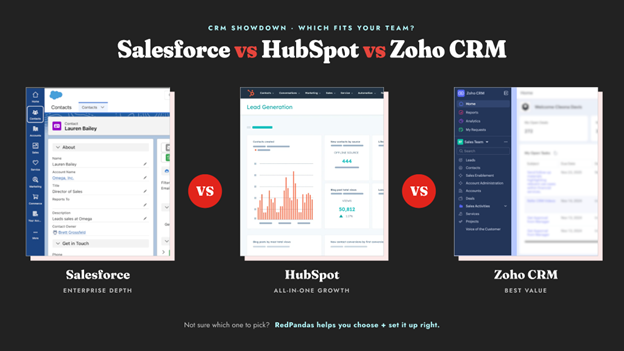
Pricing only tells part of the story. This HubSpot comparison table looks at how each platform actually performs once your team is using it daily.
| Dimension | HubSpot | Salesforce | Zoho CRM |
| Ease of use | G2 Ease of Use score is around 8.7/10. Teams without a dedicated CRM admin often onboard within weeks. | Most powerful of the three, but also the most involved to set up. Enterprise rollouts commonly take three to six months, with a dedicated admin considered essential. | Quicker initial setup for small to mid-sized teams, thanks to simpler configuration and visual automation tools. Less polished than HubSpot but not difficult to learn. |
| Automation and AI | Breeze AI includes 20+ agents across hubs (rep assistance, prospecting, support automation), billed on a usage credit system on top of your subscription. | Agentforce and Einstein offer the deepest automation potential of the three, especially when paired with Salesforce Data Cloud. That depth adds setup and governance work. | Zia AI handles predictions, anomaly detection, and workflow suggestions. Rated strong for the price, though less refined than HubSpot’s or Salesforce’s AI stacks. |
| Integrations and ecosystem | App Marketplace lists roughly 500 native integrations, covering tools like Slack, Zoom, and QuickBooks. | 1,000+ native integrations, with the AppExchange marketplace listing thousands more third-party apps. | Fewer standalone third-party integrations, but Zoho One bundles 45 to 55-plus native business apps (CRM, finance, HR, support) under one subscription. |
| Support model | Free and Starter tiers don’t include 24/7 support. Professional and Enterprise tiers do. | Standard support included by default. Premier Success plans cost roughly 20 to 30% of licence fees for faster response times. | Standard 8×5 support on all paid plans. Premium adds 24/5 live chat and phone. Enterprise adds full 24/7 coverage. |
HubSpot leads on ease of use and bundled automation, Salesforce leads on depth and customisation, and Zoho leads on features per dollar.
The best option for your business depends on your team size, budget, and how much admin support you have in-house.


HubSpot vs Salesforce: Detailed Feature & Pricing Comparison
Other HubSpot Alternatives for Small Business
The “HubSpot competitors Australia” and “HubSpot alternatives small business” searches often lead people to smaller, more specialised tools than Salesforce or Zoho.
Three come up consistently in this HubSpot comparison for small teams:
Pipedrive
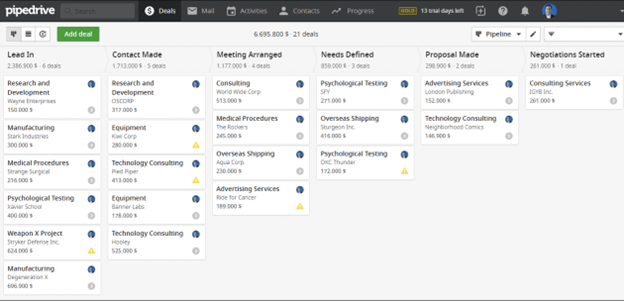
Best for: Sales-only teams that don’t need marketing tools bundled in
Pipedrive skips marketing automation almost entirely. There’s no built-in email campaign builder or landing page tool, and connecting one usually means adding Zapier or a dedicated email platform.
What it does well is the sales pipeline itself. Reviewers consistently rate its visual, deal-focused interface as one of the most intuitive on the market, which tends to mean reps actually use it.
ActiveCampaign
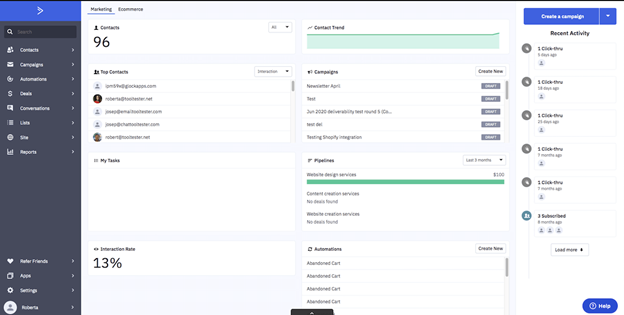
Best for: Small teams that live in email marketing and want deep automation without HubSpot’s per-hub pricing.
ActiveCampaign starts at roughly ~AUD $21/month for 1,000 contacts on its Starter plan, rising to around AUD $70/month for Plus, which adds the built-in CRM and sales automation.
Pricing is contact-based rather than flat, so costs climb as your list grows. Some pricing guides note the Starter plan can reach roughly ~AUD $213/month once you cross 10,000 contacts, at which point the Plus plan often works out to better value for the extra automation you gain.
EngageBay
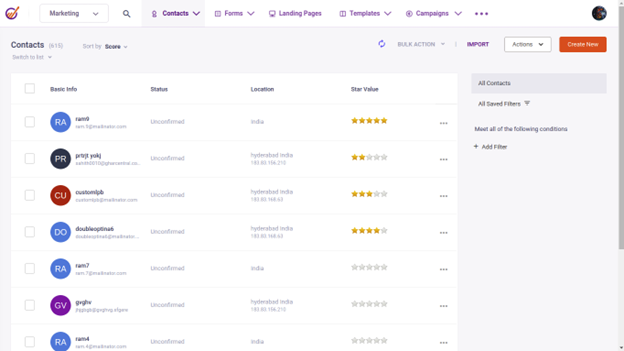
Best for: small businesses wanting HubSpot’s all-in-one structure without HubSpot’s price jump between tiers.
EngageBay is one of the few tools genuinely built to look like a smaller HubSpot. It bundles CRM, email marketing, marketing automation, landing pages, live chat, and a help desk into one platform.
The free plan covers up to 250 contacts. Paid tiers start around AUD $21/month and scale up to roughly AUD $143 to AUD $171/month on the top tier, depending on billing term.

5 Mistakes B2B and Industrial Businesses Often Make When Choosing a CRM
How to Choose the Right CRM
Everything covered so far in this HubSpot comparison points to one conclusion: the right platform depends on your team, not on which vendor has the loudest marketing.
Here’s everything worth keeping in mind before choosing a platform to work with:
Five Questions to Ask Before You Decide
Work through these before committing to any platform:
- “How many people need access, and what do they do day to day?”: Marketing and sales working together points toward HubSpot or Zoho. Sales only points toward Pipedrive
- “What’s your realistic three-year cost, not just the sticker price?”: Factor in onboarding fees, per-seat increases, and add-ons, not only the entry-level number
- “How much do you need it to connect to your other tools?”: Check whether your accounting, email, and support tools have native integrations or need Zapier as a middle layer
- “Do you have in-house technical capacity?”: Salesforce generally needs a dedicated admin. HubSpot and Zoho are built for teams without one
- “Will this still fit in three years, not just today?”: A tool that’s perfect for five people can become expensive or limiting at fifty
Test Before You Commit
Every platform in this HubSpot comparison offers a way to try before you buy:
- HubSpot has a permanent free CRM tier, plus trials on its paid Professional and Enterprise tiers
- Salesforce offers a 30-day free trial of its paid editions
- Zoho CRM has a free tier capped at three users, alongside trials on paid plans
- Pipedrive gives full feature access for 14 days, with no credit card required
Load real data into your top two candidates before deciding. A short pilot with your actual contacts and deals reveals adoption issues that a feature list never will.
Planning a Migration
If you’re switching platforms rather than starting fresh, budget two to four months for the move.
Successful migration experiences usually start with a full data audit: export contacts, deals, activities, and custom fields, and clean up duplicates before you migrate, not after.
Most platforms, including HubSpot, Salesforce, and Pipedrive, offer native import tools for CSV files and common CRM exports. Run your old and new systems in parallel for at least one billing cycle before switching over completely.
Here’s a guide on what to watch out for if you’re thinking about migrating from Pipedrive to HubSpot.
Frequently Asked Questions: HubSpot Comparison
What are the best HubSpot alternatives for small businesses?
Zoho CRM, Pipedrive, ActiveCampaign, and EngageBay are the strongest HubSpot alternatives for small businesses. Zoho offers the broadest features per dollar, Pipedrive suits sales-only teams, ActiveCampaign favours automation-heavy marketers, and EngageBay mirrors HubSpot’s all-in-one structure at a lower price. The right pick depends on budget and whether you need marketing tools alongside sales.
Is Salesforce better than HubSpot?
Neither platform is universally better. Salesforce suits large or complex sales organisations needing deep customisation and access to over 1,000 integrations. HubSpot suits small to mid-sized businesses wanting a simpler setup and bundled marketing tools. For teams under 50 reps, HubSpot commonly works out to be simpler and more cost-effective.
Is Zoho cheaper than HubSpot?
Yes, in most cases. Zoho CRM starts from around AUD $22 to AUD $28 per user per month, compared with HubSpot’s paid tiers starting around AUD $24 and rising sharply at the Professional and Enterprise levels. Zoho One also bundles 45-plus apps from roughly AUD $60.50 per employee per month, undercutting HubSpot’s per-hub pricing.
What is the best HubSpot competitor in Australia?
There’s no single best HubSpot competitor in Australia, since Salesforce, Zoho, and Pipedrive each lead in different areas. Salesforce suits complex enterprise sales teams, Zoho suits budget-conscious small businesses, and Pipedrive suits sales-only teams. All three now offer Australian data hosting, matching HubSpot’s own Sydney data centre.
How much does HubSpot cost in Australia?
HubSpot’s free CRM costs nothing, with paid tiers starting around AUD $24 per seat per month for Starter. Costs rise sharply at the Professional and Enterprise levels depending on the hub, reaching AUD $2,330 or more per month for the top-tier Content Hub. Billing is in USD, so your AUD cost shifts with the exchange rate.
Can I switch from HubSpot to another CRM easily?
Switching is possible but takes planning. Budget two to four months for migration, starting with a full data export and cleanup of contacts, deals, and custom fields. Most platforms, including Salesforce, Zoho, and Pipedrive, offer native import tools. Run both systems in parallel for one billing cycle before cutting over fully.
Which CRM is best for a small business in Australia?
For most small Australian businesses, HubSpot’s free CRM or Zoho’s Standard plan, from around AUD $22 to AUD $28 per user per month, offer the best starting point. Choose HubSpot if you need marketing tools alongside sales. Choose Zoho if budget is the priority and you’re comfortable with a steeper learning curve.
Is there a free HubSpot alternative?
Yes. Zoho CRM offers a free tier for up to three users, EngageBay offers a free plan for up to 250 contacts, and HubSpot itself has a permanent free CRM tier with unlimited users. Each free tier limits automation and advanced reporting, so budget for a paid upgrade as your business grows.
Your Next Move After This HubSpot Comparison
This HubSpot comparison started with a fair question: is HubSpot actually worth it, or would your business be better off elsewhere?
The honest answer is that it depends on what you’re running:
- HubSpot wins for businesses wanting marketing and sales connected on one platform
- Salesforce wins when your sales process is too complex for a simpler tool to handle
- Zoho wins when budget matters more than polish
- Pipedrive wins when you don’t need marketing automation at all
None of these platforms is the wrong choice in the abstract. Each one is the wrong choice for a specific type of business, and the right choice for another.
If you need expert help gauging which CRM works best for your business and needs, our growth experts are here to help. Book a free consultation call through the link below to get the clarity you need to make the best decision possible.

Get In Touch With Our Growth Experts
About the Author
The team at RedPandas Digital, a HubSpot Diamond Solutions Partner based in Sydney, Australia, wrote this article. RedPandas is one of a small number of agencies accredited under HubSpot’s Partnered Scale Onboarding programme, and has delivered results including a 49.8% revenue increase and 378% lead growth within five months for an Australian client.
About the Author




Get the best content marketing insights right in your inbox!
Subscribe to our Newsletter and get marketing insights delivered to your inbox every week.