









Best HubSpot Use Cases By Industry

Key Takeaways
- Match HubSpot to your industry. Generic setups create low adoption and vague reporting, regardless of company size
- The CRM creates shared context. Marketing, sales, and service work from the same contact record and the same lifecycle definitions
- B2B services firms need visibility. Long, non-linear sales cycles benefit most from stage tracking and structured handoffs to delivery
- SaaS businesses need timing and signals. Trial-to-sales handoffs, churn flags, and acquisition-to-revenue tracking drive the biggest gains
- Manufacturers need deal clarity. Long cycles and distributor-led revenue are easier to manage when pipeline data separates direct from partner deals
- Regulated industries need controlled coordination. Healthcare and education providers benefit from enquiry tracking and reporting, not aggressive automation
- Start with one breakdown point. Pick where revenue or handoff currently fails, then build your HubSpot workflows around fixing it
Stop me if you’ve heard this one before.
You invest in HubSpot because you want clearer reporting, better leads, and tighter alignment between marketing and sales.
A few months later, the CRM is full of half-used records, sales are still complaining about lead quality, and leadership is asking the same question again: “So… what return are we actually getting from this?”
This usually isn’t a HubSpot problem. It’s a use-case problem.
Most teams try to use HubSpot the same way, regardless of industry. But the problem is that a B2B service business, a SaaS company, a manufacturer, and a healthcare provider all have very different customer journeys.
When your workflows don’t match how your buyers actually behave, HubSpot customer relationship management turns into a glorified contact database instead of a revenue engine.
Here’s the good news: when HubSpot is applied properly by industry, it works extremely well.
You’re likely to see higher CRM adoption from sales, clearer attribution for marketing, and reporting that finally makes sense to leadership. This is all because you’ll end up using the right ones for how your business really operates.
In this article, you’ll learn the best HubSpot use cases by industry and how different types of businesses use HubSpot to generate better leads, shorten sales cycles, and turn customer data into decisions you can actually trust.
Quick Answer
HubSpot delivers the strongest ROI when its workflows match how your industry actually buys and sells, not a generic setup.
B2B services firms benefit most from visible long sales cycles and structured handoffs to delivery.
SaaS businesses benefit from trial-to-sales timing and early churn signals.
Manufacturers and regulated industries such as healthcare and education benefit from distributor visibility and controlled enquiry tracking rather than heavy automation.
What HubSpot Actually Is Today
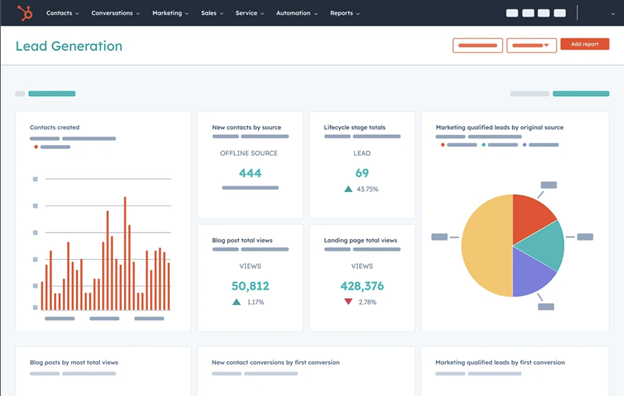
Before you can judge whether HubSpot is working, you need to be clear on what it’s designed to do now, not what it was known for years ago.
Many teams still approach HubSpot as if it were a marketing tool that happens to include a CRM. That assumption quietly shapes every decision they make, from setup to reporting.
And this is usually where things start to go wrong.
Here are a few things you need to know to get a more accurate idea of what HubSpot is today and how it can help your business:
The CRM as the Foundation
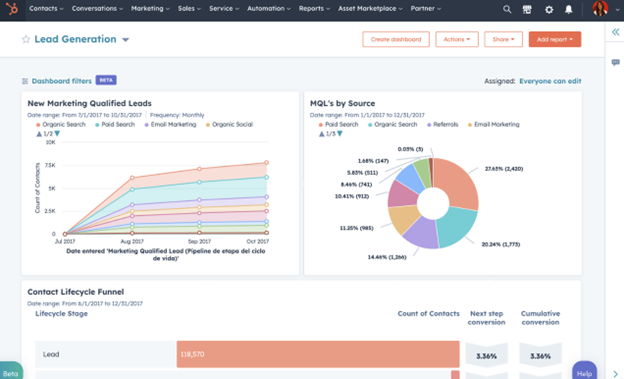
Generally, it helps to think of HubSpot customer relationship management like the foundations of a building.
You don’t admire them, and they’re not what people notice first… but if they’re weak, everything above them starts to crack.
At its most basic level, the CRM exists to create shared context across your business to stop teams working from different versions of reality. And when that foundation is in place, a few important things become possible:
- Marketing, sales, and service all see the same contact record, rather than maintaining their own spreadsheets, notes, or side systems. This removes the “that’s not what I see” conversations
- Lifecycle stages mean the same thing to everyone, so a “qualified lead” isn’t just a label, but a clear handover point with agreed criteria
- Revenue discussions are based on behaviour, not opinion, because activity history, deal progress, and outcomes all live in one place
The practical outcome is simple: decisions get faster, and arguments are minimised. Without this layer, even the best campaigns or sales processes struggle to scale.


How to Align Your Sales and Marketing Teams Using HubSpot
The Hubs Exist to Remove Friction, Not Add Complexity
Once the CRM foundation is stable, the Hubs come into play. Each one is designed to address a specific type of friction that appears as businesses grow:
| HubSpot Hub | Type of Friction it Aims to Solve |
| Marketing Hub | Reduces friction at the top of the funnel by capturing intent, qualifying interest, and passing context to sales, rather than just raw leads. Marketing Studio extends this further. It uses AI to plan campaigns and build assets in one shared workspace, instead of switching between tools. |
| Sales Hub | Reduces friction inside the pipeline by helping reps prioritise the right deals, follow a repeatable process, and avoid chasing low-probability opportunities. |
| Service Hub | Reduces friction after the sale by making support visible, structured, and measurable, while surfacing signals for retention and expansion. |
| Operations Hub | Reduces friction behind the scenes by keeping data clean, synced, and trustworthy as more tools and integrations are added. |
| Content and Commerce Hubs | Reduce friction for buyers who want to self-educate, self-serve, or move faster without waiting for manual steps. |
These tools only add value when they’re introduced to solve a specific problem. Turning everything on at once is like buying every tool in the shop before you know what you’re building.
HubSpot Use Cases For B2B Services And Professional Services Firms
B2B services businesses generally need to sell trust before they sell outcomes because buyers take longer to decide, involve more people, and need reassurance at every step.
That means your CRM can’t just function as a database: it also needs to work as a system that holds the story of the relationship.
When HubSpot customer relationship management works well in this industry, it consistently reduces uncertainty for everyone involved.
See, B2B services businesses rely on long-term relationships, not one-off transactions. Sales cycles are slower, decisions involve more scrutiny, and value is often delivered well after the deal is signed.
And because of that, HubSpot customer relationship management only works when it supports continuity and clarity across the entire journey.
Here are the use cases that can deliver the most value in professional services environments:
| Use Case | What It Solves | How HubSpot Delivers It | Outcome |
| Pass sales leads clearly ready for a real conversation | Marketing and sales lack shared criteria for “ready,” leaving qualification open to interpretation | A small set of fit criteria (company type, service relevance) combines with limited intent signals, surfaced on the contact record before handoff | Sales trusts why a lead was passed, CRM usage rises, and marketing gets actionable feedback instead of vague complaints |
| Keep long sales cycles visible so deals don’t quietly stall | Professional services deals move slowly and rarely follow a linear path, so visibility matters more than speed | – Deal stages reflect actual buyer actions – Key interactions log automatically – Stalled deals surface without manual analysis | Sales leaders spot slowdowns early, reps pick up conversations without relying on memory, and forecasting improves over time |
| Ensure structured handoff from sales to delivery | Risk spikes the moment a deal closes if delivery teams lack full context on what was sold | – A minimum standard applies before close – The client’s primary objective, agreed scope, key stakeholders, and known risks or sensitivities | Delivery teams start engagements with clarity, improving onboarding, protecting margins, and reducing early churn |

Cordell Connect & HubSpot Integration
For professional services firms, HubSpot delivers value by bringing discipline to how work moves between teams.
The strongest setups focus on shared definitions, consistent handoffs, and reliable visibility across the full lifecycle of a client relationship.
When lead qualification is clear, sales activity is visible, and delivery teams inherit real context, your HubSpot portal stops being something people tolerate and starts being something they depend on.
HubSpot Use Cases For SaaS And Subscription-Based Businesses
Usually, SaaS businesses don’t struggle because they lack data: they struggle because the right data isn’t reaching the right team at the right moment.
When marketing, sales, product, and customer success all work from partial views, decisions become reactive instead of intentional.
But if you use it properly, a HubSpot portal can act like a shared control panel.
Everyone sees the same signals, understands what stage a customer is really in, and knows when to step in… and when to stay out of the way.
The HubSpot use cases below focus on outcomes SaaS leaders actually care about: better timing, smoother handoffs, reduced churn, and clearer revenue insight.
These use cases focus on the outcomes SaaS leaders care about most: better timing, smoother handoffs, reduced churn, and clearer revenue insight.
| Use Case | What It Solves | How HubSpot Delivers It | Outcome |
| Routing trial users to sales at the right moment | Sales teams need to engage leads only when it improves conversion odds, without acting on guesswork | Trial start data, key in-product actions, and marketing engagement history come together in one place, letting sales define clear rules for when a user is sales-ready | Better-timed outreach avoids disrupting evaluation and stops high-intent users slipping through unnoticed |
| Identifying churn risk early using lifecycle data | Churn follows a pattern: engagement drops, support issues rise, or key milestones get missed | – Lifecycle stages get tracked beyond closed-won – Engagement, support, and communication data centralise – Accounts needing proactive attention get flagged. | Customer success teams act early instead of reacting once renewal is already at risk |
| Linking acquisition channels to long-term subscription revenue | The real question isn’t where a lead came from, but which sources produce customers who stay and grow | Original acquisition source, sales motion, activation speed, and renewal/expansion data connect in one system | Leadership invests more confidently in channels and motions that produce durable revenue |

Is HubSpot Right for My Business? Here’s How to Tell
For SaaS businesses, HubSpot delivers value when it connects decisions across the lifecycle, not when it’s treated as a series of isolated tools.
Trials, sales conversations, onboarding, and retention all influence the same outcome of predictable, recurring revenue… And they need to be visible to the same teams.
When your HubSpot portal is configured around these outcomes, your teams can stop working separately and start working with full collaborative effort.
HubSpot Use Cases For Manufacturing And Industrial Businesses
Manufacturing and industrial businesses don’t struggle because their sales processes are outdated.
They struggle because their processes are complex, slow-moving, and involve more people than most CRMs are designed for out of the box.
When HubSpot works in this industry, it’s often because it gives teams shared visibility across long timelines, layered decision-making, and fragmented channels.
The most effective HubSpot use cases for manufacturing and industrial businesses focus on making long, complex deals easier to manage:
| Use Case | What It Solves | How HubSpot Delivers It | Outcome |
| Making long sales cycles easier to manage and forecast | Long sales cycles only become a problem when momentum is hard to assess | – Deal stages reflect real buying milestones instead of internal sales activity – Inactive opportunities surface instead of blending in with active ones – Full communication history stays intact over time | Sales leaders can see why deals sit in the pipeline, beyond just how many there are |
| Creating clear visibility across distributor and partner-led deals | Manufacturers selling through third parties struggle to see where revenue actually comes from | – Direct and partner-led opportunities separate within the pipeline – Distributor-submitted opportunities and their progress get tracked – Partner contribution reports use closed revenue instead of assumptions | More productive partner conversations and more reliable internal planning |
| Connecting marketing activity to real revenue outcomes | Industrial marketing supports trust, education, and timing rather than high-frequency conversion | – Engagement with technical resources, product information, and documentation gets tracked – Buying signals surface when prospects re-engage after long gaps – Closed deals attribute back to the marketing activity that influenced them | Marketing leaders can demonstrate impact using deal-relevant data instead of volume-based metrics |

Penrith Solar & Becoming the Most Trusted Voice in the Industry
For manufacturing and industrial businesses, the value of HubSpot lies in clarity, not acceleration.
When sales teams can see who’s involved, where deals truly stand, and which activities influence revenue, decision-making improves at every level. CRM adoption becomes more natural because the system reflects reality, and leadership gains confidence in forecasts because they’re grounded in observable progress.
HubSpot Use Cases For Healthcare, Education, and Regulated Industries
Regulated industries tend to approach CRM with caution, and that instinct is usually earned.
When data sensitivity, compliance, and trust are part of the equation, the cost of getting things wrong is much higher than the cost of moving slowly.
Now, your HubSpot portal can still play a valuable role here, but only when it’s treated less like a growth engine and more like a controlled coordination system.
If HubSpot is implemented with restraint and intent, it can solve coordination problems without becoming a repository for sensitive data. The following use cases focus on process clarity and accountability, not aggressive automation:
| Use Case | What It Solves | How HubSpot Delivers It | Outcome |
| Capture and route enquiries quickly, without storing sensitive information | The first interaction often decides whether trust is built or lost. Delayed or inconsistent responses create doubt early. | – Captures only essential contact details and enquiry type – Auto-assigns ownership – Ensures every enquiry is acknowledged within a set timeframe | Your portal manages flow and accountability at this early stage, without over-collecting detail you don’t need yet |
| Maintain full interaction history for consistent, informed follow-up | In healthcare, education, and similar sectors, decisions span weeks or months, and prospects deal with multiple people across departments. | – Logs every email, call, meeting, and note against one record – Gives any authorised team member instant context – Preserves continuity through reassignments or staff changes | A complete relationship view, no reliance on personal inboxes or memory, and no conflicting messages to prospects |
| Track enquiry-to-outcome performance for planning and oversight | Leadership needs visibility, but reporting shouldn’t create pressure that distorts behaviour | – Tracks conversion from enquiry to appointment, enrolment, or approval – Monitors volumes over time – Tracks sources to support audits, funding, or compliance reviews. | Reporting shows real capacity and effectiveness, turning it into a genuine strategic planning tool |

5 Benefits of Using HubSpot to Grow Your Business
In regulated industries, HubSpot works best when it is used as a coordination system instead of a catch-all database.
By focusing on enquiry handling, continuity, controlled access, and responsible reporting, organisations can use the CRM to improve efficiency and visibility without increasing risk.
Frequently Asked Questions: HubSpot Use Cases
What are the best HubSpot use cases by industry?
The best HubSpot use cases depend on your industry. B2B services firms use it to track long sales cycles and manage handoffs. SaaS businesses use it to time trial conversions and flag churn risk. Manufacturers track distributor deals, while healthcare and education providers use it for compliant enquiry tracking and reporting.
Is HubSpot good for SaaS companies?
HubSpot works well for SaaS companies when it connects trial activity, sales conversations, onboarding, and renewal data in one system. This lets you time outreach to trial users and flag churn risk before renewal. It also links acquisition channels to long-term subscription revenue instead of treating each stage as separate.
How does HubSpot help B2B services businesses?
HubSpot helps B2B services businesses by making long, non-linear sales cycles visible and standardising handoffs. Deal stages reflect real buyer actions, stalled deals surface automatically, and delivery teams inherit full context before a project starts. This builds trust across long relationships where scrutiny and decision-making involve multiple stakeholders.
Can HubSpot be used in healthcare and education?
Yes. HubSpot can be used in healthcare and education when it’s configured as a controlled coordination system rather than a growth engine. It captures only essential enquiry details and logs every interaction for continuity. It also tracks enquiry-to-outcome performance for oversight, without becoming a repository for sensitive personal information.
Which HubSpot Hub is best for manufacturing businesses?
Manufacturing businesses typically get the most value from Sales Hub and Marketing Hub working together. Sales Hub tracks long, complex deals and separates direct from distributor-led revenue. Marketing Hub connects engagement with technical content to closed deals, giving marketing leaders deal-relevant attribution instead of volume-based metrics.
Do I need a HubSpot partner to set up industry-specific use cases?
You don’t strictly need a partner, but industry-specific HubSpot use cases are easier to configure correctly with one. A HubSpot Diamond Partner like RedPandas Digital has experience mapping workflows to how different industries actually sell. This reduces setup errors and speeds up adoption across marketing, sales, and service teams.
How do I know if my HubSpot setup matches my industry?
Your HubSpot setup matches your industry when workflows reflect how your specific buyers actually behave, not a generic template. Warning signs include low CRM adoption from sales, unclear lead qualification, and reporting that leadership doesn’t trust. Start by mapping one point where revenue or handoff breaks down today.
Make HubSpot Earn Its Place in Your Business
If HubSpot is already in your business, the opportunity is to use it with intent.
Across every industry covered here, the teams that see real returns aren’t doing anything clever or flashy. Instead, they’ve made a clear decision about what HubSpot is for in their business, and they’ve built around that.
If you’re not sure where to start, the next steps are simple:
- Pick one point where revenue or handoff breaks down today.
- Map how that actually works inside your business.
- Decide what HubSpot should make easier, clearer, or more visible.
And if you want help pressure-testing that thinking, or sense-checking whether your current setup is helping or holding you back, feel free to get in touch with our HubSpot experts for a free consultation before you invest.

6 Benefits Of Onboarding with a HubSpot Partner (Instead of HubSpot’s In-House Onboarding)
About This Article
This article was written by the team at RedPandas Digital, a HubSpot Diamond Solutions Partner based in Sydney, Australia. RedPandas has implemented HubSpot for 150+ Australian businesses across B2B services, SaaS, higher education, and professional services. View our HubSpot partner profile here.




Get the best content marketing insights right in your inbox!
Subscribe to our Newsletter and get marketing insights delivered to your inbox every week.