









What Is GEO, and How Can I Get Ahead With It in 2026?

You’ve finally built a marketing engine that works: strong SEO, consistent content, and steady inbound traffic.
But lately, the numbers are slipping.
Organic clicks are down, impressions are unpredictable, and your once-reliable keywords aren’t driving the same results.
Here’s the problem: people aren’t searching the way they used to.
Instead of typing questions into search engines like Google, they’re asking ChatGPT, Perplexity, or the new AI-driven Search Generative Experience (SGE). And those generative engines aren’t just pointing users to links like normal search engines.
Instead, they’re creating answers… which effectively cuts out the search result-surfing that was the foundation of SEO for decades.
This is where Generative Engine Optimisation (GEO) becomes the topic of discussion. It’s considered by many as the next evolution of SEO, designed for a world where visibility is now about being included in the answer itself.
At RedPandas, we’ve spent years helping brands navigate shifts ranging from Google updates to algorithm overhauls.
And here’s what we learned: every search disruption creates two groups of businesses.
Those who adapt early and gain market share, and those who cling to old models and fade from sight.
In this article, you’ll learn exactly what GEO is, why it’s reshaping search in 2026, and how to position your brand at the forefront of this update before your competitors do.
What Is GEO (Generative Engine Optimisation)?

Generative Engine Optimisation (GEO) is the process of optimising your brand and content to be discoverable and cited by AI-powered search engines.
Think of it as the process of ranking on the responses of AI tools like ChatGPT, Perplexity, and Google’s Search Generative Experience (SGE).
Unlike traditional SEO, which focuses on ranking high in a list of search results, GEO focuses on earning a place in the AI-generated answer itself. This usually happens when your brand’s online presence, website, and content are optimised for AI models that understand, summarise, and synthesise information.
When someone asks an AI engine, “What’s the best CRM for small businesses?”, the engine doesn’t return ten blue links.
It generates a single response, often pulling insights from trusted sources, data, and well-structured content.
And if your brand’s expertise feeds that answer, you’re going to win visibility in a whole new way.
To thrive in this new landscape, brands need to:
- Create AI-readable content: structured, factual, and source-backed.
- Build recognisable authority: consistent brand mentions and expertise signals.
- Optimise for intent-rich topics rather than isolated keywords.
Despite what most people fear, the reality is that GEO isn’t replacing SEO. Instead, it’s elevating it.
It’s the bridge between your content and the AI engines that now decide what your audience sees first.


Is SEO Still Relevant in the AI Era?
4 GEO Tips for Better AI Search Discovery
The shift to Generative Engine Optimisation (GEO) is about positioning your brand as a valued resource for AI-powered search engines like ChatGPT, Perplexity, and Google’s Search Generative Experience (SGE).
Here’s how to optimise for AI-driven discovery and start building in-answer authority:
Tip #1: Shift From Keywords to Context
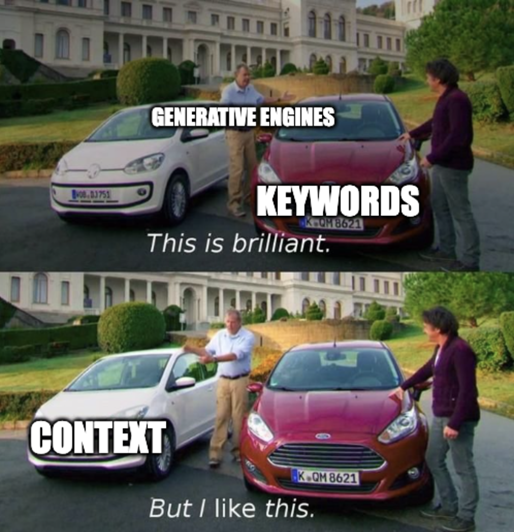
When it comes to adapting to the age of GEO, it helps to think about how people search today.
Traditional SEO is keyword-driven, focused on ranking for specific terms. But generative engines work by understanding context through the relationship between concepts, questions, and answers.
To put it simply, it’s like teaching a child how to answer a question. If you give them just the right words, they’ll repeat them.
But if you give them a well-rounded understanding, they’ll provide a more thoughtful response.
When you focus on context, you’re creating content that AI engines can understand and use to generate accurate answers.
For example, let’s say you’re giving a lecture on a subject. Instead of delivering just a handful of isolated facts, you’re telling a compelling story that ties everything together.
AI engines favour that deeper, more meaningful approach.
The more comprehensive and structured your content is, the better the chances of it being cited by AI-driven engines.
Here are three ways you can adjust your approach to shift from keywords to context and bump up your chances of ranking with GEO:
- Create cornerstone content that answers big questions: Instead of aiming to rank for individual keywords like “best home building options,” develop a comprehensive piece of content like “The Complete Guide to Working With a Home Builder.”
- Provide depth, not just breadth: One well-researched, context-rich piece will likely perform better than ten articles on narrow topics.
- Add supporting articles that build topical clusters: Generative engines look for consistency. When multiple articles on your site explore different angles of the same core topic, it signals expertise.
Think of this like building a spiderweb: the cornerstone content is the centre, and your supporting articles are the strands connecting everything. But to get the best results, these supporting pieces should:
- Answer narrower sub-questions.
- Provide examples or comparisons.
- Link back to the main page for context
This cluster structure helps AI engines “see” the full picture of your expertise, increasing your chances of being referenced in generated responses.

Is Answer Engine Optimisation (AEO) and AI Search Overview Replacing SEO?
Tip #2: Signal Credibility at Every Level
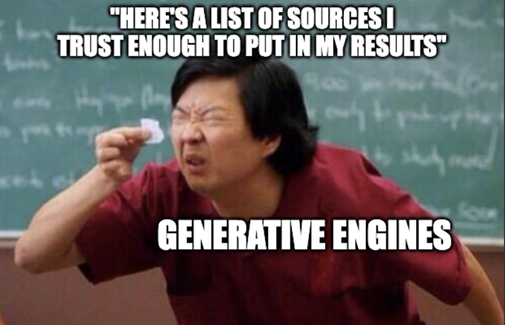
Generative engines don’t just want to understand your content; they need to trust it.
Just like a journalist would rely on multiple sources to write a balanced article, AI engines rely on external signals to determine your brand’s credibility. These signals help them “see” you as an authority on a given topic.
Think of these trust signals as referrals: the more places your content appears, the more likely an AI engine will cite you as a reliable source.
Here’s how to signal credibility:
- Distribute content across credible platforms (LinkedIn, trusted blogs, industry publications): The more authoritative the source, the stronger your trust signal.
- Publish case studies and real-world data: AI engines are drawn to evidence-based content. Think of your content like a courtroom presentation; you need solid proof to back your claims.
- Get featured in credible, third-party sources: Mentions from well-known publications, experts, or influencers are powerful signals of your authority.
Consider this approach as something like building a network. If your peers and industry leaders recognise your expertise, AI engines will too.
More signals lead to more trust.

Can Users Recognise AI Written Content & What Should You Do About It?
Tip #3: Design for Machine and Human Readability

AI-driven engines are still machines… and machines need clear, structured content to understand what’s being said.
Think of it like this: imagine you’re giving a complicated speech to a group of people who don’t speak your language. The clearer and more organised your message, the better the chances they’ll “get it.”
When content is well-structured, AI engines have an easier time processing it.
Here’s how to design your content for both machines and readers:
- Break content into digestible sections using clear headings and subheadings: This helps AI understand how different concepts relate to each other, much like an outline for an essay.
- Answer questions explicitly and directly: When you phrase your content like an FAQ, it’s easier for AI engines to pick up the “question-and-answer” format.
- Keep paragraphs short and scannable: Not only does this improve readability for human readers, but it also helps AI engines process the information more effectively.
By putting these tips into practice, you’re creating a map for both your readers and AI to follow.
The clearer your structure, the easier it is for AI to locate your content and use it.
Tip #4: Invest in Thought Leadership

Remember that originality is key.
Just like how you’d want to stand out in a crowded market, you want to ensure your content adds fresh, valuable insights. The more unique your perspective, the more likely AI engines will feature your content.
After all, if everyone’s saying the same thing… So why would the engine choose you?
Because of this, it helps to invest in thought leadership that brings new ideas to the table.
Think of this as setting the agenda: AI engines will turn to your content when you consistently offer fresh, actionable advice or perspectives that other sources haven’t yet covered.
You can effectively invest in thought leadership and rank higher in GEO results with it by:
- Publishing proprietary research, case studies, and insights: If your brand has access to unique data, make sure it’s front and centre in your content.
- Pushing boundaries by challenging industry norms: Generative engines often highlight content that introduces new ways of thinking, making it more likely your insights will be included in the AI-generated answers.
- Creating explainers that simplify complex ideas without dumbing them down: One of the biggest blind spots in thought leadership today is complexity. When you simplify complex ideas into plain-English explanations, you become a go-to source for AI engines trying to understand and teach those concepts.
When you break down complicated industry topics into clear, digestible insights, AI models use your explanations to “fill the gaps” in their training data.
These simplifying explainers could include:
- Breaking down jargon-heavy concepts.
- Translating technical processes into step-by-step frameworks.
- Visual metaphors and analogies that make ideas click.
By putting out more thought leadership pieces, you’re not just producing content. You’re shaping the conversation and influencing what’s said in the AI-generated responses.
When it comes to Generative Engine Optimisation (GEO), the stakes are higher than ever.
If you focus on context, credibility, readability, and originality, you won’t just survive the generational shift in search… You can thrive in it.
By embracing these strategies today, you’ll set your brand up for success in the AI-powered search world of 2026 and beyond.
Is GEO the Next Evolution of SEO?
In 2026, how your brand gets found could look very different from how it does today.
Generative Engine Optimisation (GEO) is here, and it’s reshaping the search landscape… and it’s a huge opportunity for businesses that take action now.
If you wait, you could risk falling behind as generative engines become the dominant way consumers find answers, products, and services.
And the longer you put off adapting, the more you’ll lose in terms of visibility, credibility, and trust.
But don’t worry. It’s not too late to get ahead.
You can start preparing your business for GEO by ensuring your content is built with clarity, structure, and authority. Focus on providing direct answers, backing them up with trusted sources, and making your content easy for AI engines to parse and cite.
This way, you’re not just writing for humans anymore; you’re writing for machines that will amplify your voice.

The Ultimate Guide to Generative AI In Marketing




Get the best content marketing insights right in your inbox!
Subscribe to our Newsletter and get marketing insights delivered to your inbox every week.