








How to Use Loom Videos to Personalise 1:1 Sales and Shorten Your Pipeline

Picture this: your team’s sending emails, sequences, and LinkedIn messages… and barely anyone replies.
Your prospects are drowning in noise, your sales cycle keeps stretching, and every touchpoint feels like you’re fighting just to be noticed. And even though you know personalisation matters, the idea of adding one more thing to your team’s workflow feels exhausting.
Here’s the real problem: your buyer doesn’t need more information. Instead, they want to feel like you actually understand what they care about, not that you’ve copied and pasted text into another outreach template.
That’s exactly why 1:1 Loom videos work.
They cut through the noise because they feel human, quick, and direct.
And despite what most people think, you don’t need fancy equipment, a perfect script, or “video confidence” to make them effective.
We’ve worked with teams who were convinced video was “too awkward” or “too time-consuming”, only for them to discover their first Loom took 60 seconds and got a reply in minutes.
Once they had a simple framework, everything clicked… and their outreach suddenly felt like a real conversation again.
In this article, you’ll learn how to create short, personalised 1:1 Loom videos that help you stand out, build trust faster, and speed up your pipeline without adding complexity to your day.
What is Loom?
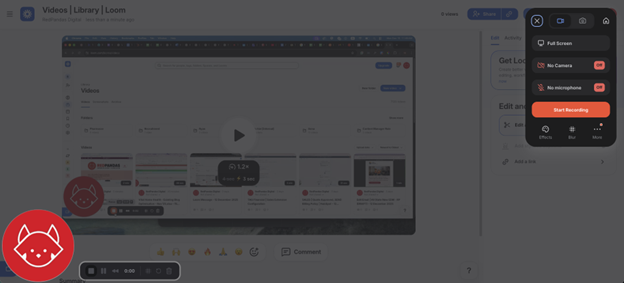
A sample of the Loom Interface, which features simultaneous camera recording and screen recording.
Loom is a video messaging tool that lets you quickly record and share personalised videos.
It’s designed to be simple, fast, and easy to use, making it a strong option for sales teams and marketers who need to stand out in a crowded inbox.
With Loom, you can record your screen, your face, or both… all at the same time. This means you can walk your prospect through a document, explain something on your website, or show them a product demo while also adding that all-important human touch.
What makes Loom potentially effective for your sales strategy is how much more engaging a video is compared to a cold email or standard text outreach.
People want to see and hear from real humans… so a quick 30 to 60-second video could help build trust and make your message feel more personal and authentic.
Instead of sending a block of text that gets skimmed or ignored, Loom allows you to communicate your message clearly, in a way that stands out.
It’s fast, it’s flexible, and it can be one of the easiest ways to bring a human element back into your outreach.


The One Question Every Salesperson Should Ask to Close More Deals
Why Loom Works for 1:1 Sales
Most outreach usually gets ignored for one simple reason: it all looks and sounds the same.
When your buyer opens their inbox, they’re hit with a wall of text, template intros, and generic “just checking in” messages.
Nothing stands out. Nothing feels meant for them.
A 1:1 Loom changes that instantly because it delivers something every buyer craves but rarely receives: a human, personalised moment in a sea of automation.
Let’s break down why Loom can work well for 1:1 sales and how it aligns with how people actually make decisions:
| Insight | Core Idea | Key Benefits |
| A Loom Video Signals Effort, And Effort Creates Trust | The video format itself communicates care, like a handwritten note among mass-printed flyers | Builds trust through perceived effort; feels custom not automated; differentiates you before content begins |
| Video Compresses Complexity in a Way Text Never Can | Like a quick sketch vs. a paragraph, 20 seconds can replace five emails | Tone conveys meaning instantly; screen share removes ambiguity; facial cues build clarity and confidence |
| Buyers Respond Faster When They Feel Like They Know You | Video creates early familiarity, lowering the emotional barrier to replying | Humans trust before logic; seeing you builds trust faster than text; familiarity drives quicker responses |
| It Creates a Micro-Experience Your Competitors Aren’t Delivering | Most teams don’t use personalised video well, doing it right makes you stand out immediately | Clear over dense; human tone over corporate fluff; creates a memorable moment of clarity that compounds over time |

What’s a Good Sales Close Rate and How Can I Improve It?
When to Use Loom in the Sales Cycle
Loom works best when your buyer needs clarity, reassurance, or a nudge to move forward. If you think about your own inbox, the messages that stand out are the ones that feel personal and easy to understand.
That’s exactly where a Loom video shines.
And there are a few key moments in your sales cycle where it can make a noticeable difference:
| Sales Moment | Why Loom Works Here | How to Use It | Pro-Tip |
| 1. Prospecting | You need to stand out fast and show you’re not another automated message. | – Call out something specific about their role or context – Keep it to 20 to 30 seconds – Clarify the one reason you reached out – Focus on relevance, not perfection | Hold a sticky note beside your camera with the prospect’s name so you naturally mention it early. |
| 2. After a First Call or Demo | Buyers forget details quickly. A recap creates clarity and keeps momentum alive. | – Summarise the call in three beats: their problem → what resonated → agreed next step – Keep it under a minute – Make it easy to share internally | Start with: “Just recapping the key points so it’s easy for you to share.” It saves them effort and positions you as helpful. |
| 3. Follow-Ups (Stalled Deals) | Silence usually means distraction, not rejection. A Loom adds a human nudge without pressure. | – Open with empathy (“I know things get busy”) – Remind them of the core problem you’re solving – Offer a simple next step; one option, not three | Keep these under 25 seconds. The shorter it is, the more likely they are to watch it immediately. |
| 4. When Sending Proposals | Proposals often fail because buyers get confused, not because they disagree. Loom removes that confusion. | – Walk through the proposal on-screen – Highlight only the sections that affect their decision – End with a simple, confident recap of the outcomes they can expect | Use screen-highlighting to keep their attention where you want it. Avoid scrolling endlessly. |

How to Align Your B2B Content Marketing Strategy with Your Sales Goals
A Simple Framework for High-Converting 1:1 Loom Videos
Most people overthink video because they believe it needs to be polished, scripted, or impressive.
But the Loom videos that convert are as clear as they can be, instead of just being hyper-focused on production value. Your buyer watches them because you make their life easier, not because you deliver a flawless performance.
And this framework gives you a structure that keeps your message tight, relevant, and human:
1. Personal Hook (5 to 7 seconds)
Before diving into value, you need your prospect to think, “This is genuinely for me.”
And a quick personal hook achieves this instantly.
A personal hook is effective because it answers the silent question buyers ask the moment they open any message: “Why should I care?”
When you call out something specific about them, like a hiring update, a product launch, a LinkedIn post, or a challenge in their industry, you show that you’ve paid attention. And this makes your video feel intentional rather than mass-produced.
Saying “Hey, I thought I’d send you a quick video” might give them no reason to care. Instead, you can say: “Hey, I saw you’re hiring two new SDRs; do you need help with increasing your lead volume anytime soon?”
This tells them:
- You know who they are
- You understand what’s happening in their world
- You can already see what problem might be emerging
And that’s enough to keep them watching.
2. Problem Snapshot (10 seconds)
A problem snapshot is where you name the issue in a way that reflects the true pain, not just the surface-level inconvenience. This is where your buyer starts to recognise themselves in your message.
Many businesses stay too vague here, saying things like “response rates are low” or “pipeline is slowing”. But those statements don’t carry emotional weight.
At the end of the day, buyers aren’t motivated by generic problems; they’re motivated by the consequences those problems create.
If you want to accurately capture a deeper-level issue your lead’s experience, you can tell them something like: “Most teams hit this point and realise their outreach sounds the same as everyone else’s. So, response rates drop right when they need them to increase.”
This shows:
- You understand the trigger, which, in this case, is team expansion and pressure
- You understand the pattern
- You understand the consequence
This moment of recognition builds trust quickly because your buyer thinks, “Yes, that’s exactly what’s happening.”
Once the buyer feels seen, they’re ready to hear something useful that reframes their situation or gives them clarity.
3. Your Insight or Value Cue (10 to 15 seconds)
This is where you offer a small but meaningful insight, not a pitch. Your job here is to help the buyer see their challenge in a clearer, simpler way.
Think of this part as giving them a mental shortcut they didn’t have before. Something that makes them think, “Ah, that makes sense.” When information feels actionable, buyers attribute expertise to you… even before they’ve spoken to you.
For this next part of your Loom video, you can tell them something like: “What usually helps is shifting from text-heavy outreach to short personalised videos. It speeds up replies because buyers actually understand the message.”
This tells them:
- The solution is simple
- The solution reduces effort
- The solution speaks to modern buyer behaviour
You’re not promising the world; you’re creating a moment of clarity. And that’s what builds momentum.
With your value cue established, the final step is to make moving forward feel effortless rather than demanding.
4. The Next Step (5 to 10 seconds)
The biggest mistake most people make in 1:1 videos is ending with a pushy CTA. Buyers don’t like feeling cornered.
But what they do respond to is a low-friction next step that feels natural and easy.
Your CTA shouldn’t require commitment because it can have a higher chance of pushing a potential lead away. Instead, you should build it well enough to require curiosity, no more and no less.
You can do this by saying something like: “If you’re open to it, I can show you a few examples that consistently book meetings. Just reply ‘yes’, and I’ll send them over.”
Why this works:
- It lowers resistance
- It reduces effort
- It gives value before a meeting is even discussed
- It positions you as someone who helps, not someone who hustles
Buyers engage not because you’ve cornered them, but because you’ve made the next step feel obvious.

How to Send a 1:1 Video with Your Sales Proposal
Your Next Step Starts with One Short Loom
Your sales messages are competing with hundreds of others every week… and most of them sound the same. In this case, Loom gives you an advantage your competitors haven’t earned yet: an immediate human connection.
When someone can see your face, hear your voice, and understand your point in under a minute, they’re far more likely to reply, book a call, or move forward.
But here’s the catch: this advantage only exists while most teams still aren’t doing it. And that window’s going to close soon enough.
The longer you wait, the more your outreach blends back into the noise you’re trying to escape.
If you’re ready to take the first step, here’s your simplest move: record one 30-second Loom for a prospect you’ve been trying to reach.
Don’t script it. Don’t overthink it. Just follow the framework above and send it. That one action will teach you more than anything else, and it could be the message that reopens a stalled deal or books your next meeting.

How to Use AI to Close More Sales Deals




Get the best content marketing insights right in your inbox!
Subscribe to our Newsletter and get marketing insights delivered to your inbox every week.