









5 Signs Your Keyword Targeting Might Need an Overhaul

Key Takeaways
- Intent mismatch hides behind healthy dashboards, so rising traffic can still mean the wrong visitors are landing on your page
- Keyword cannibalisation splits authority when several of your pages compete for the same topic instead of one page owning it
- Generic content matches the keyword yet skips the real question your buyer is actually asking
- Unanswered objections around adoption, cost, and implementation stall decisions, even on pages built for product-led keywords
- Mismatched conversion paths push buyers toward action before trust exists, or offer steps that don’t move them forward
- Fix one page first. Aligning intent, message, and call to action on your highest-traffic page often creates more pipeline movement than months of new content
Content is going out. Rankings are improving. Traffic is trending up. And yet… sales still isn’t happy.
If you’re honest, you’ve probably had this thought in the back of your mind: “What if we’re attracting the wrong people?”
This is the frustrating part of keyword targeting that no one warns you about.
You can rank well, look busy in reports, and still fail to move revenue forward. Not because SEO “doesn’t work”, but because the keywords you’re targeting don’t line up with how real buyers think, research, and make decisions today.
Search intent isn’t simple anymore:
- Some people are just learning
- Others are comparing options
- Some are deep into problem-solving mode, while others are almost ready to buy
If your content treats all of those people the same, you’ll get traffic… just not the kind that turns into qualified leads or sales conversations.
In this article, you’ll discover five clear signs that your keyword targeting needs an urgent overhaul. By the end, you’ll know how to spot misalignment fast, understand why it’s costing you results, and see what to change first so your content supports revenue… and not just rankings.
Quick Answer
Your keyword targeting needs an overhaul when rankings and traffic climb but leads and sales stay flat. Watch for five patterns: mismatched intent, competing pages, generic content, unanswered objections, and a misaligned conversion path.
Start with your highest-traffic page and fix its intent, message, and call to action together. This single move often creates more momentum than months of new content.
Sign #1: You’re Attracting the Wrong Intent, Even if Traffic Looks “Good”
At first glance, this problem hides in plain sight.
Dashboards look healthy and rankings hold steady. But, look past clicks and impressions and cracks start to show.
Keywords describe what someone typed. Intent explains why they typed it. Ignore that gap and traffic turns into noise instead of pipeline.
Think of your website like a car dealership floor. Some visitors are browsing, some are comparing models, and some are ready to buy today.
Hand everyone the same brochure and walk away.
Footfall being up won’t fix flat sales, and neither will traffic fix flat leads.
A single keyword can hide several different mindsets:
- Learning: understanding a concept or category for the first time
- Comparing: narrowing down solutions or providers
- Evaluating: looking for proof, reassurance, or detail on one option
- Planning: weighing implementation, pricing, or internal buy-in
- Fixing: trying to solve a problem with a tool or process that isn’t working
Each mindset expects a different answer.
Treat them all the same, and you’re teaching beginners and experts the same lesson, at the same pace.
That’s where misalignment usually shows up. Watch for these patterns:
- The page explains what something is, but never says who it’s for
- The content stays educational when the search signals evaluation or decision-making
- The call to action is too pushy for someone still orienting themselves, or too soft for someone ready to move
Search intent sets expectations.
Miss them, and readers skim, leave, or convert into leads that stall in your funnel.


Why Is My Website’s Bounce Rate So High?
Sign #2: Your Pages are Competing Against Each Other
This problem usually shows up after months of “doing the right thing”:
- You publish a new article to support sales
- You add a landing page for conversions
- You write comparison content because buyers keep asking the same questions
Each move feels fine on its own. Together, they can quietly undermine performance.
Think of it like giving directions: five people, five slightly different routes to the same destination. The listener ends up more confused, not less.
Search engines react the same way when multiple pages all hint they’re the answer to the same core topic, with no clear hierarchy.
This is what’s known as keyword cannibalisation.
How Keyword Cannibalisation Usually Develops
Keyword cannibalisation happens when a content strategy grows without a clear ownership model.
Over time, you end up with a content stack like this:
- A blog post explaining a core concept
- A product or service page describing your solution
- A comparison article aimed at mid-funnel buyers
- A page focused on implementation or optimisation
Each page takes a different angle, but they all circle the same primary keyword.
Search engines can’t tell which one should lead, and this means that your authority can end up splitting instead of concentrating.
What This Might Look Like on Your Website
Watch for these warning signs:
- Several URLs ranking for the same keyword, none holding position for long
- One page gaining visibility while another quietly drops
- Traffic spread thin instead of consolidating around a strong performer
It’s like splitting your sales team across five half-filled meetings instead of putting them all in the room where the decision gets made.
Buyers feel this too: they land on one page, click through to another, and hear the same idea framed slightly differently.
That inconsistency makes it harder to trust there’s a clear point of view guiding them.
What Cannibalisation Costs, and How to Spot It
Cannibalisation costs you momentum, not just SEO metrics.
When no single page owns a keyword, it’s harder to:
- Build a narrative that moves someone from understanding to evaluation
- Align calls to action with the right stage of intent
- Signal authority to a buyer who’s close to deciding
Spotting cannibalisation takes clarity, not advanced tools.
Ask yourself:
- If you had to send a serious buyer to one page about this topic, which would it be?
- Which page would you put in front of a sales-qualified lead?
- Do your supporting pages reinforce that main page, or compete with it?
If those questions feel uncomfortable to answer, that’s your signal.

Is SEO Still Relevant in the AI Era?
Sign #3: Your Page Matches the Keyword, But Not the Question
The optimisation looks solid. The keyword’s in the right places. The page ranks.
Relevance is the real problem here.
A broad keyword compresses a set of concerns into a few words. Your job is to unpack what the searcher actually wants to know.
Take “I’m looking at electric cars.” The real question is whether one fits your commute, budget, charging options, and lifestyle.
Most searchers behind a broad keyword are wrestling with:
- Fit: “Is this right for a business like ours, or will we outgrow it?”
- Comparison: “How does this stack up against other options?”
- Adoption: “Will our team actually use this?”
- Effort: “What does implementation look like after signing?”
Each carries cost, time, or career risk. Ignore that, and the reader doesn’t feel understood.
Generic pages explain the solution, list a few features, and stop. Swap the product name, and the page still works. That’s a page describing a category, and it isn’t helping anyone decide.

What’s Included in a Strategic Website Build (And What Should NEVER Be Skipped)
Sign #4: You’re Targeting a Product-Led Keyword, But Ignoring Buyer Objections
Someone searching a product-led keyword isn’t browsing. They’re narrowing options and carrying unspoken concerns.
Think test drive, not brochure. They don’t need more features listed.
Your buyer needs reassurance that this choice won’t create problems they’ll have to explain later.
Many pages talk around the product category and never touch the doubts actually slowing the buyer down.
These objections are professional fears: the kind that affect credibility, budgets, and internal trust.
They usually fall into four buckets:
- Adoption risk: buyers aren’t worried whether a tool can do something. They’re worried whether people will actually use it. Skip onboarding and real-world usage, and adoption anxiety stays unresolved
- Cost vs. value: the real question isn’t “is this expensive?” It’s “will I have to justify this spend in six months?” Skip ROI framing, and the reader assumes the worst
- Implementation complexity: buyers have been burned by tools that looked simple and turned into messy rollouts. Ignore setup, and hesitation creeps in even for a solid product
- Long-term fit: leaders buy for scale, integrations, and future teams, not just today’s use case. Speak only to the immediate need, and the solution feels temporary
Unanswered objections don’t disappear. They resurface as:
- Stalled deals
- Cautious enquiries
- A quiet loss of confidence
Strong keyword targeting supports decision-making. Acknowledge the objection, give context, and the buyer moves forward with confidence.

Common Reasons Your Website Isn’t Generating Leads
Sign #5: Your Conversion Path Doesn’t Match Where the Buyer Actually Is
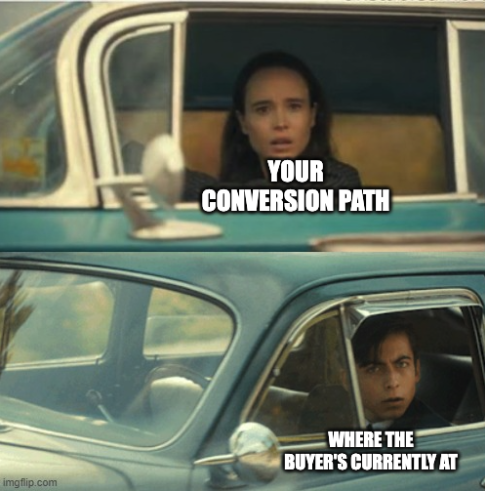
Even when intent, content, and messaging are right, how you ask someone to move forward can undo all of it.
Ask for too much too early, and people pull back. Ask for too little, and momentum dies.
Here’s how that misalignment shows up:
- You’re asking for commitment before trust exists. Pushing for a sales conversation too early is like proposing on the first date. Most buyers are still building internal confidence, and want to feel informed before they feel sold to
- You’re offering actions that don’t move the decision forward. Soft CTAs like newsletters or generic blog links hand the reader something, just not what they actually need
- You’re treating all visitors as if they’re at the same stage. Some are validating a shortlist. Others are prepping to justify a recommendation internally. One blunt CTA forces everyone down the same narrow path
The result: buyers hesitate, bookmark the page “for later,” or go back to Google. The content isn’t the problem. The next step just doesn’t feel safe yet.
The strongest pages act like a well-designed shop floor, not a checkout counter. They anticipate what someone needs next and make that step obvious.
When the conversion path matches the buyer’s mindset, taking action feels natural, not risky.

The One HubSpot Tool That Can Instantly Improve Your Marketing ROI
Frequently Asked Questions: Keyword Targeting
How do you know if your keyword targeting needs an overhaul?
Your keyword targeting needs an overhaul when rankings and traffic rise but leads and sales stay flat. Look for pages competing for the same keyword, content that matches the search term without answering the buyer’s underlying question, and calls to action that ignore where the visitor sits in their decision. These signals point to misalignment, not a lack of effort.
What is search intent in SEO?
Search intent is the reason behind a search, not just the words typed into the search bar. A keyword tells you what someone searched for, while intent tells you what they actually need: to learn, compare, evaluate, plan, or fix a problem. Matching content to intent, not just the keyword, is what turns traffic into qualified leads.
What is keyword cannibalisation?
Keyword cannibalisation happens when multiple pages on your website target the same keyword or topic, so search engines can’t tell which page should rank. This splits authority instead of concentrating it, and often shows several URLs competing for the same term without any of them holding a strong position. The fix is giving one page clear ownership of that topic.
Why is my website ranking well but not generating leads?
Rankings measure visibility, not conversion. Your website can rank well and still miss leads when content answers the keyword without answering the buyer’s real question, when pages compete for the same topic, or when your call to action ignores the visitor’s stage. Fixing intent and message usually works faster than adding more content.
How many keywords should one page target?
One page should target one primary keyword and own that topic clearly, rather than spreading a broad theme across several pages. When multiple pages target the same core keyword, authority splits and none of them holds a strong ranking. Supporting pages can target related long-tail terms, provided they reinforce the primary page instead of competing with it.
What causes buyers to hesitate even when your content ranks well?
Buyers hesitate when unspoken objections go unanswered, even on pages that rank well. The most common concerns are adoption risk, cost versus value, implementation complexity, and long-term fit. If your content doesn’t address these directly, readers fill the gaps themselves, usually assuming the worst. That quietly stalls the deal.
What should your conversion path match?
Your conversion path should match the buyer’s actual stage, not just their traffic source. Someone still building confidence needs low-pressure options like guides or case studies, while someone ready to decide needs a direct next step. Offering the same call to action to everyone forces people down the wrong path and stalls momentum.
How do you fix a keyword targeting problem?
Start with the one page that matters most for your target keyword, not every page at once. Align its content with real search intent, address the objections your buyer is actually weighing, and give it one clear call to action for its stage in the funnel. This single fix often creates more momentum than months of new content.
The Cost of Waiting Might be Higher Than It Looks
If your content is attracting the wrong intent, the impact isn’t subtle: it compounds.
Every week you wait:
- Sales keeps following up with leads that go nowhere.
- Marketing keeps reporting numbers that don’t build confidence.
- Leadership keeps wondering why a platform like HubSpot isn’t delivering the return it promised.
And the uncomfortable truth is this: keyword misalignment doesn’t usually fix itself. Keyword targeting
As search behaviour shifts and competitors sharpen their positioning, yesterday’s “good enough” targeting quietly becomes today’s drag on growth.
The upside is you don’t need a long roadmap to get traction… Instead, you need one clear decision.
Start by picking the page that matters most. Make sure it speaks to the real questions buyers are asking right now, and then give them a next step that feels helpful instead of pushy.
Afterwards, fix the intent, tighten the message, and align the action.
Your keyword strategy shouldn’t create doubt or friction: it should make growth feel simpler and more predictable.

How to Rank on ChatGPT
About the Author





Get the best content marketing insights right in your inbox!
Subscribe to our Newsletter and get marketing insights delivered to your inbox every week.