









The 4 Best Ways to Start Lowering Your Google Ads CPC in 2026 (+1 Bonus)

You open your Google Ads account, look at last month’s numbers, and feel that familiar knot in your stomach.
Spend is up. CPC is up. Targets haven’t moved.
And you’re being asked the same question again.
“Why are clicks getting more expensive… and what are we doing about it?”
If you’ve tried the usual fixes like tweaking bids, pausing keywords, and refreshing ads only to see CPC creep right back up, don’t worry: you’re probably not doing anything wrong.
See, paid media in 2026 is more automated, more competitive, and less forgiving of inefficiency than it’s ever been.
But that doesn’t mean lowering your Google Ads CPC is impossible.
Instead, it just means that the levers that work have changed.
In this article, you’ll learn the most effective, practical ways to start lowering your Google Ads CPC in 2026 without choking volume or crossing your fingers and hoping automation behaves. By the end, you’ll have a clear set of priorities you can act on immediately, and a smarter way to think about efficiency going forward.
What Causes High CPCs in Google Ads?
High CPCs (cost-per-click) in Google Ads are driven by several key factors:
Competition
- More advertisers bidding on the same keywords drives prices up through auction dynamics
- Industries like legal, finance, insurance, and healthcare are notoriously expensive because the customer lifetime value is high
Keyword Intent & Value
- High commercial intent keywords (“buy”, “hire”, “best”) cost more than informational ones
- Keywords tied to high-value conversions (e.g. “personal injury lawyer”) attract aggressive bidding
Quality Score
- A low Quality Score (below 7/10) means Google penalises you with higher CPCs
- It’s determined by expected CTR, ad relevance, and landing page experience. In other words, the quality of your ads, landing page and how relevant both are in comparison to each other
- Improving Quality Score can significantly reduce what you pay per click
Ad Rank & Bidding
- Smart Bidding strategies like Target CPA or Maximize Conversions can push CPCs up if conversion data is thin or targets are aggressive
- Broad match keywords enter more auctions, often expensive or irrelevant ones
Audience Targeting
- Layering on high-value audiences (e.g. in-market, remarketing) increases competition for those impressions
- Geographic targeting in high-income or competitive markets raises costs
With this in mind, you can focus on each of these factors to improve CPC.
1. Tighten Intent Before You Touch Bids
When CPC climbs, most people reach for bids. It feels logical: if clicks are expensive, pay less for them.
But in Google Ads, bids are rarely the root cause. One reason CPC rises is when Google struggles to confidently match your ads with the right people.
When intent is fuzzy, the system tests more, wastes more impressions, and charges more per click. And when intent is clear, CPC often drops without you forcing it.
Three areas to get deliberate with:
Clean Up Search Terms & Add Negative Keywords
Keywords tell Google what you think you’re targeting. Search terms tell you what you actually paid for.
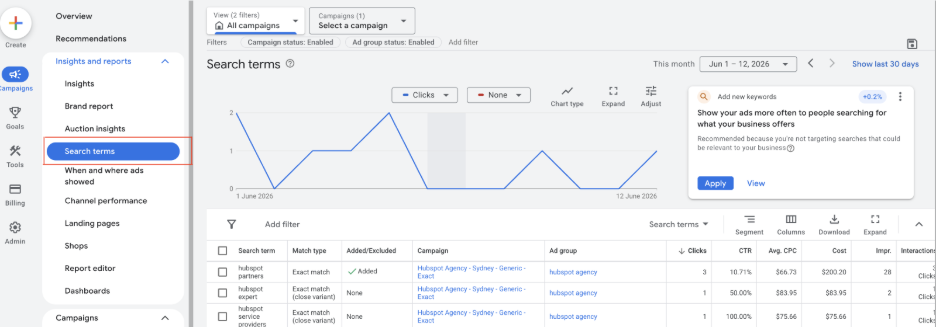
In the above image we can see the exact terms that users searched when our ads showed up, and the stats around these terms, in regards to clicks, impressions, CPC and conversions.
When reviewing search terms, don’t ask “Is this loosely related?” Ask: “If this person filled out a form today, would that be a win?”
If the answer is no, add it as a negative. Every bad click you block helps Google better recognise a good one.
To give you a better idea of how asking the question above can help, this is where most wasted CPC lives:
- Queries that signal curiosity rather than action
- People trying to learn, compare, or DIY
- Searches that sound right but never lead anywhere commercially
Removing these terms by adding them as negative keywords does more than save a few dollars here and there. It sharpens the account’s understanding of who you actually want. Over time, that clarity improves relevance signals, which directly influences what you pay per click.
Use Match Types as a Filter
Broad match isn’t always the problem, but unqualified broad match is.
In Google Ads, broad match paired with Smart Bidding can work well when:
- Your underlying keywords signal clear buying intent
- Irrelevant searches are already excluded
- Your ads are written to qualify the click, not just attract it
When match types are aligned with intent, they give the system room to find efficient traffic. But when they’re misaligned, CPC rises because the platform keeps testing low-quality possibilities.
Separate “Interest” From “Action”
Mixing early-stage and high-intent searches in the same campaign can cloud Google’s performance signals.
High-intent terms get fewer impressions, lower-intent terms absorb spend, and CPC rises across the board.
You can avoid this by separating campaigns by intent level, not just topic: it gives you cleaner data and protects the budget for people ready to act.


How to Combine Search, Display, and YouTube Ads for a Full-Funnel Campaign
Ad platforms are built to reward clarity.
When intent is tight, every other optimisation has something solid to stand on. When intent is loose, even the best bidding strategy is just damage control.
By following the best practices above, you can lower your Google Ads CPC while maximising your strategy’s results.
2. Improve Google Ad Relevance and CTR
One of the most direct ways to lower your CPCs is to improve your Quality Score, and two of its three components (expected CTR and ad relevance) are almost entirely within your control through your ad copy.
Google rewards ads that closely match what a user is searching for. When your copy speaks directly to the search query, Google sees your ad as more useful, assigns a higher Quality Score, and charges you less per click as a result. Poor ad relevance, on the other hand, signals a mismatch between your keywords and your ads and you pay for it every time someone doesn’t click.
Here’s some ways you can improve ad relevance and CTR, and eventually lower your CPC:
Include the Keyword in Your Ad Copy
- The simplest starting point is making sure your target keyword appears in your headline. When a user’s search term matches words in your ad, Google bolds those terms, making your ad visually stand out and signalling strong relevance
- Aim to include the primary keyword in at least one headline and ideally in the description too, but only where it reads naturally
Write Headlines That Match Search Intent
- Relevance isn’t just about keyword inclusion, it’s about intent alignment. If someone searches “emergency plumber Sydney”, they want availability and speed, not a brand story. Your headline should reflect exactly what they need: “24/7 Emergency Plumber, Sydney” will outperform “Smith & Sons Plumbing Services” every time
- Think about the three intent stages: Problem-aware (“why is my hot water not working”) speaks to the symptom, Solution-aware (“hot water repair service”) speaks to the service, and Purchase-ready (“emergency hot water repair Sydney”) speaks to urgency, availability, and trust signal
Use Ad Strength as a Guide, Not a Goal
- Google’s Ad Strength indicator pushes you toward more headlines and more variety, but a high Ad Strength score doesn’t automatically mean high CTR. Don’t sacrifice message clarity for variety. A focused, tightly written ad with a clear value proposition will nearly always beat a diluted one stuffed with generic headlines to hit “Excellent” status
Don’t Ignore Descriptions
- Descriptions don’t appear bolded for keyword matches, but they’re still prime real estate for reinforcing relevance, handling objections, and differentiating from competitors
Following these steps can help you improve your ad relevance score, thereby improve your overall Quality Score and reducing CPCs.

3 Ways to Improve Your Google Ads
3. Fix Your Landing Page Experience

In Google Ads, the landing page is a major part of the signal the platform uses to decide whether your ad deserves cheap, easy access to auctions.
Google measures what happens after the click and uses it to decide how much you pay for the next one.
And a poor post-click experience weakens your Landing Page Experience score, which feeds directly into Ad Rank and pushes CPC up.
Three things drive that score more than anything else:
Message Match
If someone clicks an ad for “B2B software demos” and lands on a generic homepage, they’re probably going to bounce… And Google notices that.
Strong message match means the landing page headline mirrors the ad copy closely enough that the visitor immediately thinks “yes, this is what I came for.”
Here’s an example of messages your ads might say, and the message you should have on your landing page:
| What Your Ad Might Say | The Message That Should Be On the Landing Page it Leads to |
| “Custom home builders in Sydney” | “Sydney’s Custom Home Builders: Get a Free Quote” |
| “Online courses for working professionals” | “Flexible Online Courses for Busy Professionals” |
| “Bulk billing GPs near you” | “Find a Bulk Billing GP in Your Area” |

How a Poor Landing Page Affects Your Paid Media Performance
Page Speed
A slow page looks like a bad ad to Google.
When users bounce before the page loads, Google interprets it as your ad failing to satisfy the user and adjusts your costs accordingly.
In 2026, “fast enough” means:
| Metric | Target |
| First Contentful Paint | Under 1 to 2 seconds |
| Time to Interactive | Under 3 seconds |
| Layout Stability (CLS) | No jumping elements |
Use Google PageSpeed Insights to measure these. Faster pages produce lower bounce rates, stronger engagement signals, and lower CPC over time.
Having One Page to do One Job
Humans and systems both like clarity, and the same preference extends to your Google Ads campaigns.
But if your landing page tries to do everything with multiple CTAs, broad content, mixed audiences, you can end up delivering decision fatigue instead of clarity.
Google reads that confusion as weak engagement. To avoid this, you can apply the “Rule of Ones” to the landing pages linked to your ads:
- One message
- One audience
- One action or CTA
Clean pages generate clean signals, and clean signals tell Google the click was valuable.
Valuable clicks get cheaper over time while padding your revenue.

Lead Ads vs Website Conversion Ads: Which is better?
Landing pages are more than conversion tools.
They’re feedback mechanisms to Google Ads about how well you’re serving the user who clicked.
Fix the post-click experience, and CPC tends to follow.
BONUS: 4. Get Help From a Paid Media Management Agency
Everything you’ve done so far to lower CPC relies on one thing: clear thinking applied consistently. That’s harder than it sounds when you’re close to an account, under pressure, and juggling everything else.
This is where the expertise of a paid media performance management agency like RedPandas earns its keep.
When you manage the same account week after week, inefficiencies become invisible. Spend that “isn’t great but isn’t awful” keeps running, and campaigns stay live out of habit.
An experienced Google Ads specialist comes in without that baggage, able to spot structural issues inflating your CPCs that internal teams have long stopped questioning.
The deeper fix, though, is systematic.
Google’s automation adapts quickly, so no single tweak keeps CPCs low for long. What does last is an account where intent, ads, landing pages, and conversion signals all reinforce each other. When one part weakens, the whole structure pays more.
An experienced agency keeps those parts aligned and adjusts proactively as competition shifts, budgets change, or Google rolls out updates.

What Makes a Paid Media Agency Great?
Frequently Asked Questions About How to Lower Google Ads CPC in 2026
How can I lower my CPC in 2026?
You lower CPC in 2026 by improving ad relevance and Quality Score. Focus on tighter intent targeting, higher CTR ads, faster and more relevant landing pages, clean conversion signals, and controlled automation. CPC drops when platforms see less uncertainty in your traffic.
What is a good CPC?
A good CPC supports profitable leads or sales. There is no universal benchmark. If a higher CPC delivers better-quality leads and stronger revenue, it’s more efficient than a lower CPC that produces poor outcomes.
Should I optimise for CPC or cost per lead?
You should optimise for cost per lead or cost per acquisition first. CPC is a supporting metric. When lead quality, relevance, and conversion rates improve, CPC usually decreases as a result (although this isn’t always the case).
Why is my CPC increasing even if nothing changed?
CPC can rise due to increased competition, weaker relevance signals, or declining data quality. Even without account changes, shifts in the auction or tracking signals can push costs up.
Does Quality Score still affect CPC?
Yes. Quality Score affects CPC through its inputs: expected CTR, ad relevance, and landing page experience. Improving those areas lowers CPC, even if the Quality Score number itself changes slowly.
Can automation help lower CPC?
Yes, but only with guardrails. Automation lowers CPC when it receives clear conversion signals and focused intent. Without boundaries, it often increases CPC by testing broader and more expensive traffic.
Take Back Control of Your Google Ads CPC in 2026
Every week you spend patching bids without fixing the underlying issue, Google keeps charging you a premium. That’s budget you won’t get back.
The good news is that you don’t need to fix everything at once.
Your next steps are simple:
- Pick one high-spend area of your account.
- Apply the ideas you’ve just read
- Watch what happens to both CPC and lead quality over the next few weeks.
One focused change beats ten scattered ones.
But if you want a faster path, or you’d rather not figure this out through trial and error, getting a second set of experienced eyes can make all the difference.
A free paid media audit with RedPandas’ experts can show you exactly where CPC is leaking and which changes will move the needle first without overhauling what already works. Get in touch and schedule a consultation with us here.
About the Author





Get the best content marketing insights right in your inbox!
Subscribe to our Newsletter and get marketing insights delivered to your inbox every week.