









Is a HubSpot Website Worth It? Costs, ROI, and Fit in 2027

Key Takeaways
- Revenue-connected: A HubSpot website shares one database with your CRM, so every form fill becomes a contact with full page history
- Three costs: Budget for subscription, build, and ongoing optimisation; the build alone rarely delivers ROI
- Subscription tiers: Content Hub Starter comes in the AUD $31-per-seat Starter platform; Professional starts at about AUD $700 a month
- Best fit: B2B, professional services, and SaaS businesses with longer sales cycles and sales teams in the CRM
- Poor fit: Static brochure sites, complex ecommerce, and highly experimental front-end builds
- Local hosting: HubSpot’s Sydney data centre (since February 2024) supports onshore data for Australian businesses
Quick Answer
A HubSpot website is a good investment in 2027 when your site needs to generate pipeline and prove marketing ROI, because pages, forms, and CRM records share one database.
Budget for three costs together:
- The Content Hub subscription
- A strategic design and build
- Ongoing optimisation
For a mostly static brochure site with little lead generation, a cheaper CMS usually makes more financial sense.
Weighing up a rebuild on HubSpot? RedPandas’ HubSpot website team can scope what your site would cost and what it would need to return.
Get in touch through the link below to book a free HubSpot website consultation:


Get Your Free HubSpot Website Consultation With RedPandas
If you’re on this article, you’re probably not asking whether a HubSpot website is “good”.
Instead, you might be asking if rebuilding your website on HubSpot in 2027 will drive more revenue, simplify your tech stack, and make reporting easier.
Or… if it’s going to become another expensive platform you have to defend every budget cycle.
Well, there are a few different things to consider when you answer that question.
If you’re leading marketing, sales, or the business itself, this decision probably feels loaded.
You’ve probably seen websites that look great but don’t convert. You might have lived through long rebuilds that promised “better leads” and delivered… the same problems, just with a new CMS.
And you’re likely juggling multiple vendors right now, each owning a slice of the funnel, while you’re left trying to explain ROI at the board level.
In this article, you’ll learn what a HubSpot website really represents in 2027, what the investment looks like beyond the surface pricing, and when it makes sense as a growth platform rather than just another rebuild.
What is a “HubSpot Website”?
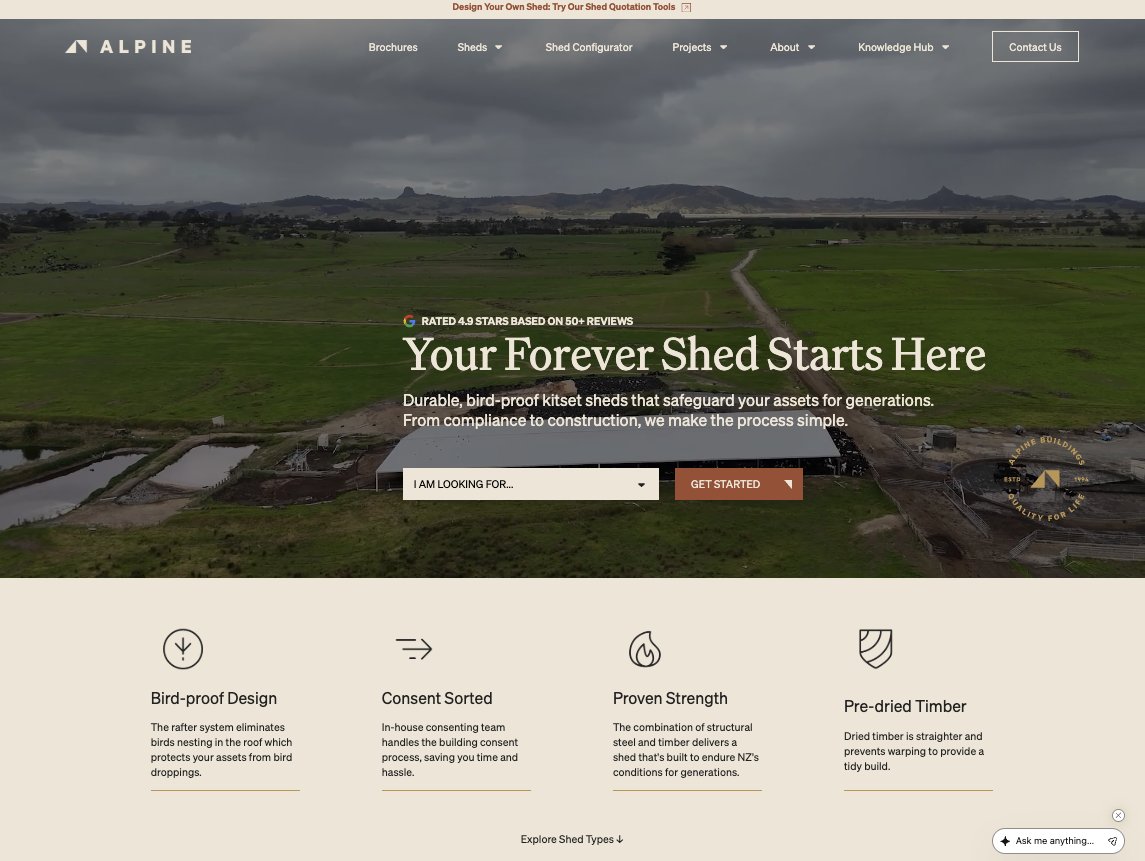
A snapshot of the Alpine Sheds site, which is a HubSpot website project that we built on the HubSpot CMS and optimised for the StoryBrand framework and lead generation.
A HubSpot website is built on HubSpot’s Content Hub, the platform’s CMS. Pages, blogs, landing pages, and forms all sit on the same database as your CRM.
That changes what happens after someone lands on your site:
- Every form fill creates or updates a contact, complete with the pages they viewed and the content they engaged with
- Visitor behaviour is tracked as a journey, from first visit to closed deal
- Hosting, SSL, and security updates are managed by HubSpot, so there are no plugins to patch
Is a HubSpot Website Right for Your Business?
Fit depends on how central the CRM is to your sales process. Use this table as a first filter:
| Good Fit for a HubSpot Website | Poor Fit for a HubSpot Website |
| B2B and professional services with longer sales cycles | Static brochure sites that rarely change |
| Sales teams already working in HubSpot | Businesses with no CRM or no plan to use one |
| Leadership needs attribution from website to revenue | Complex ecommerce with large product catalogues |
| Marketing wants to launch pages without a developer | Highly experimental, animation-heavy front-end builds |
| Regulated or enterprise buyers who ask about data hosting | Very tight budgets with low growth targets |
If most of your answers sit in the left column, keep reading.
How Much Does a HubSpot Website Cost in Australia?
A HubSpot website has three costs: subscription, build, and optimisation. Most budget problems come from planning for only one of them.
Content Hub Subscription
| Content Hub Tier | Price | Included Seats | Best For |
| Starter | AUD $31 per seat per month, within the Starter Customer Platform | Per seat | Small sites using standard themes |
| Professional | About AUD $700 per month | 3 core seats | Most B2B sites: smart content, A/B testing, and SEO recommendations |
| Enterprise | About AUD $2,325 per month | 5 core seats | Multiple sites, advanced permissions, and custom objects |
AUD figures are converted from HubSpot’s list prices, so they move with the exchange rate. Add 10 per cent GST and confirm current pricing in your quote.
Design, Build, and Optimisation
| Cost Item | Typical Year 1 Range (AUD) | Ongoing (AUD) |
| Strategy, UX, and design | $12,000 to $25,000 | n/a |
| HubSpot development and build | $15,000 to $40,000 | n/a |
| SEO migration and redirects | $3,000 to $8,000 | n/a |
| Conversion assets and team training | $5,000 to $15,000 | n/a |
| Optimisation and CRO | Starts at launch | $2,000 to $6,000 per month |
Under-investing shows up fast. Skip UX and you get traffic without leads. Skip the SEO migration and rankings drop after launch. Skip optimisation and ROI plateaus within a year.
For a detailed breakdown, read what’s included in RedPandas website projects and how much they cost.
HubSpot Website vs WordPress: Total Cost of Ownership
HubSpot usually costs more upfront, and the gap narrows over three years. The difference comes down to what’s included.
| Item | HubSpot Website | WordPress Website |
| Hosting, SSL, and CDN | Included in subscription | Paid separately |
| Security updates | Managed by HubSpot | Your team or a developer |
| CRM-connected forms | Native | Plugin or integration needed |
| Ongoing maintenance | Low | Plugin and core updates |
| Design flexibility | High within themes and modules | Very high |
| Best for | Lead generation and attribution | Content-heavy or ecommerce sites |
For a deeper comparison, read HubSpot CMS vs WordPress CMS: which is better for you?
The Real Benefits of a HubSpot Website

Another example of a HubSpot website project we developed for ConnectOS.
A HubSpot website delivers value when it changes how your business captures, understands, and acts on demand.
Here are a few benefits below that show what can materially improve once your website is built directly into your CRM and growth stack:
Benefit #1: Better Leads, With Context Attached
Sales sees which pages and offers influenced a lead before they converted. Marketing qualifies leads on demonstrated intent, and lead scoring uses real engagement data.
That ends the most common argument between sales and marketing: whether a lead is any good. Both teams work from the same behavioural evidence.
Benefit #2: Clear Visibility Into What Drives Revenue
Website interactions are tied to contacts and deals automatically. Marketing can trace how specific pages and campaigns influence pipeline, without manual data reconciliation.
When leadership questions the budget, the numbers are already in the CRM.
Benefit #3: Fewer Tools to Manage
Forms, analytics, landing pages, and CRM integration are native. Teams spend less time maintaining connectors and more time improving performance.
Fewer systems also mean fewer failure points and fewer gaps where data gets lost.
Benefit #4: Marketing Moves Faster
Drag-and-drop editors and custom modules let marketers publish without a developer. Developers still build custom templates and logic, so they focus on structural work instead of copy changes.
RedPandas built the Alpine Sheds website on HubSpot CMS around the StoryBrand framework, so the New Zealand team can update offers and landing pages themselves.
Benefit #5: Security, Hosting, and Data Location Are Handled
HubSpot manages hosting, SSL, and platform updates, which removes the plugin patching that WordPress sites need.
Australian businesses can also host CRM data onshore at HubSpot’s Sydney data centre that’s been open since February 2024.
This guide covers whether your HubSpot data should be hosted in Australia.

Best HubSpot CMS Features for Marketers
Frequently Asked Questions: HubSpot Websites
Is a HubSpot website worth it in 2027?
A HubSpot website is worth it when your site needs to generate pipeline and prove marketing ROI, because pages, forms, and CRM records share one database. It suits B2B and professional services businesses with sales teams that use the CRM. For a mostly static brochure site, a cheaper CMS usually gives better value.
How much does a HubSpot website cost in Australia?
A HubSpot website has three costs: the Content Hub subscription, the design and build, and ongoing optimisation. Content Hub Professional starts at about AUD $700 a month, and a strategic agency build typically runs from AUD $30,000 upwards. Budget for all three, because the build alone rarely delivers the ROI you expect.
Is HubSpot more expensive than WordPress?
HubSpot usually costs more upfront than WordPress, but the gap narrows once you add WordPress hosting, security, premium plugins, CRM integrations, and developer maintenance. HubSpot includes hosting, SSL, and native CRM forms in the subscription. Compare the total cost of ownership over three years before you decide which platform suits your budget.
Is HubSpot good for SEO?
HubSpot is good for SEO when it’s implemented properly. It includes clean site architecture, editable metadata, automatic SSL, fast managed hosting, and on-page recommendations. Rankings still depend on content quality, site structure, and a careful migration with URL redirects, so plan your SEO migration before the build starts to protect existing traffic.
Does HubSpot offer Australian data hosting?
HubSpot opened a Sydney data centre in February 2024, so Australian businesses can host CRM data onshore. That matters for privacy obligations, enterprise procurement, and government-adjacent organisations. Data location is set when your HubSpot account is created, so confirm your hosting region with HubSpot or your partner before you sign up.
Which businesses suit a HubSpot website?
HubSpot websites suit B2B service businesses, professional services firms, SaaS companies, and organisations with longer sales cycles that rely on lead generation. They suit businesses less well when complex ecommerce, highly experimental front-end design, or a very tight budget is the main priority. Fit depends on how central the CRM is to sales.
Do I need to use the HubSpot CRM for a HubSpot website to work?
A HubSpot website works without heavy CRM use, but most of its value comes from the CRM connection. Attribution, lead scoring, personalisation, and pipeline reporting all rely on sales teams logging deals and lifecycle stages in HubSpot. Without that adoption, you pay for capabilities your team won’t use.
HubSpot Website: What’s Next?
Waiting another year rarely keeps things neutral. Attribution stays fuzzy, sales keeps questioning lead quality, and the website keeps reading as a cost.
Before you request quotes, pressure-test your current site with three questions:
- Can you explain how the website supports revenue today?
- Does sales trust the leads it generates?
- Can leadership see what’s working without a spreadsheet?
If the answers feel vague, the next step is a scoped estimate built around your sales process.
Learn More About RedPandas’ HubSpot Website Design and Development Services
About the Author




Get the best content marketing insights right in your inbox!
Subscribe to our Newsletter and get marketing insights delivered to your inbox every week.