




Why CRM Rollouts Fail Across Sales and Marketing

Key Takeaways
- Four causes drive most failures: no shared rollout plan, data migration issues found too late, training that stops at launch, and no single owner across sales and marketing
- Poor data is costly: Validity’s 2026 report found 62% of organisations lose revenue directly due to poor CRM data quality
- Watch for early signs: shadow spreadsheets, falling logins, lead disputes, and two versions of the truth in reporting
- Alignment pays off: Influ2 found marketing influenced up to 29% of pipeline in aligned companies, compared with 10% where the hand-off was broken
- Tool overload hurts quota: Gartner found overwhelmed sellers were 45% less likely to hit quota
- Start with ownership: One cross-team CRM owner makes every other fix stick
Quick Answer
CRM rollouts fail across sales and marketing when the teams aren’t aligned on the rollout plan, data migration problems appear too late, training ends at go-live, and no single person owns the CRM across both teams.
Each cause is fixable early with a shared rollout plan, pre-launch data testing, ongoing training, and one accountable cross-team owner.
If you’re planning a rollout or partway through one, RedPandas Digital offers a free CRM rollout risk assessment for Australian businesses.
You’ll get a review of your plan, data, training, and ownership, with the highest-risk gaps flagged before they become expensive. Book your slot below:


Get Your Free CRM Rollout Risk Assessment
Picture this: it’s the Monday pipeline meeting.
Sales says marketing’s leads are junk; marketing says sales never follows up. Both teams pull up the CRM to prove their point, and somehow it backs neither of them up.
That standoff is how most rollouts unravel.
CRM rollouts fail across sales and marketing for four main reasons:
- The teams were never aligned on the rollout plan
- Data migration problems surface after go-live
- Training stops at launch
- Nobody owns the CRM across both teams
Validity’s State of CRM Data Management in 2026 report, which surveyed 500 marketers across Australia, New Zealand, the US, the UK, and Brazil, found 62 per cent of organisations lose revenue directly because of poor CRM data quality.
If you’re the leader caught in the middle, it’s exhausting: the budget’s spent, the go-live date has passed, and each team is quietly drifting back to its own spreadsheets.
RedPandas Digital, a HubSpot Diamond Solutions Partner, works on both sides of that meeting. It runs HubSpot for sales teams and paid media and content for marketing teams, so it sees exactly where the handover breaks.
One client, m|devices, nearly scrapped HubSpot because its teams worked in silos and missed hand-offs, until RedPandas brought them back onto one shared system.
In this guide, you’ll learn the four most common reasons CRM rollouts fail, the early warning signs to watch for, and practical fixes for each cause you can start this month.
The 4 Most Common Reasons CRM Rollouts Fail
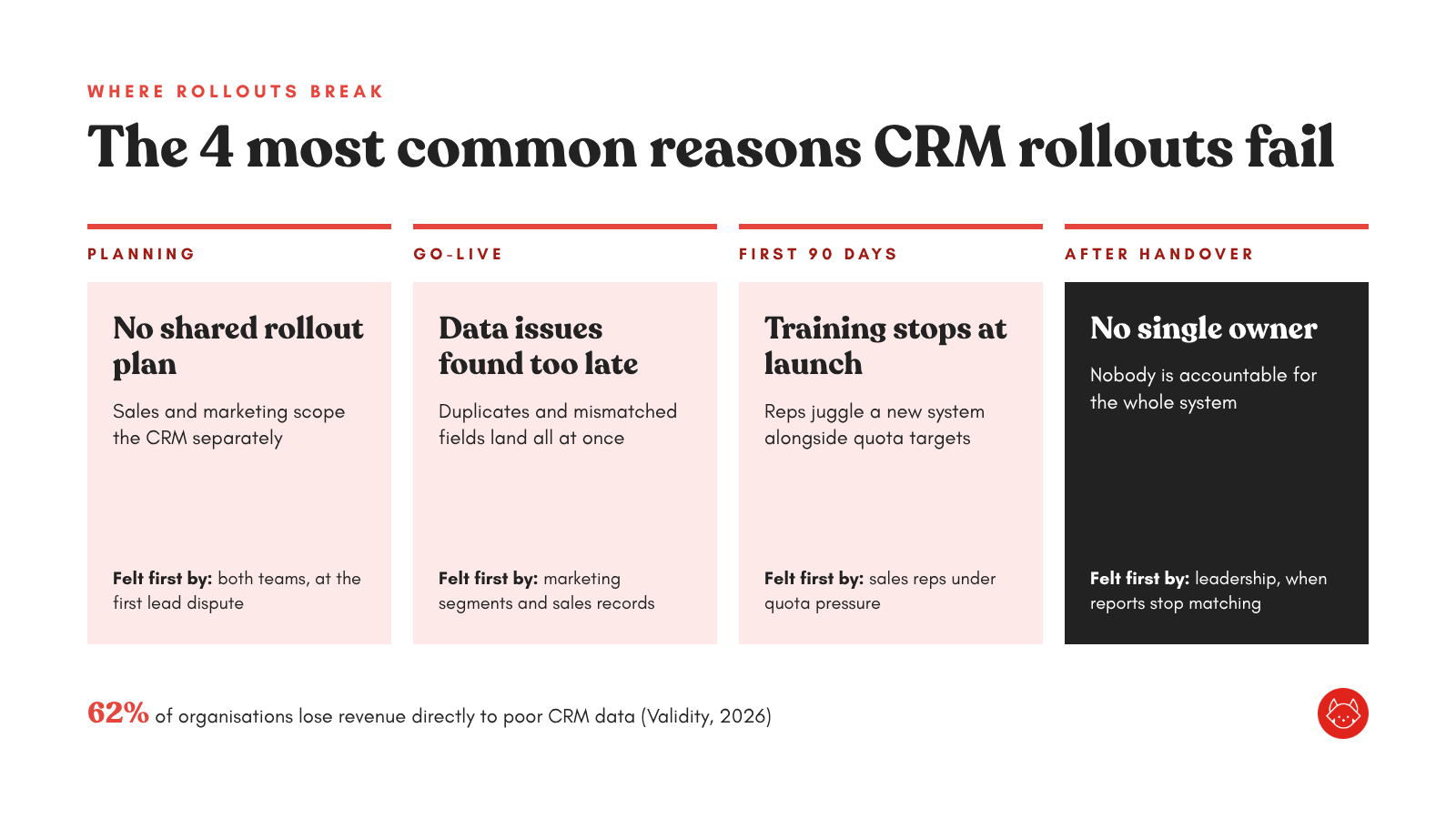
Most failed CRM rollouts trace back to the same four causes. Each hits sales and marketing differently, which is why they’re easy to miss until both teams lose trust in the system:
| Cause | When it shows up | Who feels it first |
| No shared rollout plan | Planning | Both teams, at the first lead dispute |
| Late data migration issues | Go-live | Marketing (segments) and sales (records) |
| Training stops at launch | First 90 days | Sales reps under quota pressure |
| No single owner | After handover | Leadership, when reports stop matching |
Reason #1: Sales And Marketing Aren’t Aligned On The Rollout Plan
Misalignment starts when each team scopes the CRM for its own needs. Sales wants a pipeline it can forecast; marketing wants segments, scoring, and attribution.
Without agreed lifecycle stages or a shared definition of a qualified lead, the CRM gets built twice inside one portal. The result is a broken handover.
Influ2’s 2025 analysis of 105 B2B companies found 53 per cent had a broken hand-off, with sales following up with fewer than 35 per cent of prospects marketing had engaged. Only 11 per cent were aligned on both hand-off and target audience.
Reason #2: Data Migration Issues Surface Too Late
Data problems stay hidden during the build and appear the week you go live. Duplicates, missing lifecycle stages, and mismatched fields from old systems all land in the new CRM at once.
Each team feels it differently.
Marketing can’t build reliable segments, and sales opens records with the wrong owner or no history.
Validity’s State of CRM Data Management in 2025 report found 76 per cent of CRM users say less than half of their organisation’s CRM data is accurate and complete.
Reason #3: Training Stops After Go-Live
One-off training happens at launch, then the trainers leave. Sales reps are left juggling a new CRM alongside quota targets, and marketers work out workflows by trial and error.
That overload has a direct cost.
Reps who feel buried by new tools protect their selling time by skipping CRM updates, so deal records go stale and forecasts lose accuracy.
Marketing feels it next: without reliable deal data, it can’t see which campaigns actually turn into revenue.
Reason #4: No Single Owner Across Both Teams
Ownership gaps appear when the CRM belongs to “sales ops” for pipelines and “marketing ops” for automation, with nobody accountable for the whole system.
Changes get made in isolation, properties multiply, and the two teams’ reports stop matching.
This is the pattern RedPandas Digital found at m|devices, where sales and service worked in silos, causing duplicate work and missed hand-offs.
The business came close to replacing HubSpot altogether before one shared customer journey brought the teams back into the same system.

The Complete Guide to CRM Adoption Problems in 2026 (And How to Fix Them)
Early Warning Signs a Rollout is Going Off Track
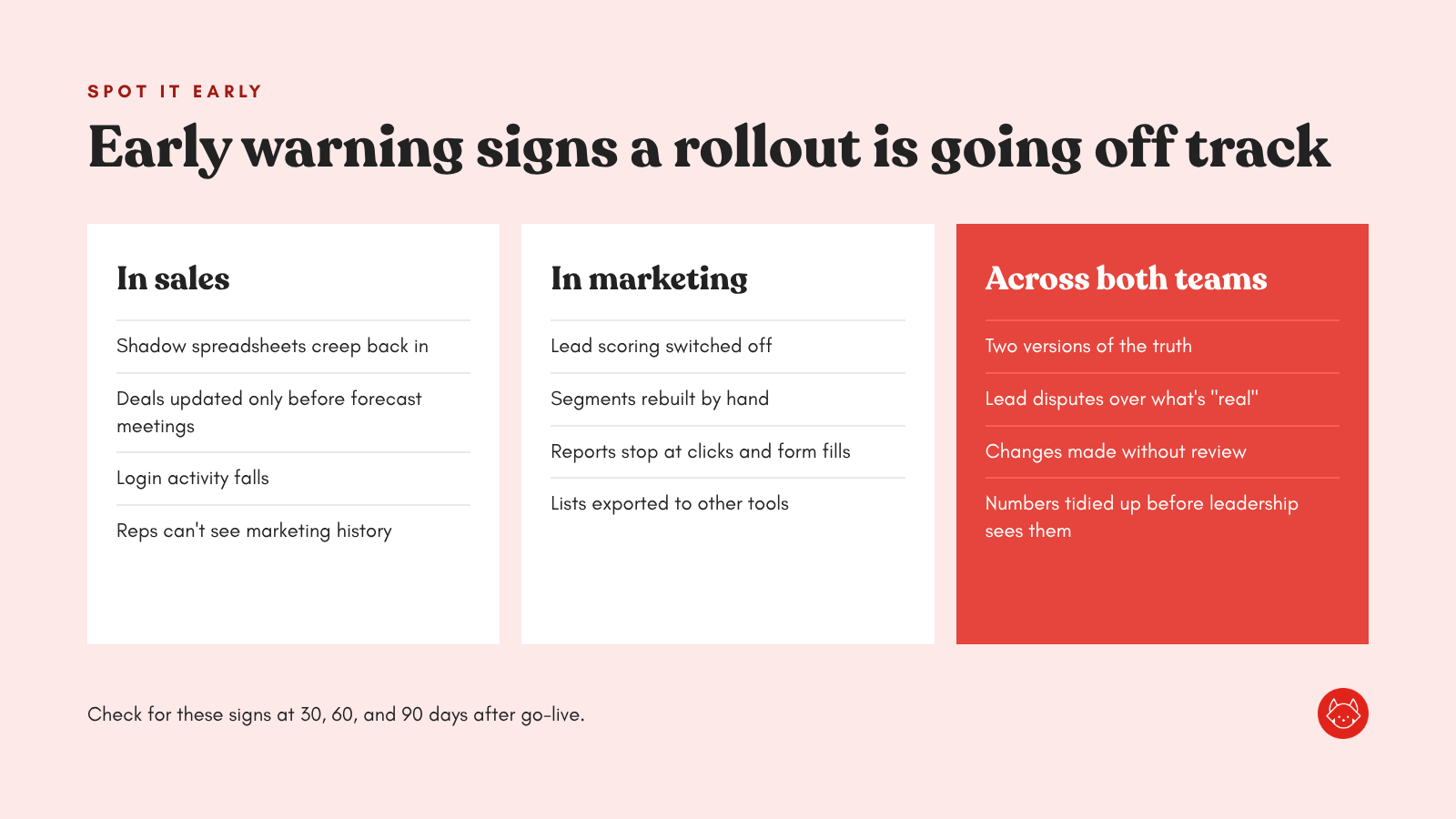
CRM rollouts rarely fail overnight. They drift, and the signs show up in behaviour long before they show up in revenue.
Spot these signs in the first 90 days, and you have time to fix the cause before both teams give up on the system:
Signs in Sales
- Shadow spreadsheets creep back in for pipeline tracking or call lists
- Deals updated only before forecast meetings, with no activity logged in between
- Falling login activity, which you can check by exporting users with their last login date in HubSpot (Settings > Users & Teams)
- Reps can’t find a contact’s marketing history before a call
Signs in Marketing
- Lead scoring switched off or quietly ignored
- Segments rebuilt by hand because lifecycle stages or properties can’t be trusted
- Campaign reports that stop at clicks and form fills, with no link to deals or revenue
- Lists exported to other tools to send campaigns
Signs Across Both Teams
- Two versions of the truth, with sales and marketing bringing different numbers to the same meeting
- Lead disputes over whether marketing’s leads are “real”
- Unreviewed changes, with new properties, pipelines, or workflows added without anyone approving them
- Adjusted reporting, where numbers are tidied up before they reach leadership
That last sign is more common than most leaders expect. Validity’s State of CRM Data Management in 2026 report found 67 per cent of C-suite respondents admit campaign data is at times manipulated to make results look better to leadership.
| Warning sign | Likely cause |
| Lead disputes, broken handover | No shared rollout plan |
| Rebuilt segments, records with no history | Late data migration issues |
| Shadow spreadsheets, falling logins | Training stopped at launch |
| Unreviewed changes, two versions of the truth | No single owner |
Tip: Check these signs at 30, 60, and 90 days after go-live, or run a full HubSpot health check. One or two is normal. The same sign appearing in both teams means the cause sits across sales and marketing, and needs a cross-team fix.
4 Practical Fixes For Each Cause
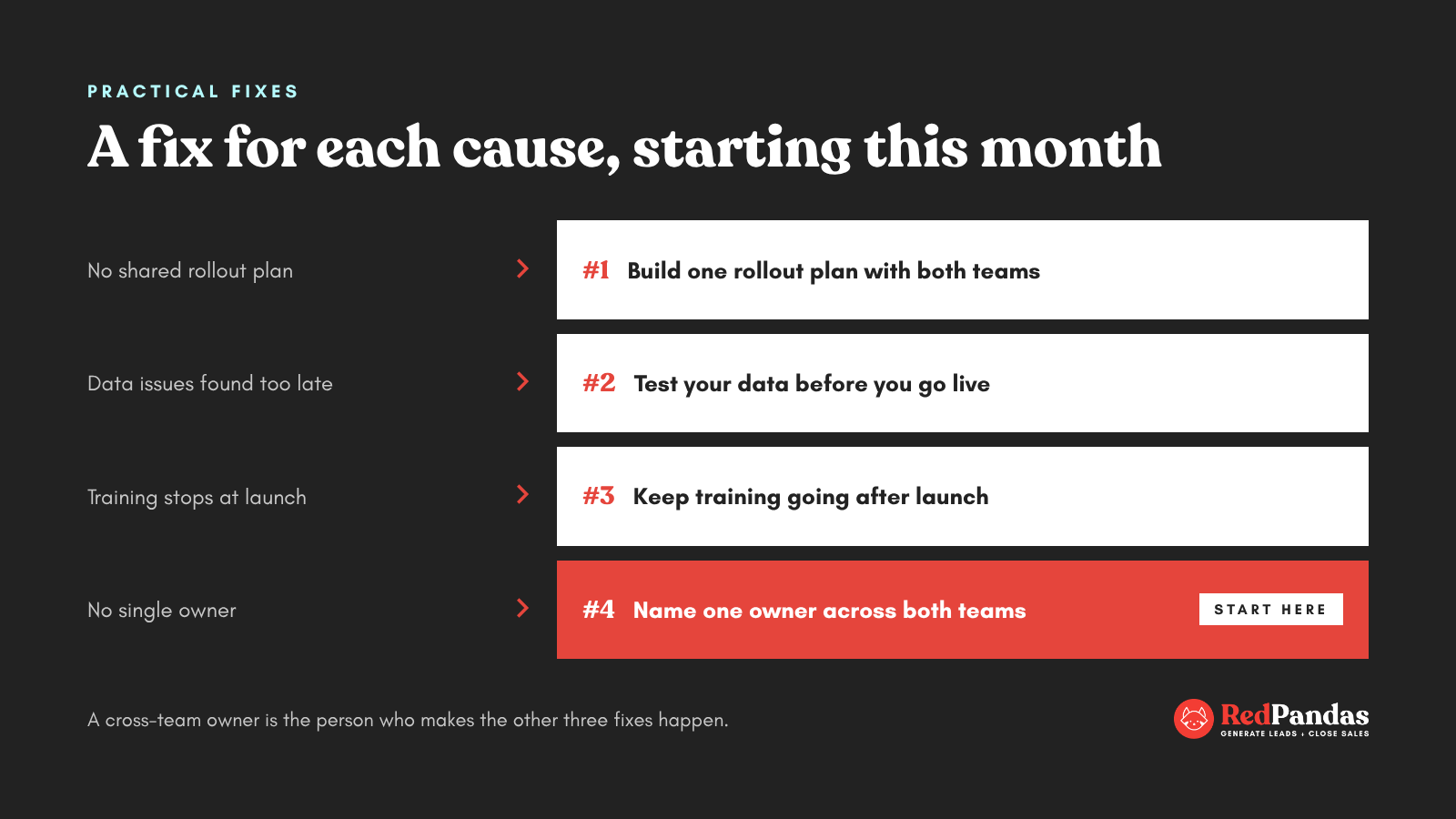
Each cause has a fix you can start early, ideally before go-live and at the latest within the first 90 days. Treat the rollout as a change project as well as a software project when you carry out these fixes:
Fix #1: Build One Rollout Plan With Both Teams
- Run a joint kick-off workshop: Put sales and marketing leaders in the same room before any configuration starts
- Agree on lifecycle stages and lead definitions in writing: Define what makes a marketing qualified lead and a sales qualified lead, and get both teams to sign off
- Set a service-level agreement for the handover: For example, sales follows up on every marketing qualified lead within an agreed timeframe, and marketing commits to a lead volume target
- Share one set of success metrics: Track pipeline created, stage conversion, and revenue, so neither team is judged in isolation
The potential payoff of applying these fixes is measurable. Influ2’s 2025 analysis found marketing influenced up to 29 per cent of pipeline in aligned companies, compared with 10 per cent where the hand-off was broken.
Fix #2: Test Your Data Before You Go Live
- Audit source data early: Identify duplicates, empty fields, and mismatched properties in your old systems before migration starts
- Map every field: Decide which old fields carry over, which merge, and which retire
- Run a test migration: HubSpot Enterprise subscriptions include a standard sandbox where you can import up to 200,000 records per object type and test workflows without touching live data
- Have both teams check the results: Sales checks deal and contact records; marketing checks segments and lifecycle stages before sign-off
Fix #3: Keep Training Going After Launch
- Train by role: Sales reps learn pipeline and activity logging; marketers learn segmentation, scoring, and reporting
- Cut tools before adding training: Gartner found overwhelmed sellers were 45 per cent less likely to hit quota, so retire the spreadsheets and duplicate tools the CRM replaces
- Schedule follow-up sessions at 30, 60, and 90 days, focused on the warning signs you’re seeing
- Appoint champions in each team who answer day-to-day questions and flag problems early
Fix #4: Name One Owner Across Both Teams
- Appoint a single CRM owner: This could be a revenue operations lead or a senior manager with authority over both teams’ requirements
- Set a change process: New properties, pipelines, and workflows go through the owner before going live
- Hold a monthly CRM optimisation review with sales and marketing leads to check adoption, data quality, and the handover SLA
- Report one set of numbers to leadership, drawn directly from the CRM, so there’s a single version of the truth
Tip: If you can only start one fix this month, start with fix four. A cross-team owner is the person who makes the other three happen.
How RedPandas Digital De-risks CRM Rollouts Across Teams
Most CRM onboarding partners are built around one function: sales pipelines or marketing automation. RedPandas Digital works across both.
The agency runs HubSpot implementation and onboarding alongside paid media and content marketing, so sales and marketing are planned into one CRM from the first workshop.
As a HubSpot Diamond Solutions Partner with CRM Implementation and Onboarding accreditations, RedPandas tackles each cause of rollout failure directly:
| Cause of failure | How RedPandas addresses it |
| No shared rollout plan | A customer journey mapping workshop with sales and marketing together, defining lifecycle stages and the handover before configuration |
| Late data migration issues | Data clean-up and segmentation before automation is built, with training based on test runs |
| Training stops at launch | Weekly coaching sessions through the engagement, plus role-based training for marketing and sales on your own portal |
| No single owner | Activity reporting and custom dashboards that give leadership one view across both teams |
Marketing And Sales Data In One Place
Because RedPandas also manages paid media, campaign spend is tracked through to closed deals in the same CRM. That gives both teams a shared view of what’s working:
- Meta Ads: cost per acquisition cut from AUD $216 to AUD $90
- Google Ads: $303,622.84 in revenue generated from $22,911.88 in ad spend
Case study: m|devices
m|devices, an Australian business running HubSpot across sales, service, and marketing, nearly replaced the platform. Teams worked in silos, missed hand-offs, had inconsistent campaign tracking, and pipeline reporting couldn’t support forecasting.
Over a three-month HubSpot Optimisation Program, RedPandas mapped one shared customer journey, cleaned and segmented the data, built 10+ automation workflows, and trained each team on its own portal.
The results:
- HubSpot licence retained
- More than 12 hours saved each week on reporting
- 4x faster customer response rates
- Full visibility of productivity, deals, and pipeline for leadership
- Consistent UTM tagging so that marketing campaigns could be tracked reliably
Sam Chaisumdet, CEO of m|devices, said the RedPandas team “made a complex setup feel much more manageable.”
Read the full m|devices case study here.

Best HubSpot Partners in Australia: A Buyer’s Guide to Choosing the Right Agency (2026)
Frequently Asked Questions: Why CRM Rollouts Fail
Why do companies struggle with CRM implementation and onboarding services?
Companies struggle with CRM implementation and onboarding when sales and marketing scope the system separately, data problems surface after go-live, training ends at launch, and nobody owns the CRM across both teams. Validity’s 2025 report found 76% of CRM users say less than half of their CRM data is accurate and complete.
Why do CRM rollouts fail?
CRM rollouts usually fail for people and process reasons more than technical ones. The most common causes are misaligned teams, poor data migration, training that stops after launch, and no accountable owner. Gartner found 50% of B2B sellers feel overwhelmed by the technology their jobs require, which pushes them back to spreadsheets.
What’s the biggest cause of CRM implementation failure?
There’s rarely a single cause, but poor data quality is often the most costly. Validity’s 2026 report found that 62% of organisations lose revenue directly because of poor CRM data quality. Bad data erodes trust in the system, and once sales and marketing stop trusting the CRM, adoption falls quickly.
How do you align sales and marketing during a CRM rollout?
Run a joint kick-off before configuration starts and agree on lifecycle stages and lead definitions in writing. Set a service-level agreement for lead follow-up, share one set of pipeline and revenue metrics, and appoint one CRM owner who reviews changes and reports to both teams monthly.
What are the early warning signs a CRM rollout is failing?
Common warning signs include reps tracking deals in spreadsheets, falling login activity, marketing rebuilding segments by hand, and lead disputes between teams. Sales and marketing bringing different numbers to the same meeting is a strong signal. Check for these signs at 30, 60, and 90 days after go-live.
Who should own the CRM in a business?
One person should own the CRM across both sales and marketing, usually a revenue operations lead or a senior manager with authority over both teams. The owner approves changes, runs a monthly review, and reports one set of numbers to leadership. Split ownership between teams often leads to conflicting data.
How long does CRM onboarding take?
CRM onboarding timelines depend on how many teams, systems, and records are involved. Many mid-sized rollouts run over a few months, including data migration, configuration, and training. RedPandas Digital’s HubSpot Optimisation Program for m|devices ran over three months, covering journey mapping, automation, reporting, and team training.
Why Now?
Every month a rollout drifts, the fix gets harder. Spreadsheets become habits, bad data spreads into new records, and each team builds its own workarounds. The good news: all four causes are fixable early, and the cheapest time to fix them is before go-live.
Pick one warning sign from this guide and check for it this week. If you find it in both sales and marketing, start with ownership and a shared rollout plan.
About RedPandas Digital
This article was written by the team at RedPandas Digital, a HubSpot Diamond Partner based in Sydney, Australia, and one of only four HubSpot-accredited Diamond partners in the Asia-Pacific region.
RedPandas has implemented and optimised HubSpot for businesses across construction, healthcare, legal, education, and professional services. Learn more in this HubSpot partner page.
About the Author


Get the best content marketing insights right in your inbox!
Subscribe to our Newsletter and get marketing insights delivered to your inbox every week.