




CRM Change Management Guide for AU Businesses With Long Sales Cycles

Key Takeaways
- Long sales cycles amplify CRM rollout risk, with bigger buying committees, slower feedback and deals that stall mid-cycle
- Structured change management pays off. Prosci found projects with excellent change management are about seven times more likely to meet objectives
- Use four steps: map stakeholders, roll out in phases, train at each deal milestone, and run fortnightly feedback loops
- Prove progress with leading indicators that move within weeks, long before the first deal closes
- Rollouts can be turned around. m|devices, a RedPandas client, went from weeks away from replacing HubSpot to saving 12+ hours a week on reporting
Quick Answer
Companies struggle with CRM implementation in long-sales-cycle businesses because more stakeholders, slower feedback and delayed results make it easy to slip back to old habits.
Fix it with structured change management: map stakeholders, roll HubSpot out in phases, train at each deal milestone, and run regular feedback loops.
Once you have a solid structure, track leading indicators to show early progress.
If you want a clearer picture of what to improve in your HubSpot setup for better change management, the free HubSpot Health Check Quiz shows you where to start.
Build your CRM adoption roadmap and get clarity on how to make HubSpot match exactly how your business works by taking the quiz below:


Get Your Free HubSpot Health Check
There’s a problem that comes up six months after your HubSpot portal goes live: you open the pipeline, and it barely matches what your reps reported in Monday’s sales meeting.
Senior reps still track deals in spreadsheets, and the forecast you promised leadership is mostly guesswork.
If that sounds familiar, you’re not alone.
In fact, you’re probably facing one of the things most businesses moving to HubSpot overlook: change management.
Companies often struggle with CRM implementation and onboarding because a rollout changes how people work every day, and that change needs as much planning as the software setup.
Long sales cycles make it harder: more stakeholders, slower feedback, and months before anyone sees a deal tracked from first touch to close.
Structured change management solves this.
It maps every stakeholder, rolls HubSpot out in phases, trains people at the moments they need it, and builds feedback loops so problems surface early, long before the first deal cycle ends.
RedPandas Digital has rescued rollouts exactly like this. As a HubSpot Diamond Partner, the agency works with Australian B2B businesses in construction, professional services, education and healthcare, where deals take months, and buying committees are large.
In this guide, you’ll learn why long sales cycles amplify rollout risk, a step-by-step change management framework, how to show progress before the first deal closes, and the warning signs that your rollout is drifting off track.
Why Long Sales Cycles Amplify CRM Rollout Risk
Every CRM rollout asks people to change habits. In a long sales cycle, that change has to survive months of meetings, proposals, and approvals before anyone sees the payoff:
| Long-Cycle Factor | Why It Raises Rollout Risk | What It Looks Like in HubSpot |
| Bigger buying committees | Complex B2B purchases involve 6 to 10 decision-makers, and each needs capturing | Deals with one contact attached, while the rest of the committee lives in a rep’s head |
| Slow feedback loops | Reps log activity for months before a deal closes, so the CRM’s value feels distant | Activity logging drops off a few weeks after training |
| Deals that stall mid-cycle | Forrester’s research found 86% of B2B purchases stall at some point | Stale deal stages and past close dates skewing the forecast |
| Senior, relationship-led reps | Experienced reps have sold from memory for years, so the CRM feels like admin | HubSpot updated just before pipeline meetings |
| Long marketing-to-sales handoffs | Leads nurture for months, so unclear lifecycle definitions cause friction | Leads recycled, disputed or lost between teams |
| A higher cost of getting it wrong | Months of poor adoption mean months of unreliable data | Leaders pull numbers from spreadsheets instead of dashboards |
For example, an Australian commercial builder might work with a developer, an architect, a quantity surveyor and a project manager on one tender.
If only the developer is logged in HubSpot, the deal’s real status is invisible to everyone except the rep.
The common thread is timing: people feel the cost of changing straight away, but the benefits arrive months later. Structured change management closes that gap.

How to Align Your Sales and Marketing Teams Using HubSpot
A 4-Step Change Management and CRM Transition Framework for Long Sales Cycles
Structured change management delivers measurable results.
In Prosci’s research, 88 per cent of projects with excellent change management met or exceeded their objectives, compared with 13 per cent of projects with poor change management.
For a long-cycle HubSpot rollout, it comes down to four steps:
Step #1: Map Every Stakeholder

Know who the rollout affects and what each person needs:
| Stakeholder | Role in the rollout | What they need from you |
| Executive sponsor | Uses HubSpot reports in leadership meetings and backs the rollout publicly | A clear business case and dashboards they trust |
| CRM champions | One respected user per team who tests changes and flags problems early | Early access, extra training and a direct line to the project lead |
| Senior reps | The influential users whose habits others copy | Proof HubSpot saves them time, plus input into pipeline design |
| Sales and marketing managers | Coach teams and enforce new processes | Agreed lifecycle definitions and adoption reports by rep |
| Everyday users | Log activities, update deals and work leads | Simple processes and short role-based training |
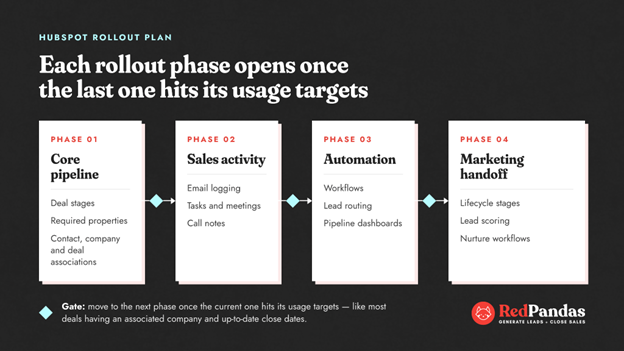
Step #2: Roll Out in Phases

Launch in stages so each team masters one change before the next:
- Core pipeline: Deal stages, required properties and contact-to-company-to-deal associations
- Daily sales activity: Email logging, tasks, meetings and call notes
- Automation and reporting: Workflows, lead routing and pipeline dashboards that pay reps back for their data entry
- Marketing handoff: Lifecycle stages, lead scoring and nurture workflows
Move on once the current phase hits its usage targets, such as most deals having an associated company and up-to-date close dates.
Step #3: Train at Each Milestone

Teach a feature at the moment people need it.
Train reps on logging a buying committee when they open a new opportunity, on quotes when they send their first proposal, and on forecasting when month-end reviews begin.
This step helps ensure adoption by giving your team more exposure to unique situations and training them to handle each one. With enough training, each member becomes more comfortable with the CRM and rationalises using it through repeated exposure.
Step #4: Build Feedback Loops
Find problems while they’re small.
Hold fortnightly check-ins with your CRM champions, review an adoption dashboard by rep, fix friction quickly, and tell the team what changed.
Tip: If your business already uses a formal change model, such as Prosci’s ADKAR, the four steps above slot neatly inside it.
Each phase builds the last, and the team only moves once the current phase hits its usage targets.
How to Show Progress Before the First Deal Closes
When deals take six months or more to close, leading indicators show adoption is on track long before closed-won revenue can.
Track these from the first week to more accurately report change management and CRM adoption progress:
| Leading indicator | What it tells you | How to track it in HubSpot |
| Activities logged per rep | Whether calls, emails and meetings are recorded | An activity report by user and week |
| Buying committee coverage | Whether deals capture the full group of decision-makers | Associated contacts per deal |
| Required field completion | Whether deals hold the data your forecast needs | A deal view filtered for blank amounts or close dates |
| Deal stage freshness | Whether pipeline data reflects reality | Open deals with past close dates or no recent updates |
| Stage progression | Whether deals move at the pace reps report | Deal stage history and time-in-stage reporting |
| Lead follow-up speed | Whether marketing-qualified leads get prompt attention | Time from lifecycle stage change to first sales activity |
Share these in a monthly adoption update with these recommended key points:
- Trend by rep
- One win story where HubSpot made a difference
- The next friction point you’re fixing
For example, an Australian education provider with a long enrolment cycle can track follow-up speed on enquiries and the share of complete student records. This allows them to show progress to management within weeks.
7 Signs Your CRM Change Management Approach Isn’t Working
A stalled rollout rarely announces itself, and it often starts with sales teams resisting the CRM.
Watch out for these seven warning signs:
- HubSpot only gets updated before pipeline meetings: Run meetings straight from HubSpot dashboards, so updating as you go becomes easier
- Shadow spreadsheets are back: Find out what the spreadsheet tracks, then build that field, view, or report in HubSpot
- Your CRM champions have gone quiet: Give them protected time and show them what changed because of their feedback
- The data looks a little too good: Some CRM users tend to fabricate data to keep decision-makers happy. Reward accurate updates, even when the news is bad
- Marketing and sales argue about lead quality: Document how lifecycle stages, lead status and deal stages differ, then review the definitions monthly
- Leadership pulls numbers from somewhere else: Make HubSpot dashboards the only source for pipeline numbers in leadership meetings
- The same questions keep coming up: Switch to short sessions tied to deal milestones, backed by a simple internal how-to guide
Tip: One or two of these signs early on is normal. If several appear at once, pause the next rollout phase and fix the foundations first.
How RedPandas Digital Runs Change Management for Long-Cycle B2B
RedPandas Digital builds adoption into HubSpot onboarding from day one.
As a HubSpot Diamond Partner with offices in Sydney and Melbourne, RedPandas works with Australian B2B businesses whose deals run for months.
Here’s a glimpse into what the process looks like when you work with the agency’s experts:
- Stakeholder buy-in first: RedPandas works with your sponsor and champions before configuration, so pipelines reflect how senior reps actually sell
- Phased onboarding: The core pipeline goes live first, with automation, reporting and marketing handoff layered in as usage targets are met
- Role-based training: The team holds HubSpot Trainer certification and runs short sessions tied to real deal milestones
- Adoption reporting: Leadership sees leading indicators well before the first deal closes
One HubSpot Mentors podcast episode recently unpacked seven root causes of poor HubSpot adoption, including cluttered properties, one-off training and missing leadership accountability.
What RedPandas’ Approach Looked Like for a Real Client
m|devices was weeks away from replacing HubSpot altogether. Its sales and service teams worked in silos, key processes were manual, and sales leaders struggled to forecast accurately.
RedPandas ran a three-month optimisation program in three phases:
- Strategic mapping and enablement: journey mapping, weekly coaching, data clean-up
- Automation and Service Hub optimisation: 10+ workflows, automated ticket routing, and custom dashboards
- Reporting and team training to support long-term adoption
The results:
- 12+ hours saved per week on reporting
- 4x faster customer response rates
- 100% visibility across productivity, deals and pipelines
- HubSpot licence retained, with HubSpot as the single source of truth
Read the full m|devices case study here.
Frequently Asked Questions: CRM Implementation and Onboarding
Why do companies struggle with CRM implementation and onboarding services?
A rollout changes how people work every day, and that change needs as much planning as the software. Common causes include weak executive sponsorship, one-off training, unclear processes and poor data. Long sales cycles add more stakeholders and slower feedback, making it easier to drift back to old habits.
What is CRM change management?
CRM change management is the structured process of helping people adopt a new CRM and new ways of working. It covers stakeholder mapping, a phased rollout, role-based training and feedback loops. Prosci research found projects with excellent change management are about seven times more likely to meet objectives.
Why do long sales cycles make CRM adoption harder?
The benefits arrive months after the effort. Gartner finds complex B2B purchases involve 6 to 10 decision-makers, so every deal needs more contacts logged and associated. Deals also stall for long stretches, letting stage and close-date data go stale unless reps keep updating it.
How long should a CRM change management rollout take?
Most structured rollouts run in phases over several months, moving forward as each phase hits its usage targets. RedPandas Digital’s HubSpot optimisation for m|devices, for example, ran over three months in three phases. Keep reinforcing adoption until at least one full deal cycle is tracked in the CRM.
Can you recommend tools or strategies to facilitate CRM change management?
Start with an executive sponsor and a CRM champion in each team. Roll out in phases, train people when they need each feature, and hold fortnightly feedback check-ins. In HubSpot, adoption dashboards tracking activities, deal updates and associated contacts per rep show where support is needed.
What are common challenges faced during a CRM transition and how to overcome them?
Common challenges include resistance from experienced reps, messy migrated data, unclear lifecycle definitions and training that fades too soon. Involve senior reps in pipeline design, clean data before go-live, agree stage definitions across sales and marketing, and tie short training sessions to real deal milestones.
What are the best practices for a smooth CRM switch?
Start with clean data and agreed processes before migration. Map stakeholders, launch the core pipeline first, then add activity tracking, automation and reporting in phases. Train each role on what they need, track leading indicators, and keep the executive sponsor using CRM dashboards.
How do I get senior sales reps to use the CRM?
Involve senior reps early by asking them to help design the pipeline and deal stages, so the CRM reflects how they sell. Show them a personal benefit, such as automated follow-up reminders. Run pipeline meetings from CRM dashboards so updating HubSpot becomes the easiest option.
How do you measure CRM adoption before deals close?
Use leading indicators that move within weeks: activities logged per rep, contacts associated per deal, required field completion, deal stage freshness and lead follow-up speed. Share the trend in a monthly adoption update so leadership sees progress long before the first full deal cycle closes.
Your Next Deal Cycle Is Your Rollout Deadline
Every month a rollout drifts, your team builds another month of habits outside the CRM.
A clear sponsor, a phased plan, well-timed training and a simple adoption dashboard will get your team using HubSpot before the next deal cycle ends.
For more on getting your team using HubSpot:
- Read the complete guide to CRM adoption problems in 2026
- Learn why most businesses struggle with CRM adoption
- Check the 4 reasons your HubSpot implementation could fail
Planning a rollout or rescuing a stalled one? Get in touch through the link below for a free HubSpot consultation and roadmap session:
Get Your Free HubSpot Consultation
About RedPandas Digital
This article was written by the team at RedPandas Digital, a HubSpot Diamond Partner based in Sydney, Australia, and one of only four HubSpot-accredited Diamond partners in the Asia-Pacific region.
RedPandas has implemented and optimised HubSpot for businesses across construction, healthcare, legal, education, and professional services. Learn more in this HubSpot partner page.
About the Author


Get the best content marketing insights right in your inbox!
Subscribe to our Newsletter and get marketing insights delivered to your inbox every week.