









Can HubSpot Marketing Hub Help With B2B Lead Generation? A 2026 Australian Buyer’s Guide

Key Takeaways
- HubSpot Marketing Hub does support B2B lead generation, but results depend on your tier, configuration, and how ready your sales team is to follow up
- Professional tier is the realistic entry point. Starter lacks the workflows, lead scoring, and automation that actually generate qualified leads
- Australian pricing starts at AUD $1,380/month for Marketing Hub Professional, including three core seats, before contact tier increases and a mandatory onboarding fee
- Breeze AI adds genuine capability, including automated lead research and CRM enrichment, but it performs best on clean, well-structured data
- The biggest failure mode isn’t the software; it’s the setup. A poorly configured portal underperforms regardless of tier
- Marketing Hub suits B2B teams with a defined ideal customer profile and a sales process that can act on leads quickly
- If your sales process isn’t documented yet, fix that first. HubSpot amplifies what’s already working, not what’s broken
Quick Answer
Yes, HubSpot Marketing Hub can generate qualified B2B leads. This works from the Professional tier upward, once workflows and lead scoring are configured correctly.
Australian businesses pay around AUD $1,380 a month for Marketing Hub Professional, with three core seats included, before contact tier increases and onboarding fees apply. It suits B2B teams with a defined ideal customer profile and a sales process ready to act on qualified leads.
If you’re curious as to whether your HubSpot portal is in the right shape to reap the benefits or not, this free HubSpot Health Check Quiz gives you the answers you need in two minutes or less. Take it through the link below:


Take the Free HubSpot Health Check Quiz
HubSpot Marketing Hub can help generate B2B leads, and the platform’s own data backs that up.
In fact, businesses using HubSpot generate three times more leads on average, with 86 per cent of sales professionals reporting improved lead quality once it’s properly implemented.
That’s a strong number, but it raises one question that needs to be answered before signing a contract.
Will Marketing Hub actually deliver for your business… Or will it become another underused subscription draining your budget?
At RedPandas, we’ve built Marketing Hub portals from scratch for Australian B2B businesses across legal, education, and professional services. We’ve also fixed plenty that other agencies got wrong.
This guide breaks down what Marketing Hub actually does for B2B lead generation. You’ll get real AUD pricing and a clear way to tell if it’s the right fit for your business.
What Is HubSpot Marketing Hub?
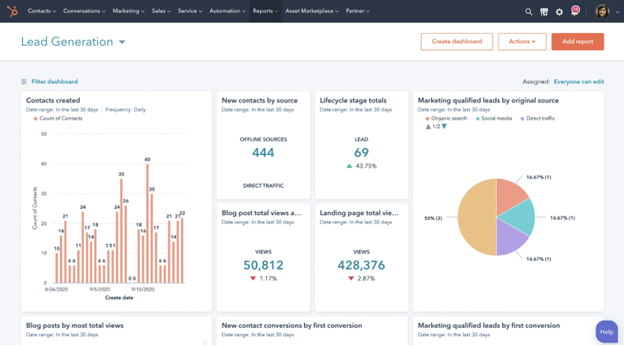
HubSpot Marketing Hub is HubSpot’s marketing automation product. It sits alongside Sales Hub, Service Hub, and Content Hub inside the wider HubSpot platform.
This hub handles email marketing, workflow automation, ad management, lead scoring, and marketing reporting.
Every Marketing Hub subscription runs on HubSpot’s core CRM, which is 100 per cent free and included by default with the purchase of any Hub, at any level. That means contact records sync automatically across your marketing, sales, and service teams.
Core capabilities inside HubSpot Marketing Hub include:
- Email marketing and automated workflows, for nurturing leads without manual follow-up
- Forms and lead capture, tied directly to contact records in the CRM
- Ad management across Google, Meta, and LinkedIn
- Lead scoring and segmentation, to separate ready-to-buy contacts from early researchers
- Marketing reporting and attribution, to show which campaigns actually produce pipeline
- Breeze AI tools for campaign drafting, content repurposing, and audience insights
HubSpot Marketing Hub vs Content Hub, Sales Hub, and the Free CRM
It’s crucial to note that HubSpot restructured its packaging in 2024. Landing pages and blogging features were moved out of Marketing Hub and into a separate product called Content Hub, which also now includes the HubSpot CMS.
If your B2B lead generation strategy depends on gated landing pages or a content-heavy website, you’ll likely need Content Hub alongside HubSpot Marketing Hub.
On the other hand, Sales Hub is a separate product again. It’s built for pipeline management, deal tracking, and sales sequencing rather than campaigns.
HubSpot Marketing Hub and Sales Hub share the same underlying contact record, so a lead’s marketing activity is visible to sales without a manual handoff.
For Australian businesses, one practical detail matters here: the platform bills Australian customers directly in AUD, with no currency conversion fees applied, so the pricing you see is the pricing you pay.
If you want to go over the costs and options of this tool, check out this guide on Marketing Hub tiers and pricing.
HubSpot Marketing Hub Features for B2B Lead Generation
Five HubSpot Marketing Hub features do the heavy lifting for B2B lead generation. Here’s how each one works and what it takes to unlock it:
| Feature | What It Does | B2B Lead Generation Impact | Tier Required |
| Forms & Lead Capture | Connects every submission directly to a CRM contact record; supports progressive profiling so returning visitors see new questions | Shorter forms that still build a full lead picture over time, with no manual data entry | All tiers (landing pages sit in Content Hub) |
| Workflow Automation | Triggers nurture sequences from form fills, score changes, or page visits | Keeps leads engaged during the average 11.3-month B2B research cycle, without a rep chasing manually | Professional and Enterprise |
| Lead Scoring | Rules-based scoring combining firmographic fit with behavioural engagement | Can move MQL-to-SQL conversion toward 30% or higher by separating real buyers from noise | Professional: 5 scoring properties. Enterprise: 50, with AI recommendations |
| ABM Tools | Target Account, ICP Tier, and Buying Role properties, plus LinkedIn Sales Navigator integration | 76% of marketers report higher ROI from ABM than other approaches; 171% higher deal values on average | Professional and Enterprise |
| Breeze AI | Breeze Intelligence enriches CRM data from 200M+ company and contact profiles; Prospecting Agent drafts outreach from CRM data | Cleaner data for scoring and segmentation, plus outreach research at roughly $1 per qualified lead | Add-on, outcome-based pricing across tiers |
Note: ABM and workflow automation both require the same Professional-tier upgrade, so most B2B teams end up needing it for more than one reason.

Why Businesses Fail at Lead Generation with HubSpot
4 Ways You Can Use HubSpot Marketing Hub for B2B Lead Generation

Knowing what HubSpot Marketing Hub can do is one thing. Using it to generate leads is a completely different story.
Here are four proven ways you can use it to improve your lead generation strategy:
1. Automate Lead Nurturing With HubSpot Marketing Hub Workflows
Most B2B buyers research quietly before they ever contact sales. A workflow built in HubSpot Marketing Hub keeps your business visible during that window, without a rep chasing every contact manually.
To set this up:
- Trigger the workflow off a specific action, such as a form fill or a pricing page visit
- Space follow-up emails a few days apart, rather than sending them back-to-back
- Route engaged, non-converting contacts into a slower nurture track, instead of writing them off after one email
23 per cent of marketing-sourced revenue is attributed to automated workflows in the median B2B program, which makes this one of the highest-leverage places to start.
2. Score Every Lead So Sales Chases the Right Ones
A form fill isn’t the same as a sales-ready lead. Scoring separates the two, so your sales team spends time on contacts who are actually close to buying.
Build your scoring model in three layers:
- Fit criteria, such as industry, company size, and job title
- Behaviour criteria, such as page visits, email opens, and pricing page views
- A clear score threshold that automatically notifies sales once a lead crosses it
Programmes that add lead scoring within six months of launch, according to a previously cited source, see a 34 per cent revenue lift on average. This is largely because sales stops guessing which leads are worth a call.
3. Target High-Value Accounts Instead of Casting a Wide Net
If a handful of accounts represent most of your potential revenue, broad-net lead generation wastes effort. HubSpot Marketing Hub’s account-based marketing tools let you focus there instead.
You can set this Marketing Hub lead generation workflow in four steps:
- Mark your best-fit companies as Target Accounts
- Assign each one an Ideal Customer Profile tier, so your team knows where to focus first
- Build a workflow that scores and prioritises accounts as they engage with your content
- Sync your top-tier accounts to LinkedIn for matched ad targeting
This approach suits businesses with a defined, relatively small list of target accounts, rather than teams selling to a broad, undifferentiated market.
4. Let Breeze AI Handle Research So Your Team Focuses on Selling
Manual account research eats up hours your team could spend actually selling. HubSpot Marketing Hub’s Breeze AI tools are built to close that gap.
Here’s a sample rep-prep workflow you can build with Breeze AI:
- Turn on Breeze Intelligence to auto-fill missing company and contact data as new leads come in
- Feed that enriched data into your scoring model, so scoring works from complete information rather than guesswork
- Use the Prospecting Agent’s account research to give reps a warm starting point instead of a blank page
This only works best once your data is already reasonably clean. Breeze speeds up good research, but it doesn’t fix a messy CRM on its own.
Is HubSpot Marketing Hub Right for You?
HubSpot Marketing Hub isn’t the right choice for every B2B business, and that’s worth saying plainly before you spend a cent. Here’s how to tell where you sit:
Signs HubSpot Marketing Hub Is a Good Fit
| Signal | Why it matters |
| You have a defined ideal customer profile | HubSpot Marketing Hub’s scoring and ABM tools need a target to aim at. Without one, they run empty |
| Your sales cycle involves genuine consideration time | If prospects need weeks or months of nurturing before they’re ready to buy, automated workflows earn their cost |
| Your lead volume has outgrown spreadsheets | Manual list management becomes the bottleneck once inbound leads pick up |
| You have someone who’ll actually configure and maintain it | A marketing operations person, or a partner, who owns workflows, scoring, and reporting on an ongoing basis |
| Your team has a documented sales process | HubSpot Marketing Hub supports an existing process well. It won’t invent one for you |
Signs HubSpot Marketing Hub Isn’t the Right Fit Yet
| Signal | Why it matters |
| Your sales process is short and transactional | If there’s no real nurture period between first contact and purchase, most of Marketing Hub’s automation goes unused |
| You don’t yet have documented sales or marketing goals | Implementing sophisticated automation before you know what you’re optimising for tends to produce expensive guesswork rather than pipeline |
| Nobody owns the platform long-term | Without a dedicated owner, workflows go stale, and scoring drifts away from how your buyers actually behave |
| You’re considering Enterprise without the operational resourcing to match | Most HubSpot Enterprise features sit inactive because the tier was bought without the marketing operations resource needed to configure it properly |
HubSpot Marketing Hub Fit by Business Size and Maturity
| Business profile | Fit for HubSpot Marketing Hub |
| Solo founder or very early-stage team | Start on Free. Move to Professional once lead volume and process justify it |
| Growing B2B team with a defined ICP | Professional is the realistic starting tier for genuine lead generation |
| Larger team, multiple business units or brands | Enterprise, but only with a dedicated marketing operations resource in place |
| Short sales cycle, low consideration purchase | Consider whether a simpler CRM or email tool serves you better first |

The One HubSpot Tool That Can Instantly Improve Your Marketing ROI
Frequently Asked Questions About HubSpot Marketing Hub
Can HubSpot Marketing Hub help with B2B lead generation?
Yes. HubSpot Marketing Hub generates genuine B2B leads through workflow automation, lead scoring, and ABM tools, provided it’s implemented on the Professional tier or above. Businesses using HubSpot generate three times more leads on average, though results depend on proper configuration rather than the software alone. Poor implementation, not missing features, is the more common cause of disappointment.
What is HubSpot Marketing Hub used for?
HubSpot Marketing Hub is a marketing automation platform for email campaigns, workflow automation, lead scoring, ad management, and marketing reporting. It runs on HubSpot’s free CRM, so every form submission and email interaction syncs directly to a contact record. Landing pages and blogging now live in a separate product called Content Hub.
How much does HubSpot Marketing Hub cost in Australia?
HubSpot Marketing Hub pricing in Australia ranges from free to several thousand dollars monthly. Professional costs around AUD $1,380 a month with three core seats, plus a one-time onboarding fee. Enterprise costs more and includes five seats and 10,000 contacts. Additional contacts and seats increase the monthly cost further.
What’s the difference between HubSpot Marketing Hub and Sales Hub?
HubSpot Marketing Hub handles marketing automation, including email, workflows, lead scoring, and ad management. Sales Hub handles pipeline management, deal tracking, and sales sequencing instead. Both share the same underlying contact record inside HubSpot’s CRM, so a lead’s marketing activity is visible to sales without a manual handoff between teams.
Is HubSpot Marketing Hub good for small businesses?
HubSpot Marketing Hub suits small businesses with a defined target audience and a genuine sales consideration period. Businesses with short, transactional sales cycles or no documented sales process often get less value from it. Starting on the free tier and upgrading to Professional once lead volume grows is a sensible approach.
Does HubSpot Marketing Hub include landing pages?
Landing pages and blogging moved out of HubSpot Marketing Hub in 2024 into a separate product called Content Hub. Businesses that need both together can bundle both hubs at a lower combined cost than buying both products separately.
What HubSpot Marketing Hub tier do I need for lead generation?
Professional is the realistic starting tier for genuine B2B lead generation. It unlocks workflow automation, lead scoring, A/B testing, and account-based marketing tools, none of which are available on Starter. Enterprise adds predictive lead scoring and multi-touch attribution, useful for larger teams with dedicated marketing operations resourcing.
HubSpot Marketing Hub: The Bottom Line
HubSpot Marketing Hub can generate real B2B leads. The evidence throughout this guide backs that up, from workflow automation and lead scoring through to account-based marketing and Breeze AI.
But the software alone won’t do the work.
Configuration, clean data, and a genuine sales process determine whether HubSpot Marketing Hub becomes a growth engine or an underused subscription.
For Australian B2B businesses weighing Professional against Enterprise, or wondering whether HubSpot Marketing Hub fits your sales cycle at all, the answer usually comes down to readiness rather than the platform itself.
If you’re still unsure whether HubSpot Marketing Hub is the right investment, or you already have a portal that isn’t pulling its weight, RedPandas’ HubSpot experts can help you find out.
Book a free consultation with any of our specialists through the link below.
Get In Touch With Our Growth Experts
About RedPandas Digital
This article was written by the team at RedPandas Digital, a HubSpot Diamond Solutions Partner based in Sydney, Australia. RedPandas is one of a small number of agencies accredited under HubSpot’s Partnered Scale Onboarding programme, and has delivered results including a 49.8% revenue increase and 378% lead growth within five months for an Australian client.
About the Author




Get the best content marketing insights right in your inbox!
Subscribe to our Newsletter and get marketing insights delivered to your inbox every week.