









A 5-Step Framework for Setting Up an Education Lead Generation Pipeline Dashboard

With marketing ROI wildly swinging from under $100 AUD per enrolled student at some Australian universities to nearly $500 AUD at others, higher education institutions are under immense pressure to justify every dollar.
But most university marketing teams still can’t tell you which channel produced their last ten enrolments… And you might be one of them.
If your education lead generation reporting is a patchwork of spreadsheets, CRM exports, and gut feel, you’re not alone.
Marketing and admissions teams at universities across Australia face the same challenge; the data exists, but it isn’t:
- Connected
- Agreed on
- Visible in one place
At RedPandas, our growth experts have worked with higher education institutions to build CRM-based education lead generation pipelines that track students from first enquiry all the way to start date.
What we’ve found is that the dashboard isn’t the reason their lead generation falls behind; the agreement, the architecture, and the discipline around it are.
In this article, you’ll learn the five steps to build an education lead generation pipeline dashboard that gives you attribution clarity, pipeline visibility, and reliable enrolment forecasts that help you deliver results.
Step #1: Agree on Pipeline Stages Before Touching Any Technology

A dashboard only becomes a true education lead generation tool when it reflects the actual student journey from discovery to start date. Even more so when it has shared definitions that both marketing and admissions agree on.
Before anyone opens a CRM, answer four questions as a combined team:
- What does each pipeline stage mean, and who owns it?
- What triggers movement from one stage to the next?
- What separates a qualified lead from a raw enquiry?
- Where does marketing’s accountability end and admissions’ begin?
Attribution only works when marketing inputs and admissions outcomes are connected, consistent, and governed collaboratively.
Without that agreement, your dashboard reflects organisational confusion instead of pipeline reality.
A half-day workshop with a single decision-maker to break ties is enough. And often, these efforts end up creating a shared pipeline map both teams sign off on before a single field gets configured.
Step #2: Centralise All Enquiry Capture Into One CRM Record
Every open day registration, web enquiry, agent referral, and phone call needs to land in the same CRM record: each tagged to the same source, campaign, and intake period.
Marketing channels, campaign IDs, and enquiry forms must feed directly into the CRM record so attribution stays attached to the student throughout the entire enrolment lifecycle.
This one step makes lead source attribution possible.


Managing Your Marketing Contacts in HubSpot
Step #3: Connect Your SIS for Confirmed Enrolment Data
Your CRM runs the pre-enrolment journey, and your SIS holds the confirmed records.
A complete education lead generation dashboard needs both.
SIS platforms lack the communication and workflow tools needed to support active recruitment, but a CRM bridges that gap.
You don’t need a complex bidirectional sync to start: a one-way feed pushing confirmed enrolment status from your SIS into your CRM is enough.
Once it’s live, your offer-to-enrolment conversion rate becomes trackable, and your forecasts stop being guesswork.
Step #4: Build Separate Views for Each Audience
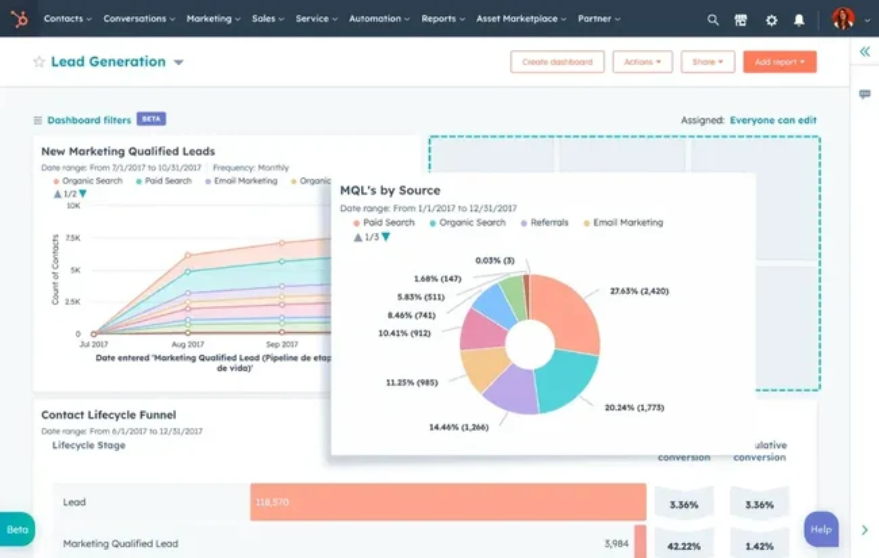
One dashboard view rarely serves everyone. Build three.
Marketing leaders need:
- Enquiry volume by channel, programme, and intake
- Cost per enquiry by lead source
- Enquiry-to-application conversion rate by channel
- Which sources produce qualified leads versus raw volume
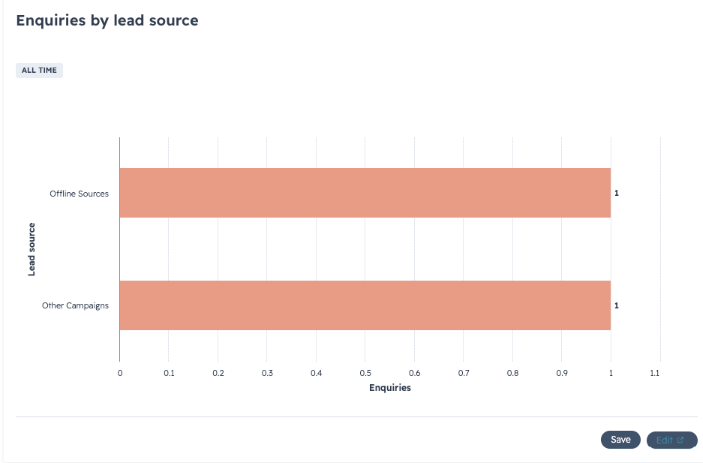
For example, in the report below, you can see enquiries broken down by lead source, showing exactly which channels are feeding your pipeline.
Admissions leaders need:
- Live pipeline volume at each stage, by programme
- Application completion rate and where drop-off is happening
- Average time from enquiry to first follow-up, by team member
- Yield rates for applicants with no engagement in 14 days
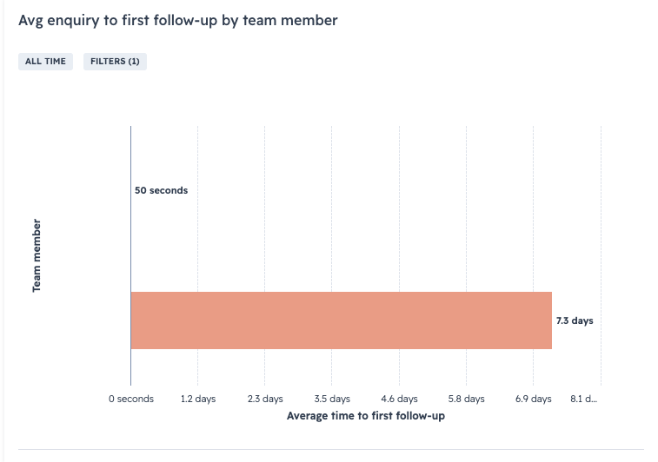
For example, in the below report you can see how follow-up speed can vary wildly between team members: one enquiry gets a reply in 50 seconds; another waits over a week.
CMOs and DVCs need:
- Total pipeline versus same point last intake
- Projected enrolments based on current conversion rates
- Cost per enrolled student by channel
- Whether the institution is ahead of, on, or behind target
For example, in the below report you can see your total pipeline value for the current quarter. It’s a live figure showing exactly how much revenue opportunity your CRM has generated so far.
Step #5: Phase the Rollout and Review It Weekly
Start with the admissions module, prove the value, then expand. Early wins build the internal momentum that sustains a longer rollout.
Five stages tracked well beats fifteen tracked inconsistently.
The most effective admissions teams focus on five to seven core metrics, reviewed weekly during active recruitment cycles; you can do this by:
- Assigning one named owner for pipeline data quality
- Building dashboard review into your standing marketing and admissions meetings
- Revisiting stage definitions at the start of every cycle
That discipline is what turns an education lead generation dashboard from a one-off project into an institutional asset.

How Do I Build a Lead Nurturing Workflow in HubSpot That Actually Works?
Frequently Asked Questions About Education Lead Generation
How long does it take to build a higher education sales pipeline dashboard for education lead generation?
CRM implementation timelines in higher education typically range from three to eighteen months, depending on complexity, scope, and organisational readiness. A phased approach that starts with the admissions pipeline and expands from there is almost always faster and more sustainable than attempting a full build at once.
Do we need to replace our SIS to start tracking education lead generation properly?
No. Your SIS stays in place as the system of record for confirmed enrolments. A properly configured CRM handles the education lead generation journey from first enquiry through to accepted offer, and a one-way data sync from your SIS closes the loop.
What’s the first step to turning education lead generation into a trackable pipeline?
Process first, every time. Before configuring any technology, marketing and admissions leaders need to agree on shared pipeline stage definitions, handoff triggers, and data ownership. Skipping this step means your dashboard reflects organisational confusion rather than actual pipeline performance.
Can we build an education lead generation pipeline if our data is messy?
Yes, but with realistic expectations. You don’t need perfect historical data to start. You need clean, consistent data flowing through a properly configured pipeline from this point forward. Begin with enquiry capture centralisation and agreed stage definitions. Data quality improves progressively as the system matures.
Who should own the education lead generation dashboard once it’s built?
Ownership should be shared, but accountability must be specific. Assign one named person responsible for pipeline data quality. Marketing and admissions leaders should each own their respective view, with a combined review built into standing meetings. Without a named owner, data quality degrades quickly, and leadership stops trusting the numbers.
How many pipeline stages do we need to manage education lead generation effectively?
Start with five to seven. The most effective admissions teams focus on five to seven core metrics, reviewed weekly during active recruitment cycles; everything else is for quarterly or annual analysis. A lean pipeline tracked consistently is far more valuable than a complex one tracked inconsistently. Stages can always be added once the foundation is working reliably.
Scale Your Education Lead Generation Performance
Your next intake cycle won’t wait for the perfect dashboard… And the good news here is that you don’t need one.
Admissions teams consistently struggle to answer basic questions about conversion rates by source, time-to-decision, and engagement effectiveness.
Avoiding this common problem starts with step one:
- Get marketing and admissions in a room
- Agree on what each pipeline stage means
- Put it all in writing
Everything else from CRM configuration and SIS integration to audience-specific views builds on that foundation.
If you’re ready to build an education lead generation pipeline that ties marketing spend to confirmed enrolments, get in touch with our growth experts for a free consultation and we’ll show you exactly where to start.
You’ll walk away with high-value insights on how to maximise your setup for predictable growth and better CRM ROI… Regardless of whether you work with us or not.
Get In Touch With Our Growth Experts



Get the best content marketing insights right in your inbox!
Subscribe to our Newsletter and get marketing insights delivered to your inbox every week.