








Can HubSpot’s All-New Revenue Hub Get You More Sales? (2026)

86 per cent of B2B deals stall somewhere between quote and close… More specifically, in the admin chaos that comes after a buyer says yes.
And HubSpot Revenue Hub was built to fix exactly that.
If you’ve ever watched a deal go cold while your team chased approvals, rebuilt a quote from scratch, or waited on finance to send an invoice, you might already know the problem in detail.
It could be that way because:
- Your quoting is slow
- Your billing has errors that surface after the fact
- Sales, CS, and finance are all working from different records, so nobody can agree on what the customer actually bought
It’s a painful way to run a revenue team, and it’s more common than most leaders want to admit.
As a HubSpot Diamond Partner, we had Platinum+ early access to Revenue Hub and were one of the first partners briefed on the product ahead of its June 2026 launch.
In this article, you’ll get an honest breakdown of what Revenue Hub actually is, what’s live today, what’s still on the roadmap, and whether it’s the right fit for your business right now.
What is HubSpot Revenue Hub?
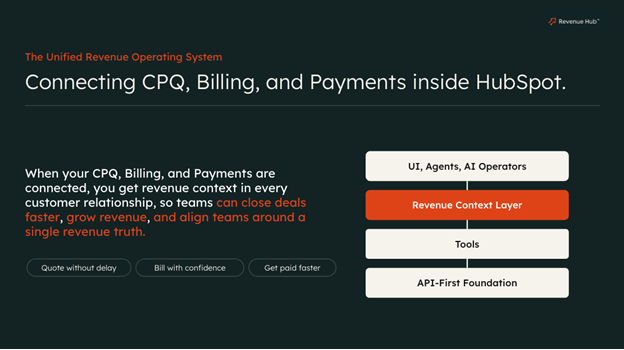
HubSpot Revenue Hub is HubSpot’s connected quote-to-cash platform: CPQ, Billing, and Payments all living in one place, built on top of your existing CRM data.
Most B2B revenue teams run their quote-to-cash process across a patchwork of tools:
- A CPQ that doesn’t talk to the CRM
- An invoicing system finance owns separately
- A payment processor bolted on at the end
Every handoff between those tools is a potential error, a delay, or a deal that goes cold while your team chases paperwork.
How HubSpot Revenue Hub Connects Your Revenue Team
When your CPQ lives in one platform, your invoicing in another, and your payment records somewhere else entirely, your sales, CS, and finance teams work from three different versions of what the customer bought.
Here’s what happens when that problem persists:
- Errors surface after the fact
- Nobody agrees on the record of truth
- Fixing it costs more time than the original deal was worth
But HubSpot Revenue Hub puts all of it on one record:
- Same deal data
- Same customer history
- Same contract from first quote to final payment
You can also adopt it in stages: a business that only needs Payments can start there; one that needs Billing without CPQ can do that too.
The full platform is available for teams ready for the complete quote-to-cash workflow.

What’s New in HubSpot: The Complete Spring Spotlight 2026 Roundup
The 4 Components of HubSpot Revenue Hub
Quoting problems, billing problems, and payments problems almost always share one root cause: disconnected systems.
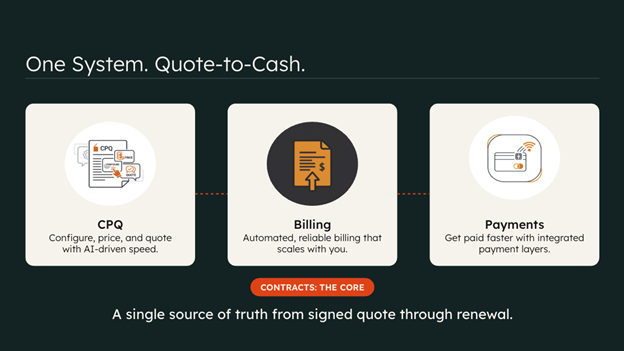
HubSpot Revenue Hub closes those gaps with four connected components:
1. HubSpot Revenue Hub CPQ
CPQ, abbreviated for “Configure, Price, Quote”, turns a sales conversation into an accurate, approvable quote at a much faster pace.
It works in three phases:
| Phase | What It Does |
| Set Up | Build your product catalogue, price books, and line items: one clean source for every quote |
| Guardrails | Quote rules, approval workflows, and role-based permissions keep pricing on-margin and on-brand |
| Customer Handoff | No-code quote builder, Breeze AI cover letters from CRM data, e-signature, and automated follow-up: all built in |
2. HubSpot Revenue Hub Billing
Manual invoicing is where revenue leaks, but HubSpot Revenue Hub’s Billing component stops it.
Here’s how it works:
| Capability | What It Means |
| Staggered billing dates | Invoices go out automatically with no manual scheduling |
| Mixed billing frequencies | Monthly, quarterly, and annual on the same contract |
| Contract-driven invoicing | Invoices generate from the contract record; sold and billed always match |
| Milestone Billing | Phased billing for project-based revenue (arriving Late Q3/Q4 2026) |
3. HubSpot Revenue Hub Payments
HubSpot Revenue Hub Payments records transactions instantly against the deal and contract record. This means that when you run your payments workflows with this feature, there’s:
- No exporting
- No reconciling
- No chasing a separate processor
It also works as a standalone module that you can refine or customise using Model Context Protocol or Command-line interface.
Start with Payments alone, and layer in CPQ or Billing when you’re ready.
4. The HubSpot Revenue Hub Contract Object
Every signed quote creates a Contract Object and record, and that record follows the customer from close through to renewal.
Here’s what the Revenue Hub Contract Object stores from your day-to-day sales activities:
| What It Stores | Detail |
| Effective and term dates | Start, end, and renewal dates in one place |
| Products and terms | Exactly what was agreed at point of sale |
| Contract value | ARR, MRR, ACV, and TCV, calculated automatically |
| Change history | Every expansion, amendment, and renewal logged chronologically |
If you’re taking on mid-term expansion, a change quote attaches to the same record. Or, if you have renewals due, you can build them from the same record.
And if you’re tired of seeing sales, CS, and finance arguing over what the customer bought, the Contract object ends that conversation.

Why Do Some Businesses Fail to Implement HubSpot Properly?
How HubSpot Revenue Hub Works
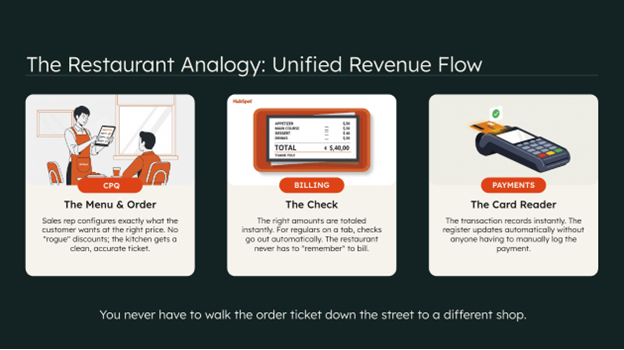
The easiest way to understand HubSpot Revenue Hub is to picture it as a well-run restaurant:
- Every component has a job
- Every job connects to the next
- Nothing gets walked down the street to a different shop to get processed
Here’s an easy-to-follow table to help you figure out how HubSpot’s latest update can fit into your workflows:
| Restaurant Part | Its HubSpot Revenue Hub Component Counterpart | What It Does |
| Menu & Order Ticket | CPQ | Sales quotes from an approved product library, at approved prices, within approved discount limits. Approval workflows handle exceptions to generate clean and accurate quotes every time. |
| The Check | Billing | Invoices generated directly from the contract record, at the right frequency, on the right dates. No manual intervention from finance. |
| The Card Reader | Payments | Transactions recorded instantly against the deal and contract record the moment they occur. No separate reconciliation. |
| The Kitchen | Contracts | The single source of truth connecting every component. Holds what was sold, what was billed, and what was collected, from signed quote through to renewal. |
Who Is HubSpot Revenue Hub For?
HubSpot Revenue Hub works for a specific type of business. Here’s how to know if that’s you:
HubSpot Revenue Hub Is a Strong Fit If…
- You’re on HubSpot, and quoting is slow: CPQ and Contracts are live now. If quotes are being built in Word or spreadsheets, this fixes it today
- Your billing is complex: HubSpot Revenue Hub is built to handle mixed frequencies, staggered dates, mid-term expansions, and renewals. The more complex your billing, the more time it recovers
- Your revenue teams can’t agree on what a customer bought: The Contract object stores products, terms, ARR/MRR/ACV/TCV, and full change history in one record. One source of truth, no more arguments
- You’re paying for tools that don’t talk to each other: A separate CPQ, billing platform, and payment processor that aren’t connected to your CRM can be a consolidation problem. HubSpot Revenue Hub solves it directly
HubSpot Revenue Hub Needs More Consideration If…
- The features you need aren’t live yet: Product Bundles, Ramp Pricing, and Milestone Billing are planned. If any are non-negotiable, confirm the release timeline before committing
- Finance owns billing in a legacy system and won’t move: HubSpot Revenue Hub’s Billing works best when invoicing lives in, or connects cleanly to HubSpot. If that’s a blocker, make it a scoping conversation first
- Your deals are simple: Single product, fixed price, no renewals; Revenue Hub is more infrastructure than you need right now
You don’t have to adopt HubSpot Revenue Hub all at once. Instead, you can start with either:
- Payments only
- Billing without CPQ
- CPQ first, Billing later
The modular structure means your starting point can match your most urgent problem, and then you can expand from there.
What’s Available Now in HubSpot Revenue Hub? (And What’s Coming?)
HubSpot Revenue Hub rolls out in three chapters. Here’s exactly where each one stands:
Chapter 1: Close Faster
CPQ and Contracts are live. Your team can act on this by:
- Build a product library with price books and line items
- Set quote rules, approval workflows, and role-based permissions
- Create professional quotes with a no-code builder and Breeze AI-generated cover letters
- Collect e-signatures and trigger automated post-quote workflows
- Track every deal from signed quote to renewal via the Contract record
Here are the CPQ features that you can already test out in Revenue Hub, plus what’s slated to be released later this year:
CPQ Features Currently In Development
| Feature | Status |
| Automated quote reminders | In development |
| Restrict editing of quote template sections | In development |
| Buyer identity verification for quotes | In development |
| Custom-coded modules | In development |
| Tax rate enhancements for products and line items | In development |
| Automate quote and line item creation | In development |
| Price Books | In development |
| Product Rules | In development |
CPQ Features Planned (Not Yet In Development)
| Feature | Status |
| Order-level discounts | Planned |
| Optional line items | Planned |
| Leverage Breeze for quote optimisation | Planned |
| Sectioned line-item tables | Planned |
| Quote approvals based on term changes | Planned |
| Display negative line items | Planned |
| Product Bundles | Planned |
| Ramp Pricing | Planned |
| Milestone Billing | Planned |
Chapter 2: Billing and Payments
Billing and Payments launch this month.
Automated invoicing with staggered dates, mixed billing frequencies, and contract-driven invoice generation are included… Plus an integrated payment layer that records directly against the deal record.
Here’s what’s set to go live, and what’s about to be developed:
Billing And Payments Features Currently In Development
| Feature | Status |
| Customer billing portal | In development |
| Manual payment retries | In development |
| Unified branding for invoices, payment links, and checkout | In development |
| APIs for billable subscriptions | In development |
| Contracts automation | In development |
| Invoice edits for partial payments | In development |
Billing And Payments Features Planned (Not Yet In Development)
| Feature | Status |
| Auto VAT/GST | Planned |
| Invoice branding and customisation | Planned |
| AI-powered accounts receivable | Planned |
| Leverage Breeze for billing and payments | Planned |
| Payment links API | Planned |
| Payout reconciliation | Planned |
| E-invoicing | Planned |
Chapter 3: Retain and Grow
This chapter brings CS revenue context into the platform. The main goal of Chapter Three is to give customer success teams full revenue visibility over:
- Renewals
- Expansions
- Retention
No confirmed release date has been announced yet, but this part is currently in private beta.
The AI Layer Running Across HubSpot Revenue Hub
Three AI capabilities operate across all chapters:
- Breeze Assistant: human-initiated AI support, available now
- Revenue Hub Agents: autonomous agents operating across the revenue workflow, available now
- Revenue Agent: advanced autonomous agent, currently in private beta as of June 2026
Frequently Asked Questions About HubSpot Revenue Hub
What is HubSpot Revenue Hub?
HubSpot Revenue Hub is HubSpot’s connected quote-to-cash platform, combining CPQ (Configure, Price, Quote), Billing, Payments, and a Contract object in one place.
It is built on top of HubSpot’s CRM and designed to help B2B revenue teams:
• Quote faster
• Invoice accurately
• Collect payments without managing multiple disconnected tools
When does HubSpot Revenue Hub launch?
HubSpot Revenue Hub launches on 16 June 2026.
CPQ and Contracts (Chapter 1) are available now. Billing and Payments (Chapter 2) go live on 16 June 2026. The third chapter, focused on CS revenue context and retention, doesn’t have a confirmed release date yet.
What does CPQ mean in HubSpot Revenue Hub?
CPQ stands for Configure, Price, Quote.
In HubSpot Revenue Hub, CPQ allows sales teams to:
• Build accurate quotes from an approved product library
• Apply pricing rules and approval workflows
• Generate AI-assisted cover letters via Breeze AI
• Collect e-signatures
And all of these can be done without leaving HubSpot.
What is the Contract object in HubSpot Revenue Hub?
The Contract object in HubSpot Revenue Hub is a single record that stores everything related to a customer agreement:
• Effective dates
• Products and terms
• Contract value (ARR, MRR, ACV, TCV)
• Full change history
It supports change quotes for mid-term expansions and renewal quotes, all built on the same record.
Can you use HubSpot Revenue Hub as a standalone module?
Yes. HubSpot Revenue Hub is modular.
Businesses can adopt just Payments, just Billing, or just CPQ depending on their most immediate need. The full quote-to-cash workflow is available for teams that want all three components working together.
Who is HubSpot Revenue Hub designed for?
HubSpot Revenue Hub is designed for mid-market B2B companies with recurring revenue, complex quoting needs, or multi-step billing cycles.
It’s particularly well-suited to sales leaders, RevOps managers, and CEOs who are currently managing quoting, billing, and payments across disconnected systems.
What is Milestone Billing in HubSpot Revenue Hub?
Milestone Billing in HubSpot Revenue Hub allows businesses to trigger invoices based on project phases or delivery milestones rather than fixed dates.
It’s currently on the roadmap and scheduled for Late Q3/Q4 2026.
What AI features does HubSpot Revenue Hub include?
HubSpot Revenue Hub includes three AI components:
1. Breeze Assistant (human-initiated AI support, available now)
2. Revenue Hub Agents (autonomous AI agents operating across the revenue workflow, available now)
3. Revenue Agent (an advanced autonomous agent, currently in private beta as of June 2026)
Is HubSpot Revenue Hub Worth Acting On?
Chapter One is live, and that means CPQ and Contracts are ready to implement today.
The teams that move now will have a working quote-to-cash foundation in place before Billing and Payments land in June… And they’ll hit the ground running when Chapter Two opens.
Here’s a simple way to identify your entry point:
- Quoting is slow or inconsistent → Start with CPQ and Contracts
- Billing errors keep surfacing → Prioritise the Billing component
- Payments are disconnected from your CRM → Begin with the Payments module
- All three are a problem → Build the full Revenue Hub workflow from the ground up
You don’t need to solve everything at once, but you do need to solve the right thing first.
And if you need an expert to come in and help you maximise Revenue Hub and other HubSpot features, we’re here to help.


Get In Touch With Our Growth Experts
About the Author




Get the best content marketing insights right in your inbox!
Subscribe to our Newsletter and get marketing insights delivered to your inbox every week.