









How AI and Automation Can Help Improve Google Ads Quality Score in 2025

Let’s be honest, Quality Score feels like one of those things you should care about in Google Ads, but you’re never quite sure what to do with it.
You’ve tweaked your headlines, tightened your targeting, fiddled with landing pages… and yet, your ads still hover around “Average” or “Below Average.” Meanwhile, your CPCs creep up and your conversions feel harder to win.
Here’s the uncomfortable truth: manual optimisation just doesn’t cut it anymore. Not in 2025. Not with the pace Google’s changing. The advertisers winning now aren’t doing everything themselves, they’re using AI and automation to do the heavy lifting.
And no, this isn’t about setting your campaigns to autopilot and walking away. It’s about working with AI to get better results, faster.
In this article, you’ll learn exactly how AI and automation can help you improve your Google Ads Quality Score in 2025, without losing control or sacrificing creativity.
Does Quality Score Still Matter in 2025
You’ve probably heard the advice: “Focus on Quality Score, it’ll bring your CPCs down and improve performance.”
And while it might sound like outdated Google Ads gospel, the truth is it still matters in 2025.
Google’s Quality Score is still made up of the same three pillars:
- Expected Click-Through Rate (CTR) – How likely your ad is to get clicked.
- Ad Relevance – How well your ad matches the intent behind the search.
- Landing Page Experience – How useful and relevant your page is after the click.
A higher Quality Score means Google trusts your ad to deliver value to users. In return, they reward you with lower costs and better ad placements. A low score? You’ll end up paying more for worse positions, even if your budget’s higher than your competitor’s.
But here’s what’s changed: how you improve these pillars.
Gone are the days when you could manually tweak one word in your headline or obsess over minor bid adjustments. Now, performance lives and dies by how well your creative, audience targeting, and landing pages work together, and that’s where AI steps in.


Why Google Ad Campaigns Fail: Common Mistakes
The Three Pillars of Quality Score in Google Ads
Google doesn’t hand out better Quality Scores just because you’re spending more. It rewards relevance, performance, and user experience. And AI? It can boost all three, if you give it the right inputs.
Let’s take a deeper look at these three pillars.
1. Expected Click-Through Rate (CTR)
Google’s AI, especially in Performance Max, analyses millions of data points in real time to predict which ad variations are most likely to get clicked.
Instead of guessing which headline will perform best, the AI tests every possible combination of headlines, descriptions, images, and videos to see what actually works.
How this helps: You get higher CTRs not by writing “clever” ads, but by feeding the machine enough creative options for it to find the winning formula.
2. Ad Relevance
AI excels at matching intent to messaging. Performance Max looks beyond keywords. It uses behaviour, search history, and contextual signals to understand what users are really looking for, and serves the most relevant creative accordingly.
How this helps: Your ad feels more aligned with the user’s needs, even if their search query is vague or long-tail. That relevance score goes up.
3. Landing Page Experience
This is where AI-enhanced tools like URL expansion come into play. Google’s system can dynamically direct users to the most relevant landing page on your site (not just the one you specified) based on their intent.
How this helps: Better alignment between ad and landing page = lower bounce rates, higher conversions, and a better Quality Score.
What is Performance Max and Should You Use it?
If you’re serious about using AI to improve your Google Ads performance in 2025, Performance Max is something you might want to consider. This campaign type is where Google’s AI goes full throttle.
So, what is Performance Max?
Performance Max (or “PMax”) is a goal-based campaign type that uses Google’s full suite of ad placements—Search, YouTube, Display, Discover, Gmail, and Maps. But what makes it different is this: it’s powered almost entirely by AI.
You give it a goal (like leads or sales), provide a mix of creative assets (images, text, video), and Google’s AI figures out the rest, like who to target, when to show the ad, and what creative combo to use.
Why does this matter for Quality Score?
- Better CTRs through creative testing: Performance Max tests hundreds of creative combinations and formats automatically. The more creative options you feed it, the better it can learn and optimise, which directly lifts your expected CTR.
- Hyper-relevance at scale: Google’s AI adjusts messaging based on user behaviour and search context, not just keywords. This makes your ads feel personalised without needing you to build endless manual variations.
- Smarter landing page matching: With features like Final URL expansion, Performance Max can choose a landing page from your site that better aligns with the user’s intent, improving the experience and your Quality Score.
The catch?
Garbage in, garbage out. AI needs good creative inputs to work its magic, which you’ll learn next.
Creative Guidelines for Google Ad Campaigns in 2025
You can’t expect AI to work miracles with bad ingredients. If you want Google’s automation to improve your Quality Score, your creative assets need to give it something worth optimising.
Here’s why this matters: Google’s AI doesn’t “write” new ads for you out of thin air. It mixes and matches the assets you upload. The more high-quality, diverse assets you provide, the better chance it has of finding combinations that drive high CTRs, strong relevance, and great user experience.
So, what does “smart creative” actually look like?
- Multiple asset formats: Upload at least three videos in different orientations (horizontal, vertical, square), 20+ images in various formats, and a full suite of headlines and descriptions. This ensures coverage across all placements and gives the AI more to test.
- Following creative best practices: Google’s ABCDs (Attention, Branding, Connection, Direction) for YouTube ads are proven to boost short-term and long-term performance. Ads that follow these principles see more clicks and conversions—two things that feed directly into your Quality Score.
- Updated and refreshed regularly: Google recommends checking and updating your assets at least once per quarter. Stale ads lead to ad fatigue, which tanks performance. Fresh creatives keep your campaign sharp and your scores high.
- Tailored to placement: In-feed ads on YouTube or Discover need to blend in more organically, while display ads should stand out. Understanding these nuances and designing creatives accordingly helps the AI perform better in each context.
Bottom line? If you want better results, give the AI better ingredients.
Examples of Smart Creative in P-Max Campaigns
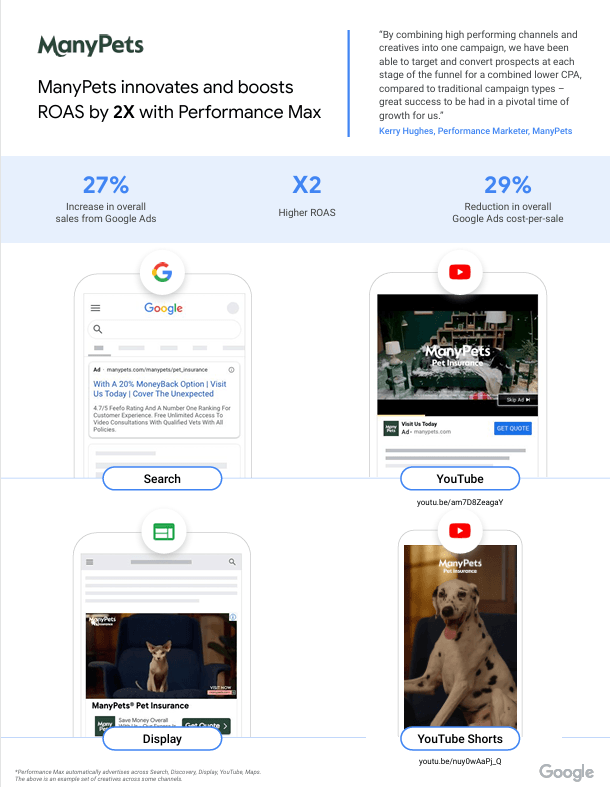
ManyPets: Doubled ROAS with Performance Max
By combining creative assets and letting AI find the best combinations, ManyPets achieved:
- 2x higher ROAS
- 27% increase in overall sales
- 29% reduction in cost-per-sale
Here’s some examples of what that looked like for them:
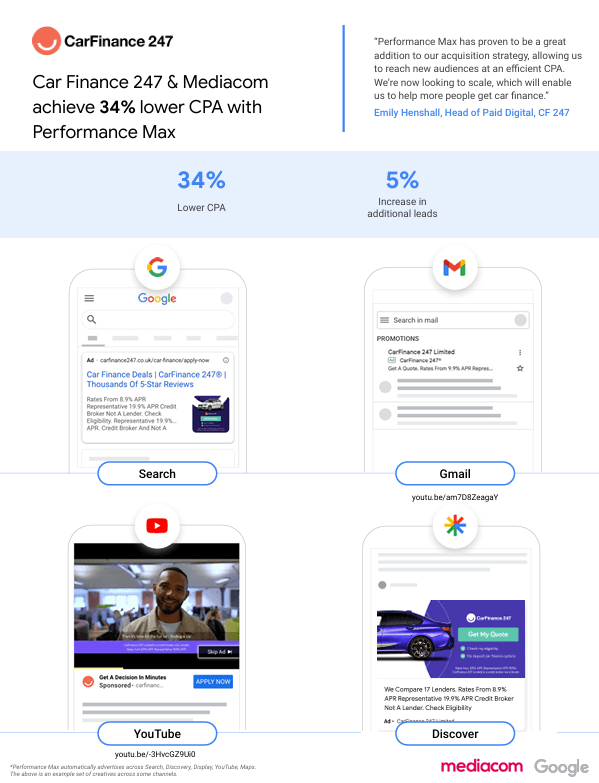
Car Finance 247: 34% Lower CPA
Using Performance Max and a mix of creative tailored to different funnel stages, they reduced their cost per acquisition by 34%, while still growing lead volume. Again, automation didn’t replace their team, it amplified their results.
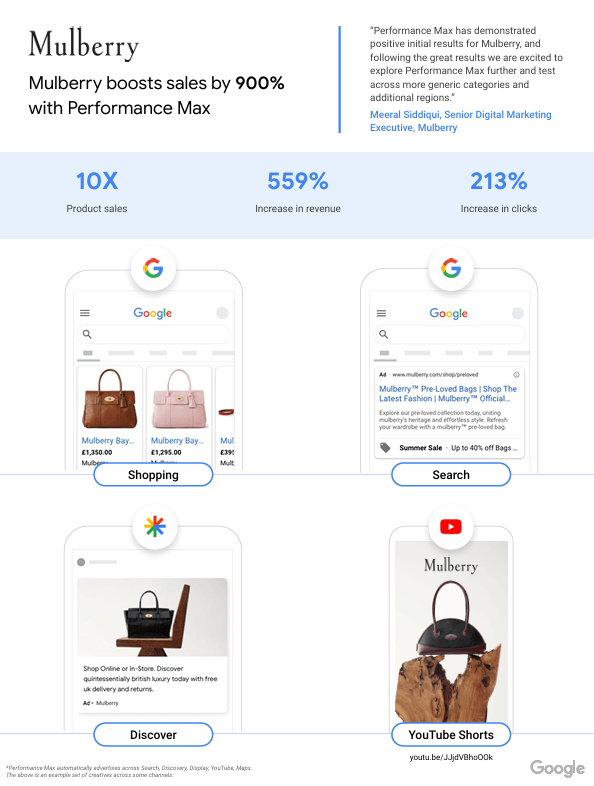
Mulberry: 10x Product Sales
Mulberry used Performance Max across more generic categories and expanded to new regions. The result?
- 559% increase in revenue
- 213% more clicks
- 10x more product sales
When to Trust AI and When to Step In
Let’s be clear: Google’s AI is powerful, but it’s not perfect. Knowing when to let it run and when to intervene is what separates great advertisers from frustrated ones.
Trust the AI when:
- You’ve provided strong creative assets: If you’ve followed best practices (plenty of variations, clear messaging, proper formats) then trust the system to find the winning combinations.
- You’re optimising for a clear, high-volume goal: Conversion-based goals like leads or online sales give the AI more data to learn from, faster. The more signals it gets, the better it performs.
- Your campaign is running across multiple channels: It’s impossible to manually optimise for YouTube, Search, Discover, Display, and Maps all at once. AI can.
Step in when:
- Your creative is stale or underperforming: The AI can’t make bad creative work. If you’re seeing “Low” asset ratings or a drop in performance, refresh your images, videos, and copy.
- You need control over messaging or compliance: Regulated industries or brands with strict guidelines may need to override or limit AI decisions. Use structured naming, URL exclusions, or limit auto-generated assets.
- You’re testing a very specific hypothesis: Want to see if “free shipping” beats “25% off”? You’ll need to structure that test deliberately. AI won’t do it for you by default.
What This Means for Your Role as a Marketer
AI isn’t here to replace you, it’s here to make you more effective.
In 2025, your role as a marketer isn’t just about writing ad copy or tweaking bids. It’s about strategy, creative direction, and understanding what resonates with your audience. The machine can optimise, but it can’t understand nuance the way you do.
Here’s how your role evolves with AI in the mix:
- From manual to meaningful: Less time spent on repetitive tasks. More time shaping big ideas, refining creative, and directing experiments that actually move the needle.
- From guesswork to insight: You don’t need to guess what’s working anymore. Reporting tools in Performance Max show exactly which assets drive results, so you can double down with confidence.
- From campaign manager to performance architect: You’re designing systems that learn and scale. You’re not clicking buttons; you’re building frameworks that grow with your business.
The best results don’t come from fighting the algorithm. They come from feeding it well and focusing your human creativity where it matters most.
Let AI Do the Heavy Lifting, So You Can Focus on What Matters
Quality Score still matters in 2025, but how you improve it has changed. It’s no longer about obsessing over the perfect headline or spending hours adjusting bids. It’s about giving Google’s AI the right creative, clear goals, and enough room to learn.
When you combine strong inputs with smart automation, you get more relevant ads, higher click-through rates, better landing page experiences, and ultimately, stronger Quality Scores.
The result? Lower costs, higher conversions, and a campaign that actually works without burning you out.
So, focus on producing the best possible creatives. How do you do that?
Check out this article that explains how to improve your ad creative.
About the Author





Get the best content marketing insights right in your inbox!
Subscribe to our Newsletter and get marketing insights delivered to your inbox every week.